
Mastering Glitter Heat Transfer Vinyl Application
As the heat-applied graphics industry continues to evolve, the unique, custom, and personalization applications a shop can offer continues to grow. Heat transfer vinyl (HTV) is a staple for decorating apparel, other fabric substrates, and even for application to wood and some metal surfaces.
HTV is versatile, easy to store, cut, weed, and apply, and surprises with its utility. It offers several special-effect materials, none more popular and appealing than glitter HTV.
Glitter HTV is a dazzling and surprisingly versatile staple in any heat transfer offering. Quality glitter HTV is reliable and delivers the added benefit of being tested safe for skin. Glitter HTV adds sparkle and style to apparel and blanks, creating fun and fashionable items. It’s perfect for spirit and cheer wear, and also lends a beautiful emphasis to applications for corporate wear, celebrations, and special campaigns such as breast cancer awareness.
Working with glitter HTV can be intimidating for many people. But quality glitter is no harder to work with than standard HTV materials. Following a few basic rules when designing for and decorating with glitter HTV helps ensure a quality cut, smooth weeding of the transfer, easy registration, and secure application to a suitable substrate.
Basic Parameters for Glitter HTV
The parameters for cutting and weeding glitter are often different than those for regular HTV materials. Pay attention to whether a 60-degree blade is recommended for your cutter. The pressure may be slightly more than for regular, thinner HTV, but with quality glitter HTV, the same pressure can be used.
Use a sharp blade. Glitter HTV can quickly wear down a blade. Be prepared, use quality blades, and ensure plenty are available.
Due to the nature of glitter HTV — a polyurethane film coated with glitter particles in a clear polyurethane topcoat — the glitter particles do not stretch, and the film has a texture from the glitter particles. Although quality glitter HTV allows for more finely-detailed designs than economy glitter, avoiding small letters and numbers and numerous tight angles, turns, corners, and insides in the transfer design will help maintain sanity when weeding the transfers.
There are smooth glitter HTV options available that are not as sparkly but have a soft, pleasant touch. This smooth glitter is a great option for infants or those sensitive to the rougher feel of normal glitter. Smooth glitter will also allow for smaller lettering and finer designs. Either glitter is gorgeous when applied.
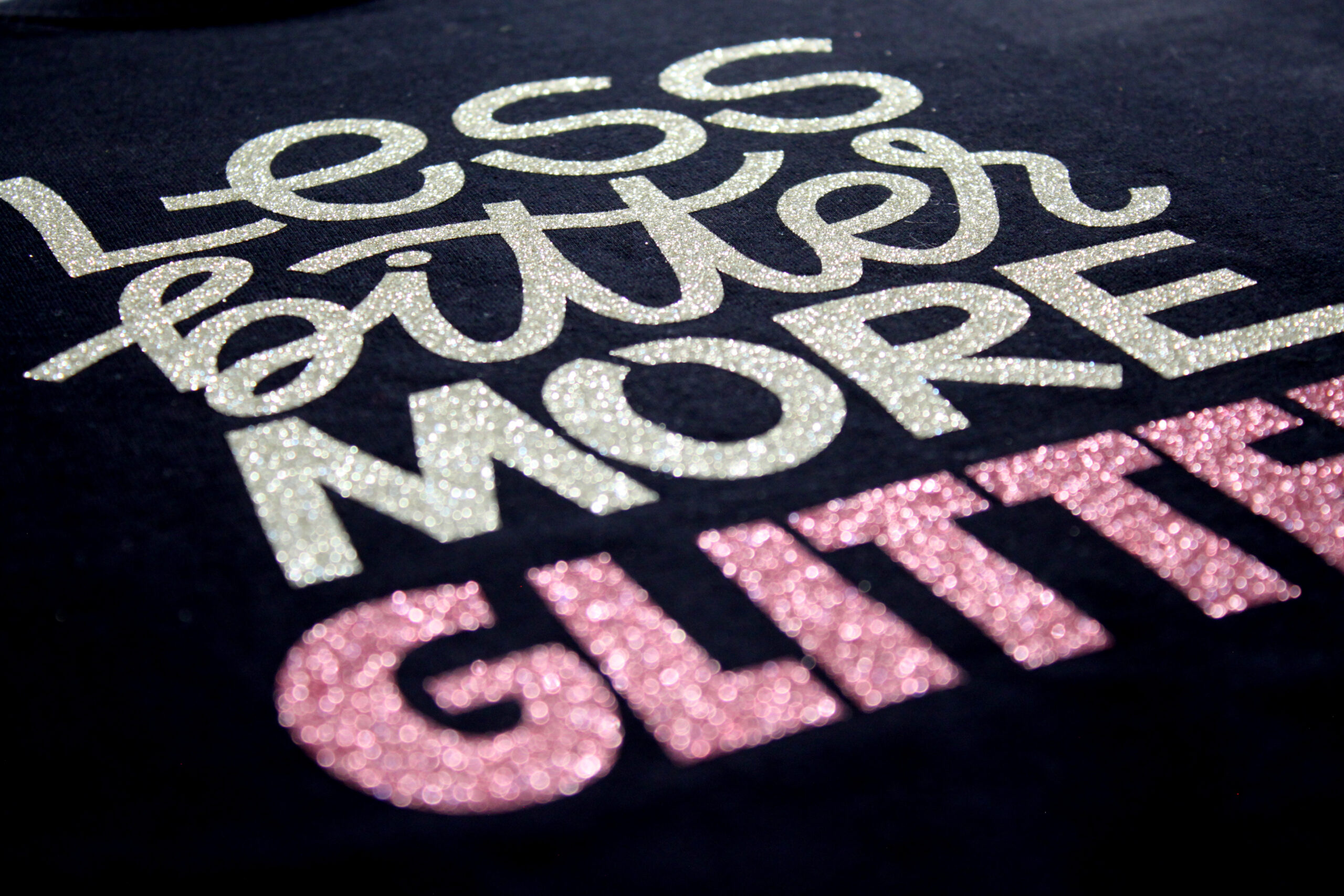
Application parameters for glitter HTV are, to some extent, universal, applying at 325 F for 15 seconds, under medium pressure, lukewarm to cold peel. These parameters are not variable. It takes heat, time, and pressure to ensure good anchorage to the substrate.
Heat and pressure-sensitive fabrics are not always candidates for glitter decoration. The best advice is to test the HTV on sensitive fabrics and do a wash test once the film has cured. The wash test is crucial for garments, as the material can shrink and cause puckering after laundering.
Layering glitter HTV on regular HTV, direct-to-film (DTF), or screen-print designs is an excellent way to enhance the design. HTV easily layers over all three of these decoration techniques.
Why add a glitter effect other than for spirit, cheer, or fashion wear? There are several reasons why:
- Enhance brand visibility by adding glitter to logos for special events, campaigns, and milestones.
- Create memorable merch for your customers.
- Personalize items for the office, kitchen, grill, and rest of the home.
- Special events and celebrations call for glitter.
Offering special effect materials, especially glitter HTV, provides your customers a valued partner who stays current on style and decoration trends and has the special-effects (SFX) materials to fulfill.
Practical Processes for Glitter HTV
Let’s break down the basics of working with glitter HTV and run through the processes for practical application to a hat and canvas shoes. Each of these examples is transferable to several different substrates and likely requires adjustment of the application parameters to ensure good adherence and protection of the substrate from the heat and pressure of the application process.
Decorating a Hat
While most ball caps, trucker hats, and hats with brims present challenges because their surface is not flat, they are unique substrates that command lucrative margins using customization. A continuing trend in hat decoration is the usage of flexible patches or transfers made to look like patches once applied. One of the hottest trends currently is the use of special effects to create dimensional, holographic, textured, metallic, glow-in-the-dark, reflective, and shiny, sparkly details.
Using glitter alone or layered with standard HTV is recommended. Logos created entirely in glitter are stunning and can enhance a special event, cause, or milestone. Glitter can also be layered into the design as the top layer over standard HTV. Glitter HTV can also be sublimated to create a fantastic, multi-dimensional patch for unique hat decoration.
Application tips for decorating a hat using glitter HTV:
- Having a hat heat press makes this a much easier job than not. If using a hat platen, ensure the pressure is set correctly to ensure proper anchorage.
- Layering glitter over standard HTV is easy. Apply the regular HTV for less time, carefully removing the liner. Apply glitter HTV as the top layer at the application parameters for the glitter, covering the layered HTV with silicone or parchment paper to protect the bottom layers. Cool-peel the glitter HTV liner. Check for fastness. If any edges lift, cover the design and press the hat once more for a few seconds to secure any lifting edges.
- No-brim hats — such as beanies, skull caps, and berets — are easy to decorate, depending on the fabric of the hat. If the hat will not scorch under the heat or is not water repellent, the panels can be decorated. The key is to achieve consistent temperature and even pressure while applying the HTV material. Since glitter applies at temperatures between 310-330 F, heat-sensitive fabrics are often not easily decorated with glitter.
Customizing Shoes
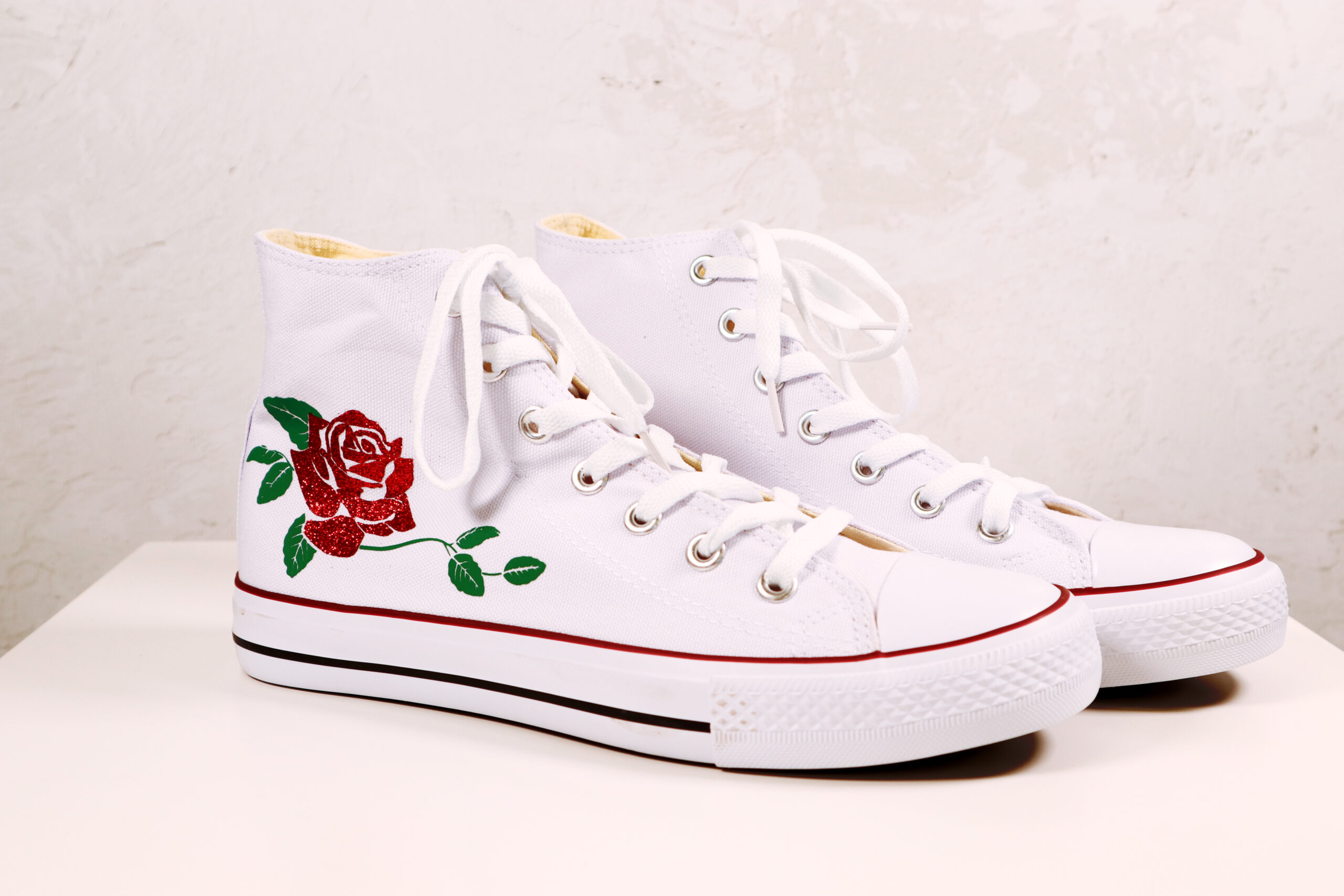
Acquiring the knowledge and experience required to decorate shoes is not difficult and is an excellent way to add additional revenue streams and bring in more projects. Shoes, more than any other clothing item, are used universally as an opportunity to express oneself, show allegiance or support, and are a culture-oriented clothing item. Why decorate shoes?
- A trade show team can easily tie together its look with similarly-decorated shoes.
- Spirit and cheer wear are obvious candidates for matching accessories, beginning with the shoes.
- Sports teams, such as bowling teams, can expand their team look to include their shoes.
Decorating shoes with HTV requires the use of either a shoe platen or a handheld press such as a mini press. Applying HTV to canvas, leather, and synthetic shoe materials is simple, as the design is applied only to these materials. Rubber soles, grommets, wood heels, etc., can be problematic and may melt or distort.
There is plenty of space to be decorated on the shoes, including the laces, without having to decorate the heat-sensitive parts of the shoe. Carefully evaluate leather for heat sensitivity from the dyes used to tan leather. Also evaluate all synthetic materials to ensure they are not heat sensitive. Canvas shoes are the easiest to decorate.
How to Use a Mini Press
- Ensure most/all of the tools in the sidebar to the right are available. Exercise caution when handling the substrate, and ensure your hands and fingers are protected from the heat of the press, which can easily be 300 F or higher. Use heat-resistant hand gear to hold the substrate to be decorated.
- Stuff cotton towels into the hat or shoe to create a more solid surface.
- Cover the transfer while applying firm, even pressure. Apply for twice the manufacturer’s recommended heat press time. Lift and move the press over a shoe or hat instead of sliding the press. Lifting the press prevents the transfer from moving or sliding on the substrate.
- The liner may lift from the transfer while applying it to the substrate. That will not be an issue. Remove the liner warm or cool, according to the manufacturer’s recommendation, and test the transfer for anchorage. If the material lifts at all, cover the transfer with a Teflon sheet and press again.
- For a backpack, stuff the area to be decorated with Teflon pillows and/or cotton towels, place the backpack on a heat press pad, and create the flattest surface possible where the decoration will be placed. Cover the transfer and the backpack material with a Teflon sheet and start pressing from the middle of the design. Pick up the press and move to the other areas — do not slide the press. Keep applying to the areas at the recommended press time until the entire transfer is pressed. Carefully lift the liner and remove it if the transfer remains on the backpack. Keep pressing with the liner if the transfer does not stick to the backpack. Repeat until the transfer remains on the backpack. If any of the edges lift, cover the transfer again with the Teflon sheet and press until good anchorage is achieved. For good measure, a quick re-press after removal of the liner is best practice.
Final Thoughts
Acquiring a few tools and developing the experience of working with glitter will enable a decorator to develop package offerings beyond traditionally-decorated T-shirts and polos. It allows decorators to bring in a plethora of add-ons, generating heaps of additional revenue.

Tips and Tool for Using a Hand Press
A mini press is an excellent tool to have around the shop for decorating hats, shoes, backpacks, book covers, soccer balls, and other dimensional items. It’s also perfect to use for decorating small areas of a garment, such as lapels, button plackets, and areas with inconvenient seams. Side note, it also makes a great travel iron.
Safety first! Care must be taken when using a hand press. If proper care is not taken, it can easily burn the operator. Achieving the required application parameters — proper time, temperature, and pressure — is tricky. However, with practice and experience, it is very easy to use it.
There are kitchen tools and apparel decorating tools that make the process even easier and are a must-have for any decorator:
- Heat-resistant gloves or silicon oven mitts – A favorite to use are oven mitts that fit over the fingers and are not a full glove. These allow for easy grip of the item to be decorated and ensure pressure is achieved while avoiding serious burns.
- Heavy cotton towels – Hand towels, washcloths, dish cloths, and the like are used to fill a cavity such as a shoe. Tightly-rolled towels stuffed into the shoe cavity will help achieve pressure and provide an additional barrier to the high heat of the press.
- Teflon pillows and sheets – Essential tools for any type of heat press decoration, especially when using a handheld press. Teflon pillows are stuffed into the pocket of a backpack to create a more even pressing surface while decorating. Teflon sheets are used to cover the HTV transfer when applying the transfer to a heat-sensitive leather shoe or a canvas shoe to protect the rubber soles and grommets.
- Heat press pad – Essential tool when using a mini press or other handheld presses. Instead of relying on cotton towels layered on the hard work surface, a heat pad is a pro tool meant to provide the perfect cushion, moisture-wicking properties, and heat resistance when using a handheld press.