'What’s Your Favorite Color?' - A Discussion on Apparel Color Trends
Today’s consumers are no longer following apparel color trends dictated by major fashion brands — they’re now making the decision on what’s popular, and decorators need to pay attention

How many times in your life have you been asked what your favorite color is? I bet the answer is, “A lot.” Yet, I know when I’m asked, it’s hard for to me to answer because there are colors I like and then there are colors I like to wear. They are not necessarily the same, and it's an important distinction when discussing apparel color trends.
COLOR FOR THE PEOPLE
There was a time when the color you liked had little to do with what you purchased. Fashion decisions were largely based on what was trending at any given moment. Major brands and fashion editors told us what to buy, and that’s usually what we bought. Cue the epic “cerulean blue” monologue from The Devil Wears Prada where fashion editor Miranda Priestly tells an underling that she, Miranda, decides what color people wear, they just don’t know it.
In 2023, that is not the way we make decisions about color — or anything else. The tables have turned. Today, we are a consumer-led rather than business-led society. Many would say this has come about just in time. Consumers now have the power through their purchases to vote for brands that “do better.”
“Doing better” is on our minds a lot lately as our globe is showing us how strained it has become due to climate change. Increasingly this is shaping how products are designed and how they look. From fiber contents to trim components, many consumers keep a detailed score card on how much of the garment has been made of recycled content, reclaimed fibers, whether it’s carbon neutral … etc.
“Is this sustainable?” is a question that admittedly could use better defining, but the bottom line is, sustainability and buying sustainable products matters more to most consumers than what any runway designer or fashion editor has to say. Times have changed.
COLOR BY THE PEOPLE
Given that, now when someone asks me, “What is your favorite color?” I am likely going to reference the soft pastel of a dye that is made from natural minerals. I can tell you about the company that sells the product and about their sustainable measures. I, the consumer, am now Miranda Priestly and because of the choices I want to make, I now lead companies to produce what I want, not the other way around.
That’s a fundamental change in how business is done. The consumer now purchases to their taste and values rather than chasing a flash-in-the-pan trend. And while that’s empowering as an individual consumer, as business owners of retail shops or decorators looking to decide what colors of apparel to keep in stock, this shift brings a lot of uncertainty. If trends are not clearly defined by the runway anymore, then what metrics matter?
While being proactive about mitigating climate change goes across generations, for the Alpha, Gen Z, and Millennial generations, “doing better” is non-negotiable. For them, buying vintage or thrifted styles in addition to buying new clothing with a sustainable pedigree is where they have landed as a good solution. And considering that the Gen Z generation alone wields $360 billion in disposable income, that makes for big business.
According to the 13th annual Resale Report by thredUP, “The global secondhand market is expected to nearly double by 2027, reaching $350 billion.” In its 2022 report, the company predicted that “the global secondhand market will grow 3X faster than the global apparel market.”
These statistics matter a lot to decorators, both in selling direct to customers and in the promotional products world, because they describe a major shift in where dollars are being spent. And since vintage or resale clothing is such a major percentage of what these younger generations are buying, what that clothing looks like also affects what new product looks like.
Consider this: When an item is purchased resale, it has potentially been worn and washed a lot. The fabric is broken in — the color may be faded from what it looked like straight off the assembly line. Additionally, the shape of the garment has likely become something new. It has possibly shrunk through washing. It may be squat, meaning it has shrunk in length, and has possibly expanded in width as well.
Many of the garments purchased through resale have this coloration and shape. The Gen Z and Millennial generations have now adopted these distorted shapes and adapted colors as normal and desirable. This, in turn, has created a knock-on effect where new items are now designed to also look like vintage items because that is the new “normal.”
That is a part of the reason that color palettes today overwhelmingly have a knocked-down, softened, “this-has-been-washed-20x-and-it-is-now-just-perfect” color effect.

Garment dye is back as well because the color comes off as imperfect, echoing the look of a vintage item with color that has washed and worn out unevenly. It’s part of that desired aesthetic. Tie-dye effects that are cloud-like or even blurry fit the bill here as well and are the newest addition to the very popular tie-dye trend that shows no sign of stopping.
There is an apparel color trend in graphics, too, for a look that is not perfect. Authenticity and a “wholesome” quality come through with hand-drawn elements, blurry images, off-level placements, and crafted and collaged images. Tactile textures like embossing, embroidery, or flocking lend a 3D, in-real-life (IRL) quality, which is desired after so much time in digital worlds that may be awe inspiring, but are accessed through flat screens.
INCLUSIVE COLOR TRENDS

Inclusivity is another part of why these soft color palettes are being seen. The resale market is contributing to softer colors, which are stripped of past gender categorizations. This appeals to the Gen Z generation because they prefer not to be gender stereotyped. They see every color as beautiful and appropriate on every-body. Color is gender inclusive in their eyes.
NATURE’S NEUTRALS
As we moved through the lockdowns during the pandemic, many people spent as much time outdoors as possible to relieve the mental pressure of being cooped up and as a way to exercise. This kindled a renewed interest in fishing, hiking, and bird watching that came from those years, and that has not waned.
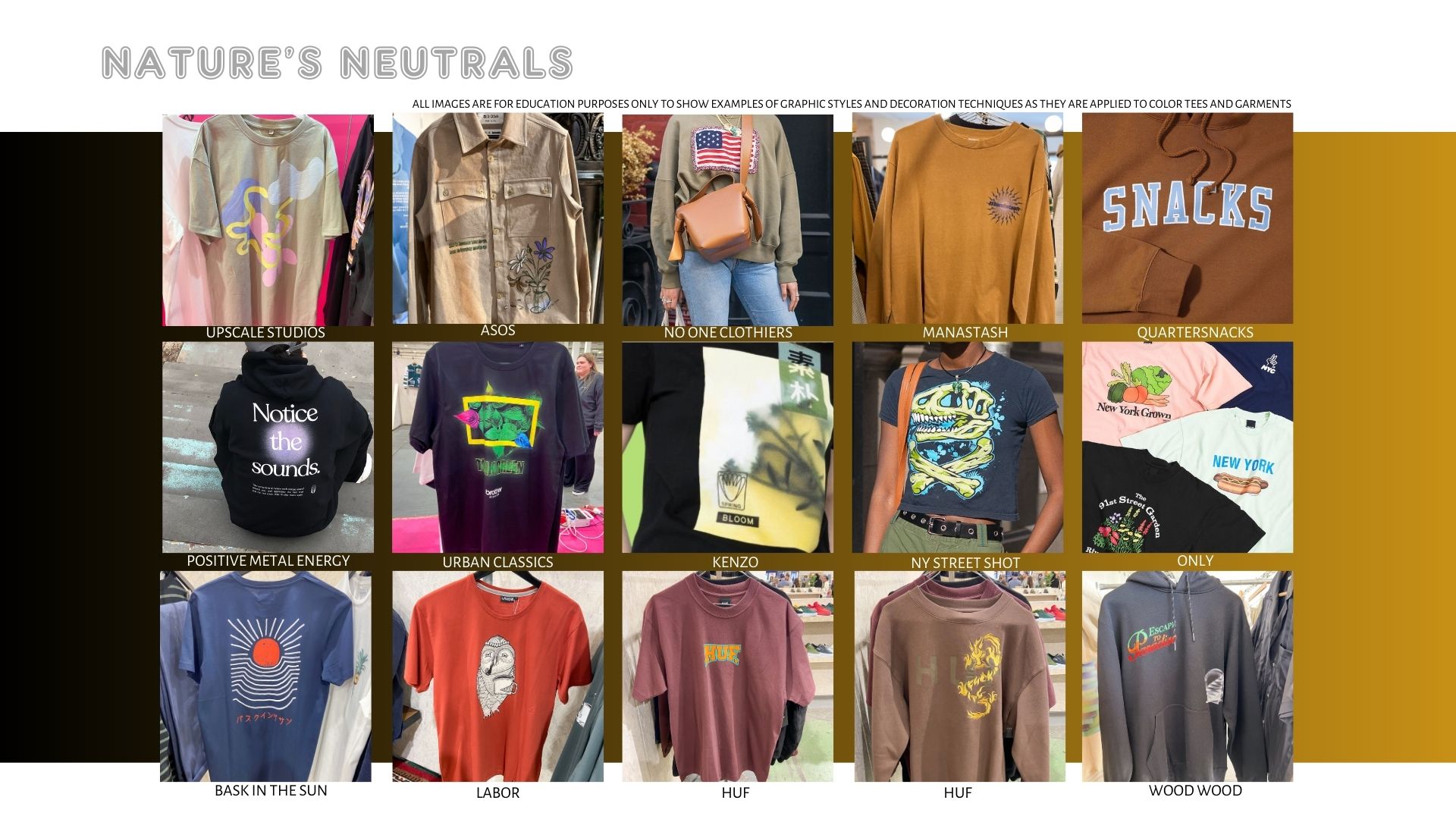
This return to nature, coupled with an alarmed awareness of our changing landscapes due to weather events, has awakened a deep love and appreciation of the colors of nature. Nature’s neutrals are now a part of our personal essential wardrobe collections.
And talking about “COLOR BY THE PEOPLE,” the power of this color palette is proven by what colors are in demand most by decorators around the country. According to the decoration team at SanMar, the resounding answer they hear from coast to coast is “desert colors” and “colors from nature.”

SO WHERE DO BRIGHT COLORS COME IN?
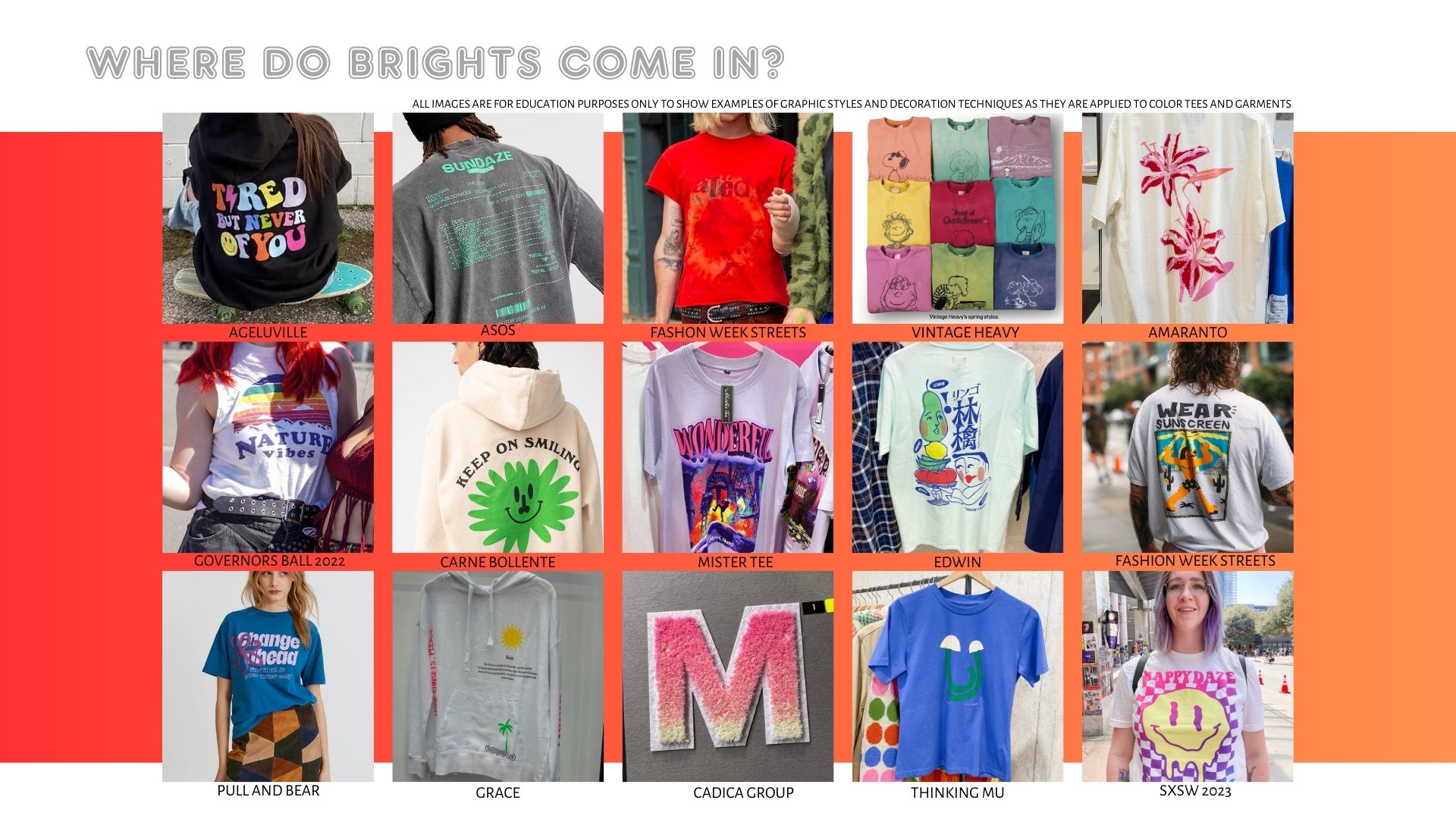
In terms of T-shirt colors, there is always room for brights. The ‘90s color trend is alive and well after all! Hyper color from that decade is also showing up in other apparel, too, like woven shirts and especially in accessories like hats. However, a majority of the bright colors in the T-shirt world show up in the way of the graphics put ON the shirts.
So where does this all fit in with decorators? It’s likely you’re getting a lot of requests for the above-mentioned colors for orders. But beyond that, it means paying attention to your business decisions: purchasing inventory that aligns with your customers’ preferences, decorating with materials that fit the trend, and asking clients the right questions.
What’s your favorite color?