
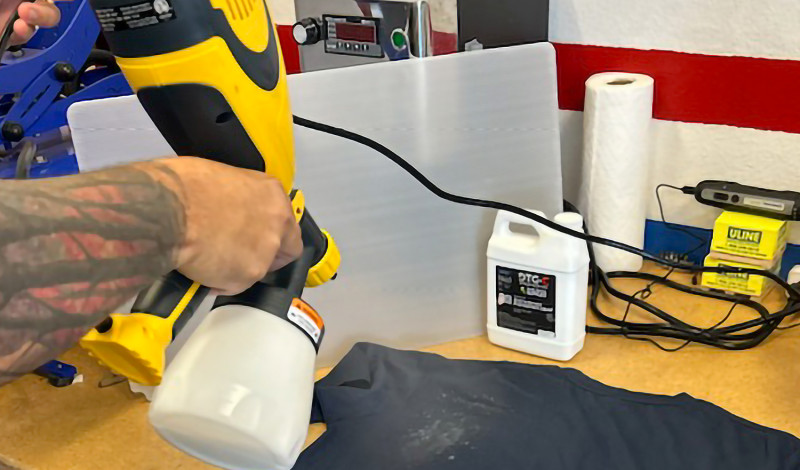
Today's Tip: DTG Pretreat Application
Most customers start off using a hand paint sprayer to apply the pretreat fluid onto a shirt. After you spray, you can use a squeegee, synthetic paint brush, or a foam roller to embed the liquid into the fibers.
When using a hand sprayer, you need to learn how to apply the correct amount of pretreat (depending on the quality and weight of your T-shirt) and ensure that it is done evenly and consistently for best print results.
Once apparel decorators gain more business (or dislike using the hand sprayer), many upgrade to a pretreat machine to help automate and streamline the process. Other reasons why customers upgrade to a pretreat machine is to be able to pretreat indoors in a smaller area with the printer or to keep their shop clean.
The amount of pretreat applied onto a garment depends on the quality, weight, and fabric content of the shirt.
Not all cotton shirts are the same! When you look at a T-shirt’s description online, take a look at the fabric details. There is a difference between 100% cotton (low quality) versus 100% ring-spun cotton (mid-quality) versus 100% Airlumed and/or combed ring-spun cotton (high quality). Typically, the lower quality shirts require more pretreatment, and the higher quality require less.
You also need to consider the weight of the fabric. Thicker shirts need a heavier application versus a thinner knit.
Lastly, keep the fabric content in mind. DTG uses aqueous (water-based) inks, which perform best on natural fibers that they can absorb into. Once you start straying away from 100% cotton into the poly blends, the white ink will begin to look less vibrant in your DTG print due to the polyester. Low poly blends wouldn’t show too much of a difference, but when working with these blends, you need to apply more pretreat compared to a 100% cotton fiber shirt. Typically, I wouldn’t use white ink and pretreat on a 50% or higher poly blend shirt, but you can use direct-to-film (DTF) instead.


