
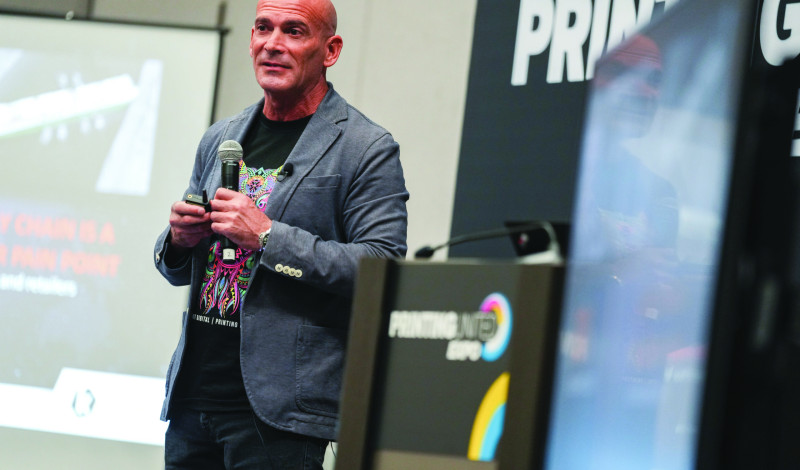
Kornit Highlights Sustainability Through On-Demand Digital
During its press conference on Oct. 19, Kornit Digital (Booth N7507) highlighted the key role digital printing has played in the evolution of apparel and textile sustainability and on-demand production.
Ronen Samuel, CEO, led a discussion on the global environmental impact of the textile industry. Fashion and textiles are responsible for approximately 20% of freshwater pollution and 10% of carbon emissions, the second largest polluting industry in the world.
Kornit has focused on developing digital printing solutions that are more sustainable in a variety of ways, including lowering power consumption, reducing inventory, and utilizing less water. The company estimates its on-demand production technology will save around 4.3 trillion liters of water.
Don Whaley, VP of marketing, led the second half of the press conference with a breakdown of Kornit’s latest equipment, the Atlas Max, the Presto Max, and the Atlas Max Poly. Whaley noted that all three machines feature top innovations in on-demand digital printing technology.
Of note is the Max Poly, which makes it possible to print on polyester material. Whaley explained that while the equipment is the same as the Atlas Max, it is able to achieve this through a different chemistry set. Kornit is also able to execute these prints through low cure temperatures and enable high-volume decoration on demand.
Kornit announced that its new machine, the Kornit Apollo, is set to release in the latter half of next year. Whaley describes it as taking the Atlas Max technology and putting it on color production steroids.


