
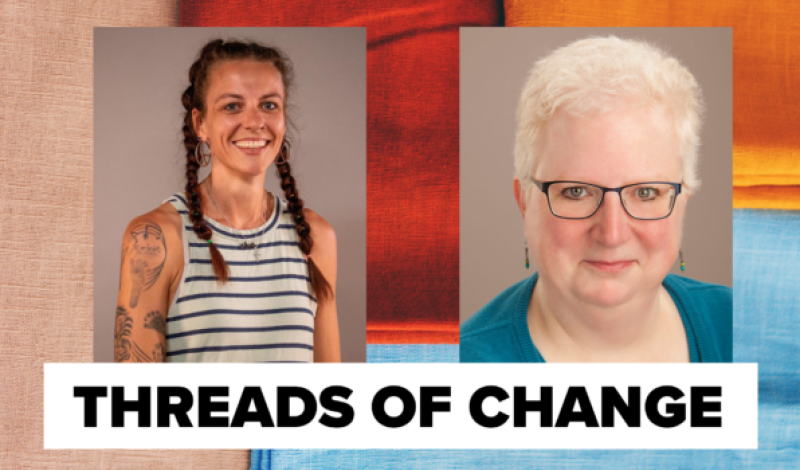
Industry Partners Launch Threads of Change Podcast
New show aims to provide a safe and approachable way to have open-minded discussions on DEI, mental health, small-business challenges, and more
When Cassie Green and I first sat down to discuss a topic that is near and dear to my heart, we had no idea that out of that conversation would come a Threads of Change, a podcast that we hope will resonate and engage the printing industry in a new way. But before we dive into that, I want to start with our “why” — why it was so important that we do something like this.
Recently, companies have been renaming, refocusing, or outright discontinuing their Diversity, Equity and Inclusion (DEI) programs because they’re being criticized or taking fire for having them. While it seemed in the past few years that DEI was the fad of the moment, in some quarters, interest is cooling.
The same arguments that have been made for years are being made again: Such programs aren’t necessary; people that work hard and do what they need to do will get ahead regardless; everyone has the same shot and the same opportunity; some people just aren’t willing to work for it.
It’s all fine, we’re all good, and really, aren’t there more important things to discuss?
And yet …
In 2018, Bizzabo, an event software company, released a study they’d done on Gender Diversity and Inclusion in Events. They surveyed 60,000 event speakers over a five-year period (2013-2018) across 23 countries. What they found was that two-thirds of the speakers at events were male (69%) and less than one-third (31%) were female. In the U.S., the ratio was slightly better at 65% versus 35%. There has not been a study with this sort of breadth and reach done since 2018, but indications are that these percentages have not improved much and may even have worsened in some years.
Mental Health and More
In a 2022 article in Entrepreneur Magazine, Dr. Michael Freeman, one of the only well-established doctors conducting research in this area, was quoted as saying 72% of entrepreneurs have mental health concerns, and some data suggests that entrepreneurs are two times more likely to have suicidal ideation. Although reliable data in this area is scarce, there may be a mental health risk for entrepreneurs and small business owners that is rarely, if ever, talked about.
If you Google “being a parent and owning a small business” what comes up again and again is “being a mom and running a business.” And while that is a topic that needs discussion, what about the stress on dads who are running businesses and trying to be good parents? Why is it assumed that moms have to deal with childcare and business matters and dads don’t? What if you’re a stay-at-home dad with a wife who’s an entrepreneur? Where are the resources and communities for you?
According to the 2022 Annual Business Survey (which covered the year 2021), 21% of small businesses are minority-owned, and 22% of small businesses are owned by women. Yet, if you’re a woman or a person of color who wants to get a Small Business Administration (SBA) loan, you’re less likely to be approved for a loan and to be considered low risk if you apply.
Women in Print Alliance serves to attract, advance, and advocate for women in the printing industry.
In 2023, almost half of SBA 7(a) loans went to white business owners. Hispanic and Black business owners received less than 10% each of the loans disbursed. Native Americans and Alaskan Natives received less than 1%. Women-owned businesses received 28.4%.
Tackling Tough Topics
You can make an objective argument that things are better than they used to be, and by and large, they are. But improvements made aren’t always improvements kept. There are also many who argue that more change and improvement is needed.
One of the best ways to figure out where change is needed and how those changes should be implemented is to talk about the issues, calmly, openly, and with an aim toward solving the problem, not apportioning blame.
How do we build diverse communities where all viewpoints and opinions are welcomed without judgment? What resources are needed to give those who might have started at a disadvantage a leg up? How do we make sure that the role models for our industry represent the industry we want to see, diverse, multicultural, and open? Who are the people and organizations leading the charge and holding the discussions that need to be had?
Ghandi said, “You must be the change you wish to see in the world.” Change starts when we have the discussions, confront the (sometimes) uncomfortable issues, and ask the hard questions. Apparelist has partnered with me, Kristine Shreve, on a new podcast, Threads of Change, and it’s designed to do just that.
We’ll talk about mental health issues, the challenges and obstacles business owners face, what it’s like to be a BIPOC business owner or an LGBTQ+ business owner and share those stories so we can all learn from each other’s experiences. The hope is that we’ll tell the story of a diverse and exciting industry that is growing and changing and making room for all — while, also, of course, being entertaining.
Listen to Episode One Now
Those who are fans of Star Trek may be familiar with an acronym IDIC, which stands for “Infinite Diversity in Infinite Combinations.” With Threads of Change, the podcast partnership seeks to celebrate that infinite diversity and spotlight the ways that infinite combinations of abilities, cultures, and knowledge can come together to make a more diverse, open, and profitable industry.
Editor’s note: Though this is a joint partnership, some opinions, thoughts, and experiences shared may not reflect those of Apparelist.


