
Could You Capitalize More on Customization?
Customizing promotional products elevates your apparel decorating business
Personalization, customization, and individualization. While all are subtly different, for many apparel decorators and printers, the many different takes on customizing garments have become a profitable, if sometimes challenging, service offering that enables them to tap into the ever-growing consumer demand for clothing and items that are individually tailored to their preferences.
However, consumers’ desires to curate a personal world of individualized clothing, decor, homeware, and other items have created a number of new challenges for businesses decorating promotional clothing and products.
Firstly, how can you create promotional items that consumers want to include in their carefully personalized world? And secondly, when you’re working with a third-party partner such as a distributor or even a printer that handles hard goods, how can you ensure that the level of customization you already offer carries through to promotional products to create a seamless experience for the end recipient of your customers’ promotional items?
Creating a seamless end-recipient experience with branded apparel and promotional products comes down to an in-depth understanding of your customer’s brand identity and their target audience. Many print service providers and apparel decorators already gather these types of insights from customers and use them to curate custom-built product bundles that combine apparel with complementary products. Adding customization options that can be seamlessly applied to each item within such a bundle can elevate your offerings to customers, simultaneously deepening your relationship with them and their relationship with their audiences.
Three Factors to Consider When Curating Promo ‘Bundles’
Getting the mix of apparel and promo products in curated bundles right is a balancing act in and of itself. Many factors come into play, but three considerations are crucial when you’re striving for a perfect fit:
- Customer campaign goals: Asking customers about their specific goals with purchases can give you insights that enable you to make recommendations for products they may not have thought of or known are possible. If they want custom sweatshirts for a company fun run, do they know that they could replace simple branded water bottles with insulated bottles customized according to each individual team member’s color, image, and sipping preferences? That way, the end product is something that is reused just as often as the sweatshirt, instead of being tossed to the back of a kitchen drawer or into the trash.
- Purchasing patterns and trends: Monitoring trending promo items within the industry can give you the confidence to offer fresh ideas to customers, and customization is no different. It’s important to keep up to date not only on what other businesses are doing with customization, but also to have a good understanding of what is possible from a technological point of view, even when you’re outsourcing hard-goods decoration.
- Audience and messaging: Making the right recommendation of customized products to complement the apparel you decorate comes down to understanding the intended audience, as well as the messaging that the brand wants to convey. For example, with completely different frames of reference and consumer behaviors, Gen Z and Millennials have very different ideas of what constitutes save-worthy swag than Gen X. In addition, your recommendations should be different for a brand emphasizing its luxury credentials than one focused on an outdoor lifestyle.
Look Beyond the Logo
Whatever your approach to building promotional product decoration into your offering, when you’re looking to customize products, it is essential to remember that personalization can be so much more than a monogram or logo.
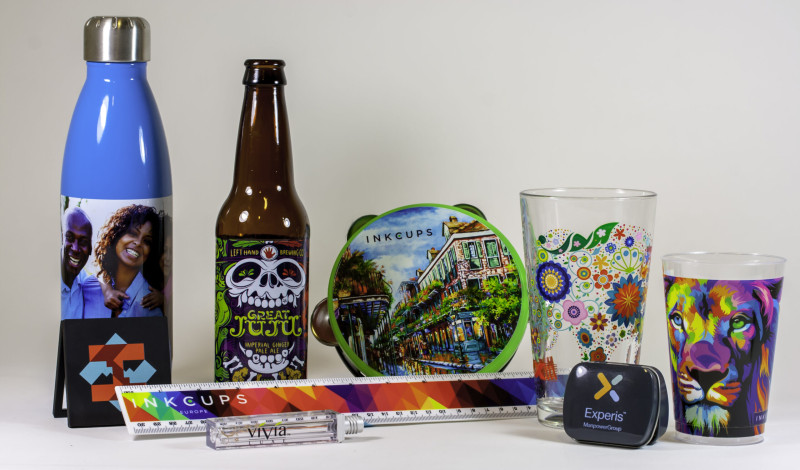
Technology has evolved so that decoration can take a myriad of different forms in the world of promotional products. Technologies such as direct-to-object inkjet printing make it possible to produce vividly colorful, seamless graphics that wrap all the way around insulated tumblers, all-over prints on reusable bags, or special effects that mirror a piece of artwork on both the inside and outside of a beer glass. What about pad printing to decorate everything from Christmas ornaments and skateboard wheels to hard hats and work tools?
The limit is really only your imagination (and that of your customer), but with digital print technologies such as direct-to-object inkjet printing, you can stretch your imagination further by easily and cost-effectively incorporating options for hyper-personalized products.
Most consumers today are accustomed to personalized marketing experiences. Retargeting ads follow them around on social media, they use retailers’ mobile phone apps to redeem personalized coupons, they customize their online newsfeeds, and they personalize gifts for loved ones. They are also empowered decision makers who seek to optimize everything for the best possible experience, with the result that consumer choice and brand preference has become part of their self-expression.
That represents a tremendous opportunity for businesses decorating apparel and promotional products. By helping your customers tap into the consumer appetite for personalization (according to Accenture, 84% of fashion consumers are interested in personalized products and 48% would welcome options to personalize prints[1]), you have the potential to make pieces of branded merchandise into coveted items that are treasured by their end-users.
If you consider how successful mass customization campaigns such as General Mills’ Cheerios Heart Month have been in the world of packaging, it is clear that, when it’s tailored to the audience or captures a particular zeitgeist, consumers are happy to engage and share information in return for a personalized item. With the right software and potential partner(s), decorators stand to not only help customers tap into the growing consumer appetite for customization but also to build more valuable long-term relationships with their customers.
[1] Accenture. 2021. Sizing up personalized fashion.


