

Recent Supreme Court Cases Shine Light on Parody and Derivative Works
More and more it seems like trademark and copyright infringement cases have been hitting mainstream headlines, including Bass Pro recently suing an apparel brand in North Carolina over trademark infringement. While cases like this fall more in the retail and consumer space, apparel decorators can learn a lot about what not to do when it comes to creating products based on artwork, designs, and overall branding that’s not their own.
The latest cases catching our eye are Jack Daniel’s Properties Inc. v. VIP Products LLC and Andy Warhol Foundation for the Visual Arts Inc. v. Goldsmith. Again, while neither of these falls within the apparel decoration space, they both put a spotlight on what is and is not allowed under trademark and copyright law.
Jack Daniel’s Properties Inc. v. VIP Products LLC
This case, according to SCOTUSblog, first began in 2022 when Jack Daniel’s Properties filed a complaint against VIP Products for selling parody dog toys that resembled a Jack Daniel’s bottle. The case put a big question out there: Are there exceptions to trademark protections when it comes to parody products?
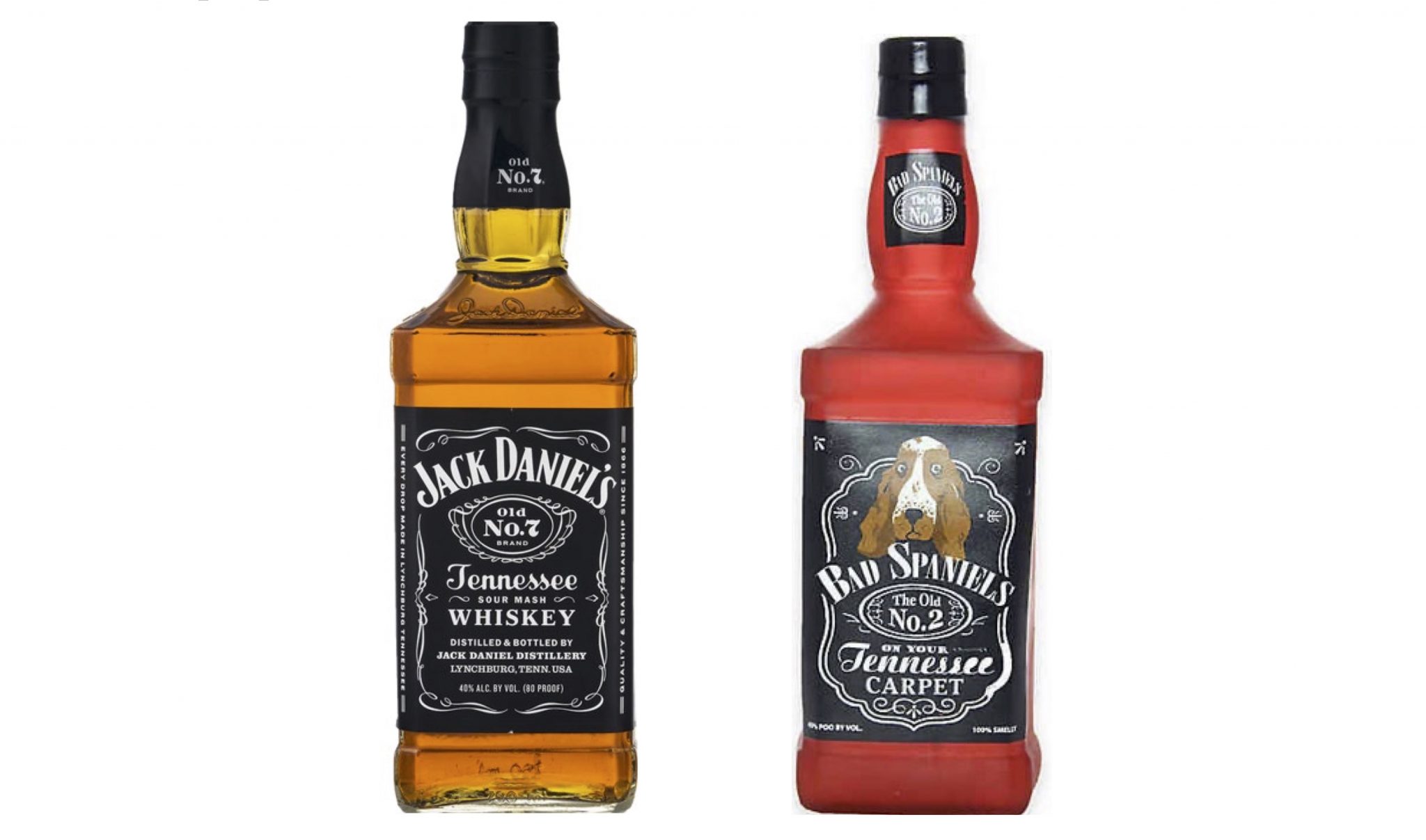
A Jack Daniel’s bottle (left) next to VIP Products’ “Bad Spaniels” dog toy (right). Credit: SCOTUSblog
Ultimately, the justices found that the dog toy was “a condemnable infringement of the Jack Daniel’s marks.” According to SCOTUSblog, Justice Elena Kagan said:
- The toy “is about the same size and shape as an ordinary bottle of Jack Daniel’s;”
- The “faux bottle” follows the original in using a “black label with stylized white text and a white filigreed border;”
- The toy has the product name (Bad Spaniels) “in a like font and arch” to those of the Jack Daniel’s bottle; and
- “Old No. 2 On Your Tennessee Carpet” replaces “Old No. 7 Tennessee Sour Mash Whiskey.”
Andy Warhol Foundation for the Visual Arts Inc. v. Goldsmith
This case looked at “the role that copyright law plays in fostering artistic creativity,” according to SCOTUSblog. Celebrity photographer Lynn Goldsmith said the Andy Warhol estate infringed on her copyright of a photograph she took of famous musician Prince. She says the estate “licensed an image Warhol derived from that photograph to serve as a cover on a Condé Nast issue published shortly after Prince’s death.”
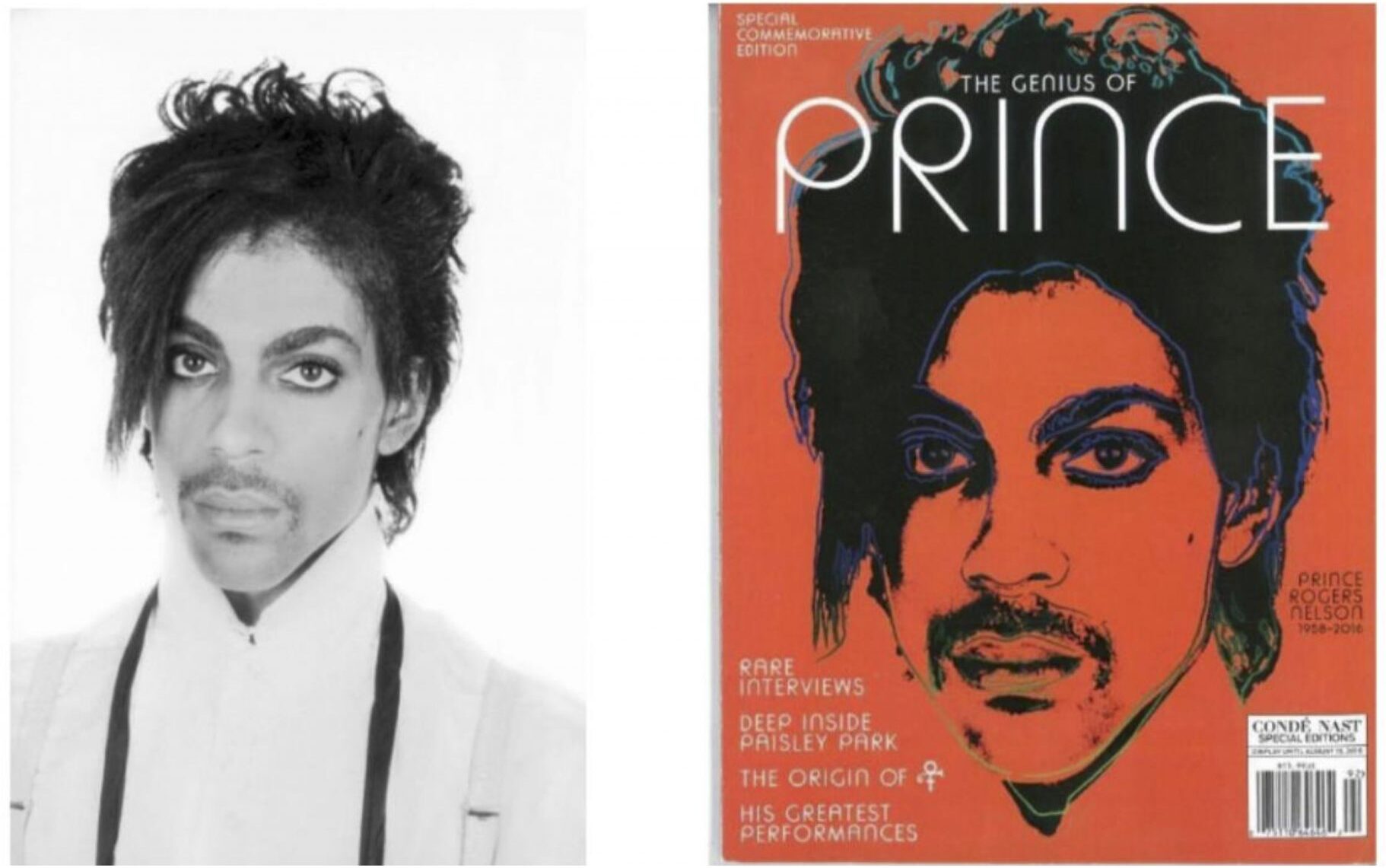
Lynn Goldsmith’s 1981 portrait of Prince (left) and Andy Warhol’s work on the cover of a 2016 issue of Condé Nast (right). | Credit: SCOTUSblog by U.S. Supreme Court
According to SCOTUSblog, the lower court rejected Warhol’s fair use claim of Goldsmith’s copyrighted photograph. “The copyright statute requires courts to consider four distinct factors in determining whether a use is fair: the character of the later use; the nature of the work; the substantiality of the copying; and the effect of the later use on the market for the original work,” states the SCOTUSblog analysis. In the end, the lower court said those four factors weighed in favor of Goldsmith and agreed to review Warhol’s argument that the first factor weighed in his favor.
While the Justices agree that Warhol’s artistic contribution is considerable, the commercial use of the work is where the issue lies. Justice Sotomayor concludes that the “character of the later use” factor favors Goldsmith because the use of the work by Warhol (on the front of a magazine cover) “share[s] substantially the same purpose” as the one Goldsmith commonly used for her photos. “The absence of a licensing fee or agreement this time makes all the difference,” states the blog.
While Justice Sotomayor says “borrowing heavily from an original” can be fair use, “licenses, for photographs or derivatives of them, are how photographers like Goldsmith make a living. They provide an economic incentive to create original works, which is the goal of copyright.”
Because the two works are nearly identical, Sotomayor describes Warhol’s use as “substantially the same as that of Goldsmith’s photograph,” as well as “shared the objective[s] of Goldsmith’s photograph, even if the two were not perfect substitutes.” With the “commercial nature” of Warhol’s print, Sotomayor concludes that the “character” of Warhol’s use goes against a finding of fair use.
This case, along with the Jack Daniel’s one, makes you wonder under what circumstance is the right to create derivative works protected? These recent cases of derivative and parody works should caution designers, decorators, and creatives when using someone else’s work or design as inspiration.


