
Why is Traceability Now the Buzzword in the Apparel and Textile Industry?
The growing noise around traceability affects everyone in the apparel industry, including apparel decorators.
Picture this …
You are the CEO of a multi-billion-dollar brand importing products from China into the U.S. market and your most recent shipment has been seized by Customs and Border Protection Services (CBP) because of a presumption of forced labor used in the production of the products. You are given 60 days to provide clear evidence that no forced labor was used in any part of the entire production process, including where the cotton came from, and need to provide:
- Names, locations, and contact information for every company that was involved in each stage of the manufacturing processes, including proof of the origin of the cotton fiber in the products.
- Copies of commercial invoices and proof of shipments for each transaction/stage in the process.
- Evidence that your diligence program addresses forced labor, including training manuals, codes of conduct/ethics, audit results, and more.
If this sounds like a far-fetched scenario in a crisis management training exercise, think again.
Initiated under the Trump administration in the form of Withold and Release Orders (WRO’s) targeting cotton coming from a specific region of China, and later passed into law under the Biden administration, the Uyghur Forced Labor Prevention Act (UFLPA) is very real, and one of the most important issues facing brands and retailers doing business in the world’s largest market.
In the first 12 months of enforcement, more than $1.2 billion worth of materials is reported to have been seized, with the initial focus on cotton products shipping out of the Xinjiang Uyghur Autonomous Region (XUAR) region of China. In 2023 (at the time of writing), more than $45 million worth of shipments have been detained from China, Vietnam, Cambodia, Bangladesh, Nicaragua, and several other countries. CBP has launched a dashboard that shows detentions by country of origin, product category, and more.
Effects on Apparel Decorators
For those readers thinking you are safe because your business is not really about shipping into the U.S. market, think again!
The same laws targeting forced labor are on the books in Canada, Australia, New Zealand, and soon coming into reality in the European Union.
Apparel decorators, and all companies selling apparel and textiles in the U.S. market, face risks associated with enforcement under UFLPA and other laws around forced labor and associated issues. These risks range from absolute seizures of products (if decorators are the actual importers) to significant supply chain interruptions if suppliers to the decorators are subject to seizures and interruption of supply related to these enforcements.
Some of you may recall a situation that happened not long ago around this issue involving Nineline Apparel. It illustrates a reseller/brand that decided to use a very reputable forensic technology to assert the origin of the fiber contained in the blanks they had purchased. Because Nineline was not the importer of those goods into the USA, the risk of seizure was probably relatively low, but Nineline wisely selected Oritain for their robust technology, which CBP has recognized for the sound scientific basis as a trusted means of determining the origin of the cotton fiber founds in finished products.
The issue, however, is UFLPA and other laws are not only asking for proof of where the cotton came from but also proof of where every step in the production process was performed. That is why a program like the US Cotton Trust Protocol, in combination with a robust forensic technology like Oritain, provides the best risk-mitigation option for all companies selling cotton products in the USA.
There was recent news from CBP related to CTPAT and the UFLPA that showcased their intent to increase enforcements, address di-minimus shipments, enhance internal market enforcement, and adopt more use of isotopic testing (like Oritain™). This would indicate to me that decorators, brands, and resellers should be addressing their supply chain to try to mitigate the risks to their business under these laws.
So, Where Do You Start?
It helps to have a little perspective of how the global textile and apparel industry actually works.
Globalization and the demands for fast fashion have morphed the global supply chains into hyper-efficient machines capable of delivering finished products quickly to brands.
As a result of many factors, including the digitization of commerce, improved logistics, and changing sourcing patterns, the industry has evolved and now benefits from inventories of pre-produced input materials (fiber, yarns, undyed fabrics) all along the supply chain that are ready to ship at a moment’s notice. These inventories are manufactured and held with no inherent connection to any specific brand orders, but rather a hope that orders will eventually come.
Here is what that looks like:
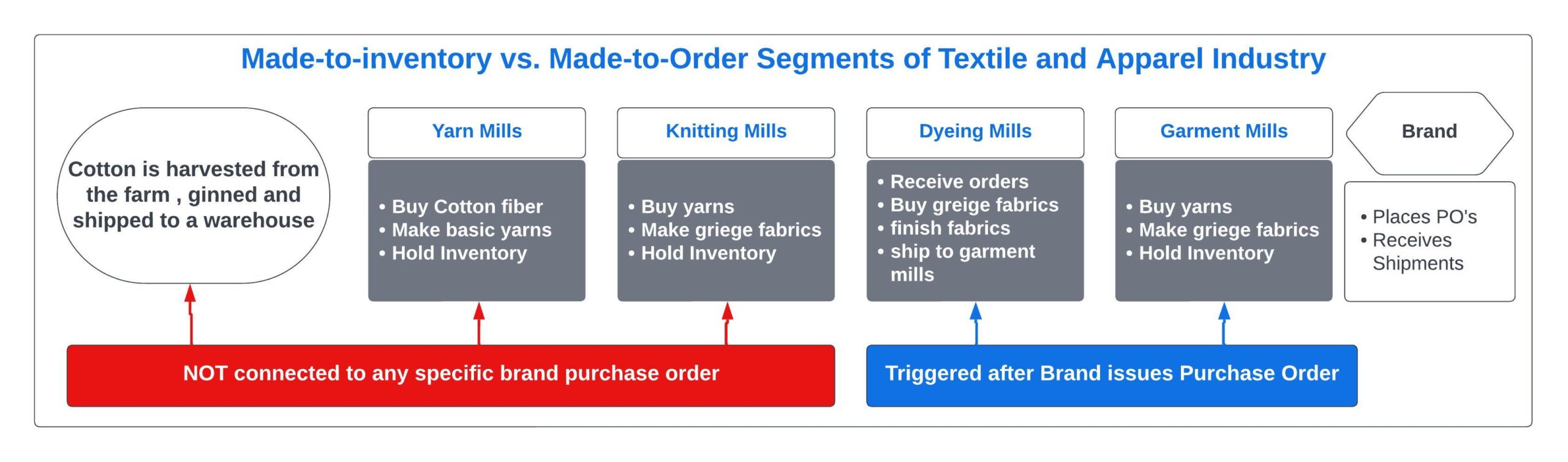
The challenge lies in the fundamental fact that almost all fiber and yarns, and many of the world’s best-selling greige (undyed) fabrics are produced with no connection to a specific brand purchase order. This ‘production to stock model’ allows factories to produce larger production lots, reduce machine downtime, and lower overall costs while making inventory available to ship at a moment’s notice.
Think of this concept as the apple being harvested from the tree and placed in inventory in advance of any specific consumer walking into a store looking for an apple pie.
Where the connectivity to a specific brand purchase order happens is usually at the moment in the process when dyeing and finishing happens (or when colors are applied). As shown above the blue box in the diagram above, those production steps are only made AFTER the brand has placed a purchase order with their garment mill (called Tier 1 suppliers).
Going Back to the Question of “Where Do You Start?”
If you are the CEO in the example, because you are looking for this information ‘after the fact,’ you likely don’t have a choice but to ask each layer in the supply chain …
- to divulge their sources for the materials they consumed to make your products,
- to share their commercial invoices and shipping documents and
- to hope that your business is important enough to each of these companies for them to share this information with you.

Purchasers of decorated apparel — whether they are brands, retailers, corporations, charities, sports teams, event merchandisers — or others all have increasing expectations that the products being sold to them by decorators are responsibly made and free of forced labor. Similar to the way in which NO buyer of decorated apparel would accept that unpaid or underage workers were in the print shop, I cannot image they would accept that forced labor went into the production of the blank apparel either.
It is important to note that enforcement of these laws is currently focused on importers, but the future could very well see accountability passed down the food chain to those selling these products in the market.
My suggestion to all decorators would be simply start by asking your supplier where each step in the process was done. If they cannot provide that information, think about what that means in terms of their risk profile as a supplier to your business.
Remember that the apparel industry has evolved over time to be one of the most fragmented and disassociated supply chain models, which is is one of the main reasons why traceability has become the biggest priorities in the past 24 months.
I can honestly say that, with more than 35 years of total industry experience and having spent the last three years consulting with the U.S. Cotton Trust Protocol building their traceability solution, I would NOT want to have to find all this information out ‘after the fact.’
My suggestion for all brands and retailers is to pre-emptively join a program like the Trust Protocol that is delivering a solution that provides its members with complete fiber-forward supply chain traceability data. Every shipment tracked in the system allows the brand to see each company involved across the full value chain, and to fast-track the process of getting all the required information if ever you face a need to prove where your products came from and what went into them. There are other traceability solutions that exist that provide that visibility into supply chains. Organizations like Textile Exchange have launched their e-Trackit system for sustainable fibers under their certified fiber programs.
It's a topic that absolutely affects apparel decorators and one you must get ahead of now to avoid future challenges.
Garry Bell
President and Founder, Chasing Better Consulting Inc.
Visit www.trustuscotton.org for more information on the US Cotton Trust Protocol program.