
Unlocking the Potential of Print-on-Demand for Your Business
The massive shift to POD during and after the pandemic is forcing shops to rethink their production approaches. Get the key insights and strategies you need to succeed with this business model.

Print-on-demand (POD) orders surged as businesses adapted to rapidly changing market conditions during the COVID-19 pandemic. With physical stores closed and e-commerce booming, POD provided a flexible, low-risk solution to meet rising online demand for small-run orders. “With POD, you can sell customized products without having to carry inventory or manage a complex supply chain,” says Travis Ross, owner of Make Your Mark Design.
The POD industry has shown remarkable resilience and growth, especially throughout the 2020s. In 2022, the global POD market was valued at $5.4 billion and is expected to skyrocket to $39 billion by 2031, with North America leading the way as a home base for 76% of the world’s most successful POD companies.
Today, POD continues to surge in popularity due to its low overhead costs, flexibility, and scalability. Print shops can easily add new products and web stores for customers without significant financial risk, meeting the growing demand for unique, customizable items. The key is in using technology and perfecting workflows to produce high-quality items quickly and get them out to consumers. Experienced shop owners and industry experts weigh in on how to capitalize on fast-turn POD orders and remain successful as the demand for POD grows.
Expert Insights and Business Adaptations During the Pandemic
Stoked On Printing had produced POD and digital printing orders for three years before the pandemic hit. The shop had a decent infrastructure, but the pandemic dramatically accelerated the pace of demand. “With that, it became apparent we had to focus on automation to remain profitable,” says Kevin Oakley, co-founder and chief revenue officer.
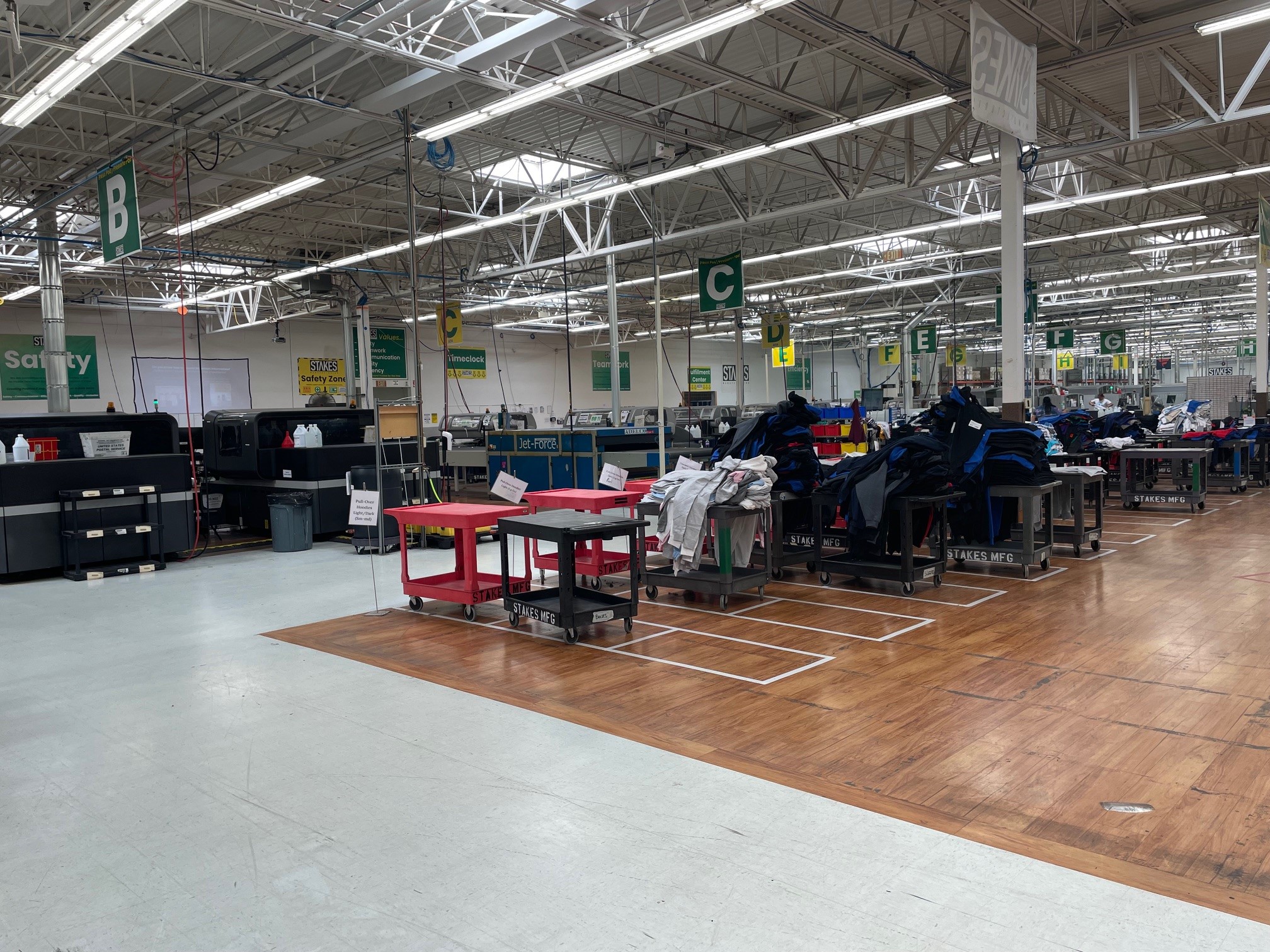
During the pandemic, Stakes Manufacturing — founded on fulfilling short-run and POD orders, which remains its core business — had to evolve its supply chain management to overcome delays and out-of-stock issues. “This entailed integrating with key supplier partners, developing machine-learning purchasing algorithms, and making deliberate manufacturing decisions to drive production efficiently and maximize client satisfaction,” Co-Founder Jed Seifert says.
Hiring challenges and rising labor costs also forced Stakes to evolve its labor management strategies during and after the pandemic. The team made system and process improvements, adjusted their scheduling methods, increased hiring efforts within the disabled community, and cross-trained employees across departments.
Additionally, they used temp labor to fill gaps when recruiting couldn’t keep up with demand. “We began implementing automation, machine learning, and AI to overcome labor shortages and enhance our business efficiency,” Seifert says. “While we’re decorators, technology and our people are the core of what we do and how we adapt to changing times to streamline our business.”
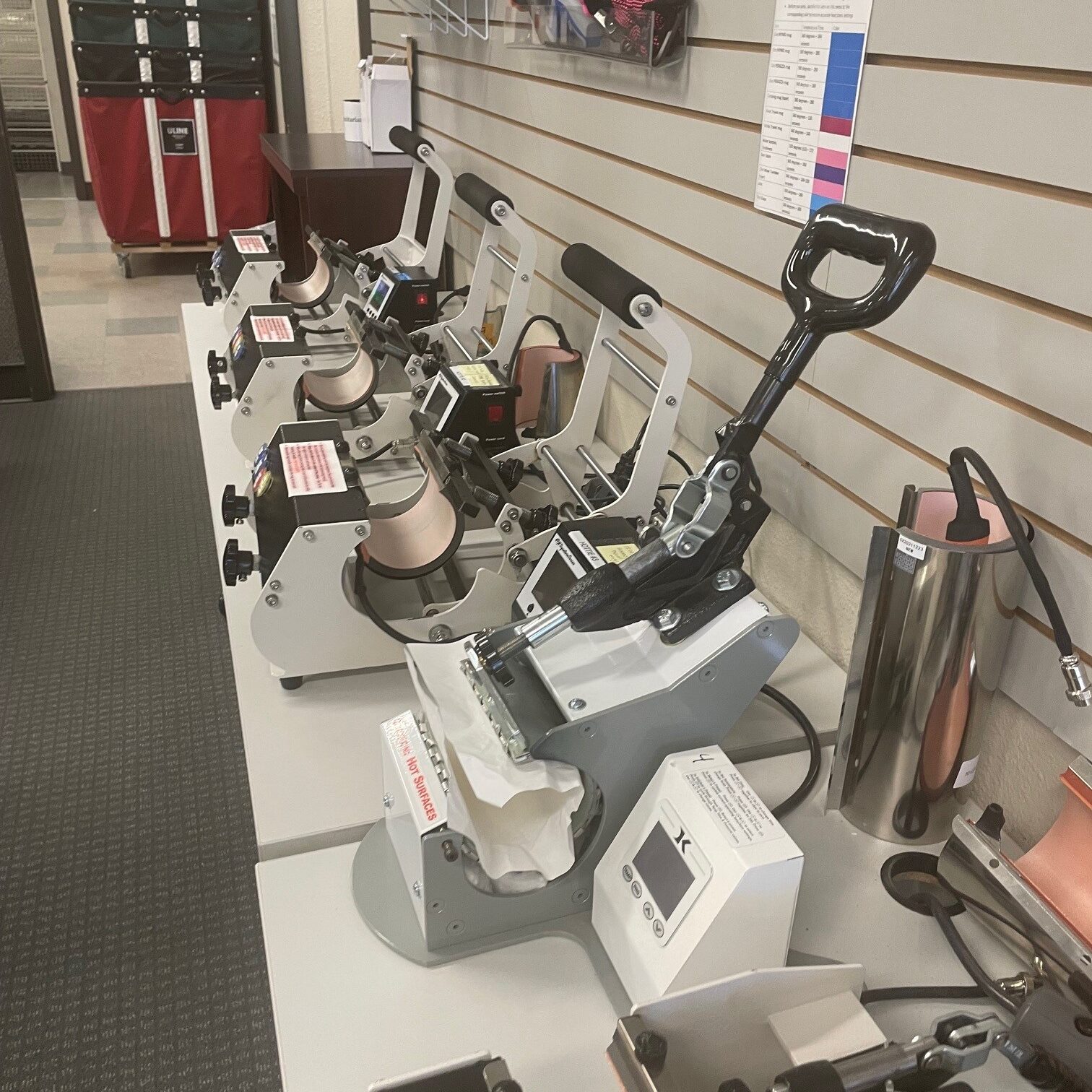
Ross launched Make Your Mark Design (MYMD) as a POD fulfillment center after being inspired by a conversation at the Rocky Mountain Reseller Conference. Initially, MYMD flourished, expanding to a team of 10 employees and a 3,500-square-foot production space. However, by early 2023, the shop faced severe financial challenges due to focusing on low-margin wholesale clients instead of higher-margin retail products. Despite efforts to recover, including reducing staff work hours and launching numerous product listings, Ross ultimately decided to shut down MYMD by mid-2023.
The closure was a difficult personal and professional decision for Ross, who had to let go of loyal employees and confront the sense of failure. Nevertheless, this transition allowed him to refocus on the retail side of his POD business.
Partnering with Gooten for fulfillment, Ross managed to streamline operations and continue his e-commerce business, handling most production through the new partner while retaining some equipment for local production. “No matter how much you plan and forecast, your business will go through ups and downs,” he says. “Don’t get too attached to one way of operating. Be nimble enough to adapt.”
Balancing Quality and Speed in POD
A major POD challenge is ensuring high-quality output while meeting short turnaround times for these orders. Here are five key ways printers keep everything in balance:
- Create service-level agreements (SLAs) with each customer. “As a problem-solving print shop, you need to understand exactly what your customers need and then create SLAs that dictate your production,” says Marshall Atkinson, business consultant at Atkinson Consulting and Shirt Lab Tribe. “Your SLA isn’t just about what you’re doing for them, but also about determining the right charges and workflow for these services. For example, you might need to ensure orders are shipped the same day they come in, so what does that look like in reality for your production team?”
- Understand what you should charge for quality and speed. “One of the biggest challenges is determining the right pricing,” Atkinson says. “To meet customer needs and expectations, you might need to print and ship the same day. Since you don’t have time to order goods, this means keeping inventory on hand for quick dispatch, even if shipping takes five to seven days. Everything revolves around solving your customers’ problems.”
- Invest in higher-quality decoration equipment. “Higher-end machines are the biggest contributor to quality for small-run digital prints, so you’re looking at a larger upfront investment,” Oakley says. “If you try to cut corners on your equipment, you’ll run into printing and uptime issues.”
- Understand how you’ll handle inventory. “We maintained a certain number of products based on demand using Kanban cards to alert us when to stock up,” says Ross. Operating in Colorado, his shop’s fastest delivery times were two to three days. “Shops in areas with one-day delivery options can afford to be more flexible with their stock.” Seifert, on the other hand, exclusively stocks blank garments and prints all items on demand. “We print upon receiving the order, minimizing the need for extensive storage and reducing the risk of overstocking,” he says. The pandemic significantly impacted decorators’ inventory strategies. “Pre-pandemic, we held more inventory, but we’ve since reduced what we keep in-house and rely more on supplier partners,” Seifert explains. By balancing blank stock efficiently and collaborating with suppliers, you can ensure timely fulfillment while keeping overhead costs low.
- Systematize your workflow — and tweak the process often. “Every order is meticulously tracked throughout production, quality control (QC), and fulfillment, allowing us to identify the root causes and trends of quality issues,” Seifert says. “We address all instances where items are shipped without meeting our quality standards by providing corrective training to the responsible employees. This approach ensures we consistently deliver high-quality products while fostering a culture of continuous improvement.”
At Stakes, the QC process combines the efficiency of technology with the precision of manual tools, supported by a dedicated team of experienced professionals who undergo thorough training and education. The shop’s products receive multiple QC checks, from receiving garments to shipping finished products. The team reports internal QC failures to isolate and resolve equipment and human errors in real time.
Maintaining Profitability with Short-Run and POD Orders
Many printers agree it’s challenging to make a healthy profit in POD. “You have to invest quite a bit of money to get to a certain scale and technology stack where you can integrate into partners or your site so that it seamlessly flows from the web to your production,” Oakley says.
The Stakes team works to be efficient by using technology and making continuous process improvements. “We diligently manage our labor planning and costs, which is extremely difficult with POD model volume fluctuations,” Seifert says. “Our approach revolves around making informed business decisions daily, driven by a continual evaluation of data, math, and metrics.”
Atkinson points out that not knowing profit margins is a key issue many decorators face with smaller-run or POD orders. “Many businesses simply ‘double’ their costs and miss out on potential profits,” he says. “Ultimately, profitability is the goal, so you need to calculate costs accurately and understand your gross and net profit. Are you tracking your profit effectively and satisfied with those numbers?”
Another crucial aspect is identifying your ideal customer. “Knowing your audience is crucial, whether you’re targeting resellers or end customers,” Atkinson says. “Not all customers are good customers. Some might be cheap, but the work required is the same. It’s important to work with people who value what you do rather than those who don’t.”
Finally, watch your profit margins closely, especially the balance between wholesale and retail orders. “The latter is almost always more lucrative per order,” Ross says. “Don’t let wholesale overtake retail unless the volume makes up for smaller margins.”
Optimizing Workflow for Print Shops
Running a print shop effectively requires an intimate understanding of your workflow. “You can only move as fast as the slowest part of your process,” Atkinson says. “If you’re unsatisfied with your results, wear your detective hat and identify what’s holding you back. For example, if getting inventory in is slowing you down, consider stocking it yourself. If ordering transfers is a bottleneck, maybe it’s time to invest in equipment to print them in-house.”
Atkinson also recommends automating your business as much as possible. “When a customer places an order on your site, does it automatically enter your system, or is it someone’s job to process it?” he says. “Implementing a system that auto-orders transfers and garments can streamline operations.”
Oakley’s shop built a separate production system called Merchloop, which operates differently from their bulk orders. “Our bulk orders are done traditionally by sales reps who write up the order, whereas Merchloop connects via APIs into e-stores,” he explains, “so orders automatically flow to our production floor.”
Ross advises that if you can’t scale to producing thousands of POD orders per day, supplement them with larger runs. “You’ll also need to dial in your systems and processes to maintain speed and quality,” he says. “If you can completely build out your workflow using tech solutions for each department, that can help a ton.”
If you’re struggling to streamline your production process, don’t hesitate to seek help. “The answers are out there — do research or attend trade shows to meet with vendors,” Atkinson says. “Getting a consultant could be a game-changer.”
Looking Forward With POD
Decorators agree that despite its challenges, POD is the present and the future. “Technology advancements in equipment and processes are moving faster than ever before, making it costly and challenging to keep up,” Seifert says. “If you aren’t constantly evolving, adapting, developing, and improving your business, you’ll quickly be left behind. Regular R&D on new print technologies and incorporating AI, machine learning, and automation into your facility are essential. Remember, whatever the best equipment and technology are today, they won’t last long.”
7 Tips to Accelerate Your Shop’s POD Success
Tip 1: Use POD as a tool, not your entire business model. “Instead of trying to fit into pre-existing models where POD is already used, look at your own business and customers to see if and how it can benefit them,” Oakley says.
Tip 2: Set up your systems and technology before offering POD. “The biggest mistake you can make is jumping in without any systems or technology in place,” Oakley says. “You can’t handle this process manually, order by order, and remain profitable.”
Tip 3: Understand your profit-and-loss numbers. “The biggest mistake we see consistently in the print industry is decorators who don’t understand the true math of their business,” Seifert says. “Without this understanding, companies often take bad deals to grow volume or land a high-profile client, which drives unprofitable work into their shops and strains their business. This lack of due diligence can slowly destroy your shop’s health and harm the industry.”
Remember, cost control is critical. “Expenses will creep up over time if you don’t actively monitor them,” Ross says. “You have to balance investments in growth with keeping costs contained. We got too focused on revenue growth without enough emphasis on protecting profit margins.”
Tip 4: Recognize the complexities of scaling your POD business. “Being able to print well digitally is only one portion of the POD business and arguably not the hardest part to master,” Seifert says. “As you scale your POD business, the complexities and challenges increase exponentially without the same benefits of economies of scale as traditional screen printing and other print processes.”
Tip 5: Invest in the right technology and people. “Too many companies don’t invest in the right areas,” Seifert says. “This includes everything from buying cheap equipment to relying too much on vendor support due to not building a proper maintenance team. Using outdated technology and making short-sighted investment and hiring decisions can come back to haunt you.” Prioritize long-term investments in quality technology and staffers to keep your shop efficient and self-sufficient.
Tip 6: Evaluate your decoration options carefully. Seifert notes that many decorators see direct-to-film (DTF) transfers as a plug-and-play silver bullet due to its lower capital expenditure than, say, DTG. “However, DTF has higher labor costs, and the technology is rapidly evolving,” he says. “Current systems and consumables can quickly become obsolete. Without expertise in file prep, color management, garment profiling, and system maintenance, you risk producing sub-par prints with color inaccuracies, poor hand feel, and low durability. This leads to disappointed customers and market pushback.”
Instead, many decorators focused on DTF outsource their transfer production to reputable vendors so that they can focus on turning out a higher volume of POD orders.
Tip 7: Accept that it won’t always be smooth sailing. “The key to success is having a strong face because you’re going to fall on it constantly,” Seifert says. “It’s about grit, getting back up, learning from mistakes, and improving daily. Remember, success is built on overcoming challenges, not just riding on past victories. So, embrace those face-plants and turn them into stepping stones for your POD journey!”