
Understanding Bankruptcy: Strategies for Apparel Decorators to Steer Clear of Financial Turmoil
Takeaway lessons from the closure of SCP Merchandise

*Editor’s Note: This article in no way serves to provide legal advice. You should consult professionals when it comes to financial and legal business decisions.
The recent and sudden closure of SCP Merchandise (SCP) rocked the decorated apparel community. While that specific incident caused quite a wave of effects and reactions, it brought to light the tough but important conversation of bankruptcy.
No small business, apparel decorators included, wants to find itself in this situation. However, the unfortunate and, as evidenced by the SCP scenario, realistic truth is that some businesses will find themselves facing bankruptcy.
In an effort to help other apparel decorators avoid bankruptcy from happening to their business, Apparelist enlisted the expertise of industry experts. They offer advice, best business practices, and policies that apparel decorating shops and owners should follow in order to try to avoid facing a similar outcome.
What is Bankruptcy?
Let’s start by briefly defining bankruptcy. Marshall Atkinson, Atkinson Consulting, breaks it down:
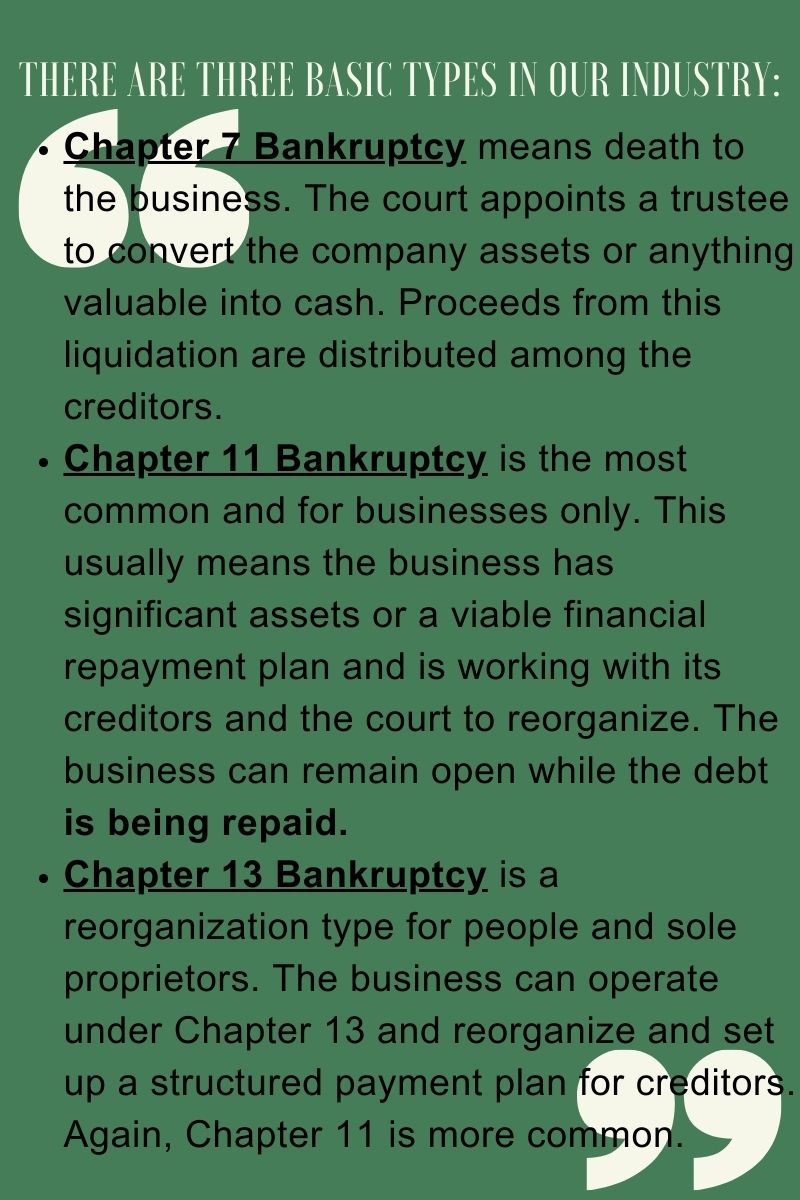
Once a bankruptcy petition is filed, it can feel like a whirlwind of negativity for both the business and those on the outside looking in. “Declaring bankruptcy has a dark stigma that most people want to avoid,” Atkinson observes. “There is a mystery about bankruptcy. What is the process, and what happens afterward? When a company declares bankruptcy, a process must be followed, and expectations on what happens next must be clear.”
There are several proceedings that take place depending on what type is filed. For the purposes of this article, we’ll look at Chapter 7 as it’s the one most applicable to the situation with SCP.
“In scenarios like [the one with SCP], there’s either Chapter 7 (liquidation) or Chapter 11 (reorganization) with a federal bankruptcy court,” explains Adam Tanaka, merch consultant and brand specialist in the industry. “This stops all debt collection efforts, and the court will appoint someone called a trustee to oversee the company's finances and operations.”
“If there was a Chapter 7 bankruptcy, the trustee will organize and sell assets to start repayment for the creditors,” says Atkinson. “If there is real estate, creditors can foreclose on the property after bankruptcy is filed.”
5 Common Causes of Bankruptcy and What Apparel Decorators Can Avoid
There are a lot of different situations that may lead to bankruptcy. And while apparel decorating shops that are experiencing financial instability should consult a professional, Atkinson notes there are some common financial problems he sees that can escalate into larger issues:
- Cash Flow - When the bills mount up faster than they can be repaid, it can be a huge problem for the business. There is a reason why cash is king.
- Governmental and Legal Requirements - Businesses must follow the law. When that doesn’t happen, it could mean trouble.
- Insufficient Funding - Lack of access to capital or recurring revenue. It’s difficult to pay the bills when the bank account is dry.
- Poor Accounting - Standard accounting practices are the core to understanding the business's health. Sadly, not all businesses follow them.
- Price Competition - For those operating on slim margins, this makes them vulnerable.
5 Ways to Avoid Financial Challenges
Tanaka notes that you don't have to become a victim to those problems. He offers these strategies to help:
- Closely monitor cash flow: Forecast, manage, and optimize cash flow to ensure sufficient funds to cover recurring expenses. Put systems in place to prevent overspending. Collect on invoices up front.
- Reduce operating costs: Evaluate ways to cut overhead without impacting quality. Renegotiate vendor contracts, streamline staff or processes, etc.
- Create multiple revenue streams: Diversify your revenue streams and evaluate the cycles your existing revenue is subject to. Try to identify ways to counterbalance the cycles with revenue streams or customers that have higher volumes while your primary revenue streams/customers are in their annual lull.
- Control your debt: Avoid excessive loans or credit lines that result in high interest costs that drag finances down. Prioritize reducing your debt, not creating more.
- Optimize pricing strategies: Use cost analysis, competitor research, and value-to-customer to set optimal pricing for profitability. Stop asking others what they charge and better understand what your value is worth.
Managing Rapid Growth
By Adam Tanaka, merch consultant and brand specialist
Your shop may experience fast growth. In turn, you have decisions to make — upgrade equipment, grow your team, add more software, add more supplies, etc. Some shops may need to take on debt to make these types of moves happen fast. If you don’t know where your finances stand at all times, you can end up with excessive debt from loans or lines of credit that can become unmanageable if cash flow is poor. Interest payments eat up capital.
Fast growth is not always good growth.
It’s crucial to know the difference between gross profit and net profit.
A shop that lacks systems can find themselves losing time and money without even knowing it. When you have no goals, you have no future. And when your goals are unclear, this can lead to flying blind, which is detrimental to you and your team. Losing sight of the goals or getting sidetracked from the goals you had initially can put you in a position where you will have to make difficult decisions.
If you find yourself scrambling to hire people without taking time to find A players, your team can quickly become surrounded by poor management. This leads to ineffective leadership, poor decisions, lack of financial control, no strategic vision, and fraud/misconduct, all of which can sink a business.
The Far-Reaching Impact of Bankruptcy
Various scenarios canThe effects of declaring bankruptcy seem to focus largely on the business itself, but the reality is, the rippling effects go much further. From the employees to the assets, to outstanding orders and customers, everyone and everything involved is affected. At this stage, our sources again emphasize that you should consult professionals; however, knowing how bankruptcy impacts the lives of everyone involved can help motivate businesses to take safe-guarding measures now.
Let’s start with the owner. “If your business is facing bankruptcy or is considering it, speaking with an attorney is the best option to get the facts to help make a solid decision regarding the next steps,” advises Atkinson. Various scenarios can be considered, so working with an attorney can help owners navigate the seemingly murky waters.
Of course, employees are also heavily hit by bankruptcy. “In most cases, employees unfortunately suffer job and financial loss through no direct fault of their own and learn of a sudden bankruptcy without much advance notice,” explains Tanaka. “Those who rely on company benefits are especially impacted.”
In the decorated apparel community, the effects of a bankruptcy can be even more difficult to deal with. “Our [apparel decorating community] niche is tiny compared to the rest of the businesses on the planet,” Atkinson feels. “It is not uncommon for a seemingly thriving shop to be open and working on a Friday, and by Monday, the doors are locked, and the staff is out of work. This leaves many people scratching their heads in disbelief. ‘What happened?’ they all ask. ‘We were so busy!’”

Atkinson explains that other shops should use these examples as cautionary tales. “This is why business coaches and experts routinely advise getting upfront customer payments and not offering terms. The company is much more solid when money is in the bank and not owed.”
Tanaka expands on that advice, adding that owners should always know where their company stands financially, regardless of how good their professional accountant or financial advisors are. “As an owner, it is ultimately your responsibility to take care of yourself, your company, and your team,” he says. “When you have a business that isn’t making money, don’t get distracted by other potential ventures. Commit to either setting goals to grow or move on. There is no in between.”
How to Handle Client Bankruptcies
Sometimes it’s not always an apparel decorating business that’s declaring bankruptcy. It’s not too uncommon for a client to do so. When this happens, it can be equally as problematic for your business, especially if it’s a larger client.
Atkinson notes that this situation can feel ominous, and again returns to the topic of payment policies. “The best way to avoid this situation with a customer is to get 100% of the payment upfront for any services,” he reiterates. “If that isn’t possible, work to keep their account current and payments up to date.”
In the event this does happen, Atkinson offers these thoughts:
- Talk to an attorney. When you receive a notice of a customer filing for bankruptcy, you must preserve your creditor rights. You should also assess the relationship with the customer and determine any viability of a sound future with them if/when they emerge from bankruptcy. Missteps here can have financial consequences, so consult an experienced creditors’ rights attorney to determine the best course of action.
- Everything stops. You cannot produce any more orders for that customer. Also, if you have goods in transit, try to get them returned. This does depend on the type of bankruptcy being filed, so again, consult an attorney.
- Stop all collection efforts. It will be counterintuitive, but stop sending notices after informing the bankruptcy trustee of the debt.
- Document everything. Start pulling together all the information on outstanding money owed, orders, a timeline, and all attempts to resolve the challenge. You need this organized so someone else can comprehend the matter.
- Check the schedule of debts. During a bankruptcy, all creditors are provided a list of the debts owed by the bankrupt business. If the debt owed to your business isn’t listed, you have specific guidelines and timing requirements to ensure your claim is included. Again, your attorney should guide you through this process.
- Get in line. The bankruptcy trustee will schedule the repayment of the debt. Your claim may not be prioritized, but you can petition to get better status. Also, you should know that some claims can be discharged, meaning the customer may no longer be legally obligated to pay.
The unfortunate truth of owning and operating a small business is that bankruptcy can and does happen. If you take the necessary steps to strengthen your business, you can avoid it happening to yours.
Suggested Resources
By Adam Tanaka and PRINTING United Alliance
- Check to see if your city offers a support hub for business owners and entrepreneurs. For instance, here in Nashville, Tennessee, we have the Entrepreneur Center, which is a game-changer for new and long-time founders who need expert guidance, support, and clear direction to get to the next growth phases.
- Get involved with your chamber of commerce. Local chambers provide guidance, networking, business education, and other resources.
- The right business coach can be an incredible asset to your personal and professional life.
- SCORE is a free mentorship program offered by the SBA where you can be matched with expert volunteer mentors who can help guide you through specific scenarios confidentially.
The above is great to have on a consistent basis. For direct resources that can assess and possibly mitigate your current financial situation, here are a few options:
- Lean on a financial advisor for guidance. Some will allow you to have one-off sessions to focus on the issues at hand.
- A business bankruptcy attorney will do a deep dive into the current state of your finances to determine if there are solutions to avoid closure or bankruptcy.
- If your debt is out of hand, you can turn to debt consolidation specialists who will help you roll your debt into one payment with a competitive interest rate.
PRINTING United Alliance also offers its members a plethora of resources that can help shop owners and employees run a better business, avoid incidents that could result in company liability, and more. As a member, shops have access to these resources that can save them thousands, if not tens of thousands (or more) in business costs and liabilities.
To become a member of PRINTING United Alliance and learn more about how our subject matter experts can assist your company with services and resources such as those mentioned in this article, please contact the Alliance membership team: 888-385-3588 / membership@printing.org.