
Glycols in Water-Based DTF Pigment Inkjet Inks – Which Ones are Safe?
Whether you are a print shop or a consumables provider, we all need to be concerned about product safety and implementation of safe procedures/systems to use these products. This is essential for the shop and its employees as well as customers that may visit the shop.
Direct-to-film (DTF) inks have captured a lot of market share and interest in the textile printing market since their introduction in 2020. There are many reasons behind the wide-scale adaptation of DTF printing technology when compared to direct-to-garment (DTG) printing: flexibility, speed, cost-effectiveness, versatility of substrates, print quality, no need of pretreatment, etc.
With DTF’s growing popularity, we need to examine the awareness regarding the safety of the chemistry being used in these inks, especially glycols.

Understanding Glycols and Where They are Found in the Industry
In most water-based pigment inkjet inks, glycols are used as humectants and/or co-solvents for ensuring that the ink stays open in the ink train and print head. This helps minimize print head nozzle clogs. The selection of these glycols is important for jetting reliability of the inks.
Ethylene glycol can cause acute toxicity in humans from prolonged exposure through inhalation and/or skin absorption. The main danger from ethylene glycol in a print shop is from the vapors that are generated during the curing process (Source: MSDS).
Some DTF inks use ethylene glycol as a co-solvent/humectant as it provides ink open times without considerably contributing to the viscosity of the ink. In addition, it is a faster boiling humectant when compared with some other glycols, and the inks dry faster after printing, making it an easy choice for ink in terms of print and cure speed.
The end-user in the printing industry might not be aware of the health hazards that some of these glycols bring into the working/printing environment. Ethylene glycol is a colorless, odorless, sweet, syrupy liquid, making it even more dangerous, as the end-user will likely not be aware of the possible hazards unless they read the ink’s safety data sheet, SDS, or MSDS.
Ethylene glycol can affect you when inhaled and by passing through the skin. Its long-term exposure can cause kidney damage, impair heart function, cause brain damage, harm a developing fetus, and is considered a potential teratogen. Ingesting enough ethylene glycol can cause death.
The information to the right is copied from the Ethylene Glycol: MSDS.

Importance of Ink Safety
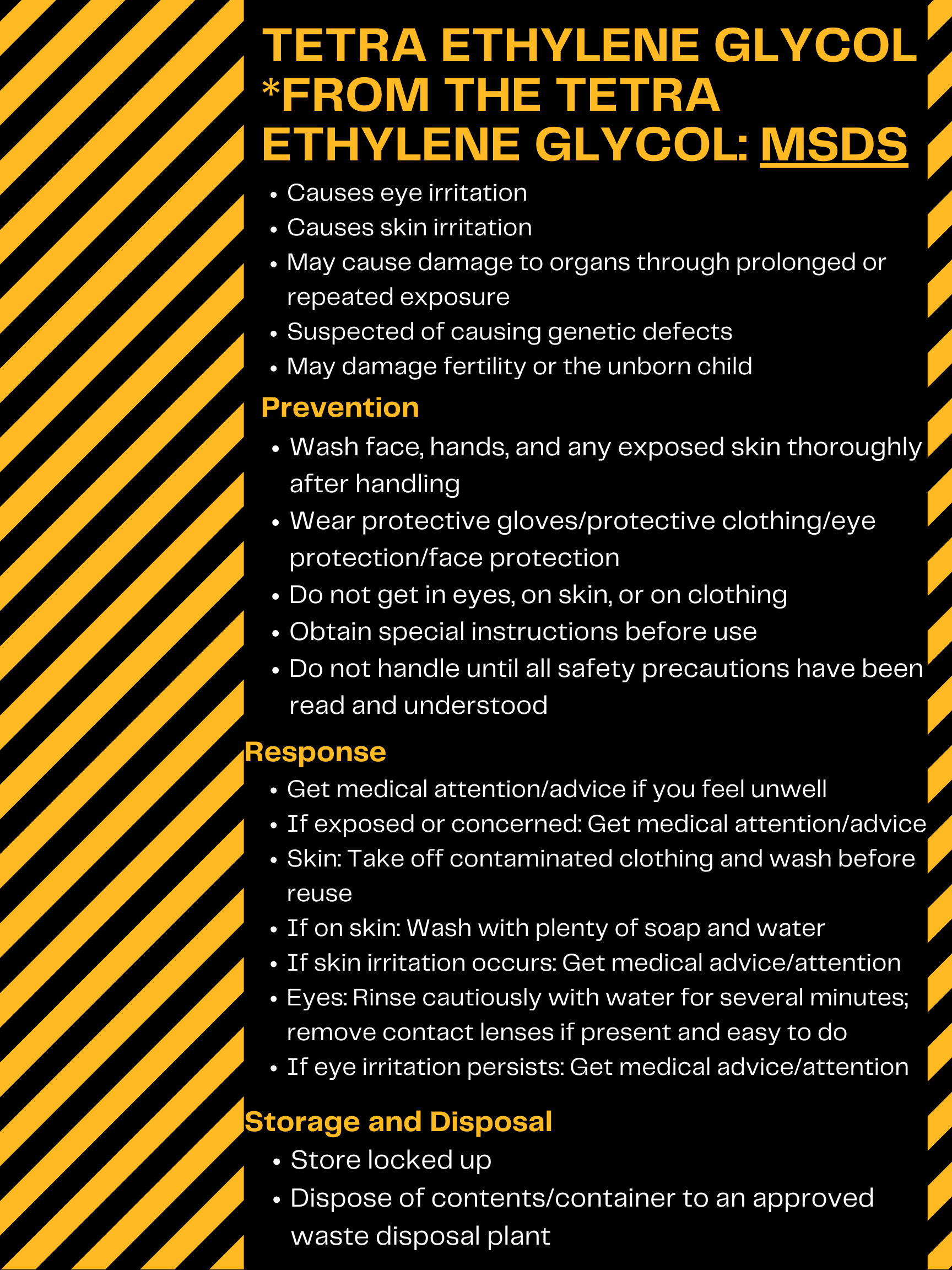
Ethylene glycol is used as an example in this article to illustrate the importance of reading the ink’s safety data sheet before use. Your ink may be listed as EG-free, but it does not mean that the alternative glycol used is safer. For example, some inks have tetra ethylene glycol instead of ethylene glycol, which is more toxic to human health than ethylene glycol (Source: MSDS).
The information to the right in the black box is from the tetra ethylene glycol MSDS.
Some of the adverse effects may show immediately, some may not surface for years.
All chemicals listed on an MSDS should have a CAS number. Many chemicals go by multiple names, but should all use the same CAS number regardless of the name they are listed under. You can google these and pull up the appropriate MSDS.
Note that if the ink has glycols like ethylene glycol, which require proper handling, then the print shops should be designed to minimize exposure, such as utilizing ventilation/exhaust systems that would re-trap the glycols and do not effuse them into the atmosphere, and the end-user must use have proper personal protective equipment (PPE).
Note: Not all glycols are a health hazard. For example, propylene glycol is generally considered safe and therefore used as an additive in food and medicine.
Please feel free to reach out to us for more information on the safety, use and proper handling of the DTF inks in your shop.
Article written in discussion with Dr. Madhu Kaushik and is based on information public information available from product SDS.