
Expand Your Profit on Every Order
By reviewing pricing, workflow systems, and current sales strategies, apparel decorators can identify areas where they can grow their profit without an added headache
What printer wouldn’t love a shortcut that would expand their profit on every order? Many shop owners think that the obvious way to accomplish this is to raise their prices.
Although that can be done, there are unpleasant side effects to simply raising prices. Customers who are price sensitive may leave and go elsewhere if you don’t communicate the price increase properly. If that happens, whatever extra profit is gained from raising prices will likely be lost with a drop in future business.
While it is true there are times and good reasons to increase your prices, that isn’t what this article is about. The ideas covered here focus on managing the costs, as well as using a variety of ideas to increase each order’s potential value.
The simple truth is you can grow your profits on your orders, and in many cases, without a tremendous amount of pain. It takes a combination of objectivity, curiosity, out-of-box thinking, and a dose of old-school frugality. A good way to start is to review pricing and cost reduction options, then look at efficiency systems that include some integrated marketing to boost potential profits.
Pricing
Before you get creative with expanding profits, it is critical to make sure you understand your “true” costs for your decoration methods to ensure you are pricing your services correctly and making profit in the first place.
As an example of computing your true costs, let’s consider direct-to-film (DTF) pricing. Although this example is specific to DTF, there are similar variables to other styles of decoration. The key point is to include all of the elements that contribute to your costs.
Factors to consider for DTF pricing:

While it is possible that occasionally a competitor may price below what their process costs, it is unlikely they can sustain that for long without losing their business. Good customers understand that you need to charge what your costs are with a reasonable profit margin.
Once you have a handle on your base pricing for the services that you offer, look at creative ways to expand your profits on each order.
Creative Profit Expansion
There are three ideas to look at in apparel decoration order expansion: volumization, cross-selling, and follow ups. This doesn’t mean that only these ideas will work, or that they are the most appropriate. They are merely a good place to start if you do not already practice them. Once you have tested these, you may find your own methods that work well for your business.
A lot of printers from the small to medium size range rely on referrals for a significant portion of their marketing. This instinct comes from a good place, but it can hamstring the potential to expand each order. Remember that two things can be true at the same time: Customers don’t want to be sold, but they love to buy (and they especially love a good deal when they buy).
If you did a quick review of frequent, after-order issues in the majority of print shops, you would see how customers commonly make several mistakes in their ordering processes:
There is a lot of room inside the average order for a customer to expand their requests and purchases during the whole process. If addressed with the right mentality, at the right time, and uses the right approach, your customer won’t feel sold to and will instead look at you as a valuable partner.

The Three Order Expansion Methods
Volumization
Volumization refers to methods that encourage a client to order a larger volume. Pushing a volume slightly higher is often in the customer’s advantage, because it is common that they will order only exactly what they need and forget additions that they should have considered.
There are several ways that printers can encourage volume ordering, and one of them you probably already use: a minimum order on certain decoration styles.
The critical first step to expanding this process is to compile and review what your customers typically order in volume for different garments and products. You can then cross check where your current ordering incentives are to see if there is room for slight bumps or incentives to be added to your current pricing and ordering processes.
One way to do this is to add pricing tiers just above your common order volumes for certain quantities.
The Right Timing
Finding the right time to offer a customer an expanded order is perhaps the most important aspect to success, and doing it well avoids discomfort both on the client side and the printer side. By using careful observation, you will note that overall, there are some ideal times for making an offer to most customers, depending on the method. If you break down each offer, and what makes it appealing, you can then test them to identify the best time(s) that are specific for each one.
That way it can be introduced at the right time of the process — when they are finalizing the order quantities. The verbiage might be, “If you reach this next tier by ordering the extra dozen, your final, per garment cost comes down.”
Using an incentive, and carefully crafted pricing tiers on volumes based on product decoration style, a customer can be converted to a larger order easier because they are focused on the per-unit cost versus the overall order volume.
A second method of volumization that can be used is often best reserved for event-style orders and larger jobs that have hard deadlines. This method is to remind the customer, while ordering, that it is common for similar orders to pad popular sizes because those tend to run out sooner.
Cross-Selling
“Would you like fries with that?” became the mantra of cross-selling and unfortunately has been overused in so many ways, that it has created a bad feeling with customers. Most of us have experienced trying to get through the checkout process on a website while being endlessly bombarded with additional products that you have to scroll past before you can finish your order.
Although these examples are frustrating, they shouldn’t turn you away from cross-selling your services. When done correctly, it is one of the best ways to expand every order without a lot of extra work. In some of my tests while working as an art director, we saw up to a 75% conversion rate with well-presented cross-sell opportunities with a good product/client/order fit.
The list of what you can cross-sell is only defined by your creativity, your client knowledge, and the limitations of the original product, process, and graphics involved.
The timing and process of cross-selling for screen printing seems to work best right at the art and order approval stages because you can intentionally show it on the additional product, and the order can still be easily expanded without delaying production.
If done well, a great cross sell offer should come across like a wonderful discovery for the client. An example presentation could be:
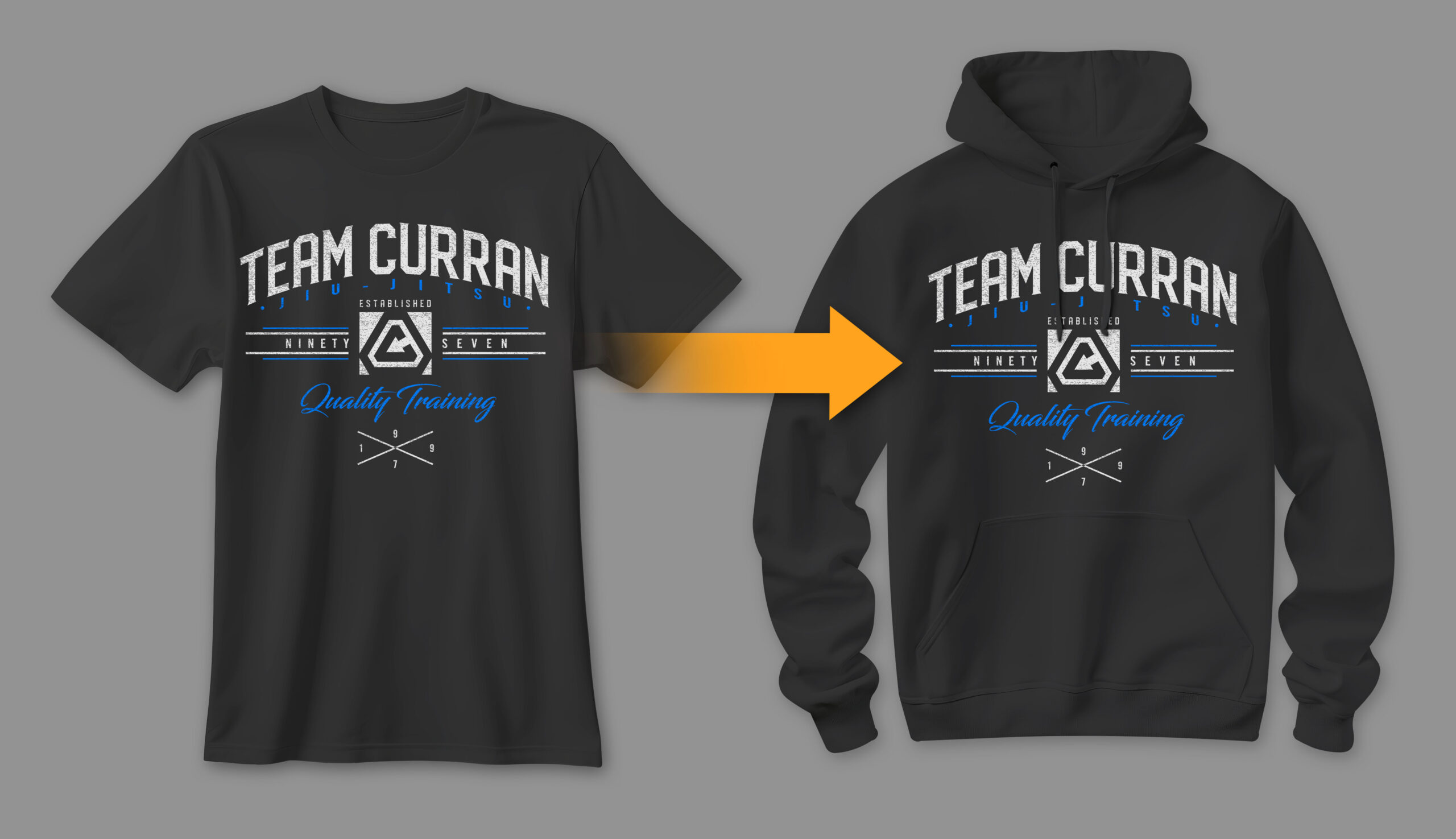
In this example, a full-front graphic on a T-shirt was checked quickly first to make sure it fit on a hoodie, so the offer could be made for the original order to be expanded. This could easily be offered with tank-tops or long sleeve garments, too. The key is to not overwhelm or confuse the client. Instead, carefully decide ahead of time, using client knowledge about their habits, what the best possible cross-sell is.
Limiting the choice makes it more personal, as well. Present it with a mock-up option and a revised, additional quote that allows the customer to buy it outright, without a lot of additional decisions. production won’t be delayed.
Using the right message subtly implies that the customer is smart enough to understand that the majority of the cost in the original order is in the setup, so adding additional items is economically advantageous.
Follow Ups
The one offer that is promising, but likely the most neglected, is the follow up. Everyone knows they should be following up on each order, and some companies do it. The key, though, is to always do it on every order (unless the customer says they don’t want it). The other part that is critical to successful follow ups is to focus on the past order first, and truly listen to any feedback. If there is an issue, you can immediately pivot into solution mode rather than continuing with the offer.
Note for timing of better follow ups: To vastly improve your follow ups and ability to connect with the decision maker two weeks after order delivery, ask during the initial order process, “Who should we follow up on this order with after it is delivered?” and make sure you get the right contact, their details, and the best method and time for connecting with them. This way the follow up is already on the radar as the order is being placed.
There are multiple reasons for following up: staying in the mind of the customer, quality control check on the order process and products, and making sure they are satisfied. What is often missed in this process is a way to expand the existing order. While this has lower percentage success rates than the volumization and cross-sell, it can still be valuable if the offer and policies of it are carefully considered and presented.
Note: It could be argued that the follow-up method is less of an expansion of an order and more about creating new orders. The point isn’t about the classification as much as capturing opportunities that are available with each order.
The process of following up should be a personal call or email. The goal of the process should be to connect with the person that is the decision maker for the order and has the details on how the products performed. About two weeks is a good timeframe to connect with a follow-up attempt. If you wait too long, they may forget about it, and too soon they may not have the final details about the products.
The Follow-Up Offer
Once you have checked on the previous order and everything is good, there are several possible follow ups that can yield residual business to an order:
Some people won’t want to talk, may not provide you with any information, and will not want any kind of follow up. The majority of clients that care about service and quality want to have a relationship with a supplier so that they can continue to get ongoing superior products. Don’t fear asking about how they liked their order, as all feedback is useful.
Making the effort to expand every order is in your customers’ best interests. You provide the right combination of quality and service with more information than your competitor’s offer. This is a true win/win, and those clients that take advantage of your suggestions can also become powerful testimonials for other prospects to copy on future orders.
Consistently following these simple principles has the potential for dramatically improving your average order’s bottom line over time, so continue to practice, test, and refine your methods to create the best offers for both you and your customers.