
Examining the New Reality of Forced Labor Regulations in the Apparel Industry
Even though it’s only been in effect for just over two years, the impact of UFLPA is already being felt by those in the apparel industry, and decorators must stay on top of updates and resources to help decipher new regulations.

Just over two years ago on June 21, 2022, the Uyghur Forced Labor Prevention Act (UFLPA) went into effect, and with it came a slew of changes in the apparel and textile industry. While the law applies to so many industries beyond textiles, it has put a powerful spotlight on forced labor and human rights when it comes to garment manufacturing.
The impact of UFLPA was felt almost immediately. Some might remember the big headline that broke when Nineline Apparel, an apparel and promotional products company founded and operated by veterans, ended its relationship with a supplier after testing revealed its fabric was made from cotton sourced from the Xinjiang Uyghur Autonomous Region of China.
After that, it seemed headline after headline hit about inventory being detained for testing, more entities being added to the U.S. Customs and Border Protection (CBP) Uyghur Forced Labor Prevention Act Entity List, and companies dropping overseas manufacturing facilities in favor of near- and on-shoring options. Most recently, five new companies were put on the list by the U.S. Department of Homeland Security (DHS).
One source reports that since the passage of UFLPA, over 8,000 shipments of goods valued over $3 billion have been stopped for potential UFLPA violations.
Apparel decorators all over the U.S. also feel the effects. Shops may have noticed inventory sourcing has changed, suppliers are shipping from different sources than in the past, and customers are making buying decisions based on their belief systems. While this discussion has a global scope, it does impact even the smallest apparel decorator.
To help guide you through recent changes, navigate updates to legislation, and help you make better purchasing decisions, Apparelist enlisted the help of several industry sources.
What the UFLPA Data Shows
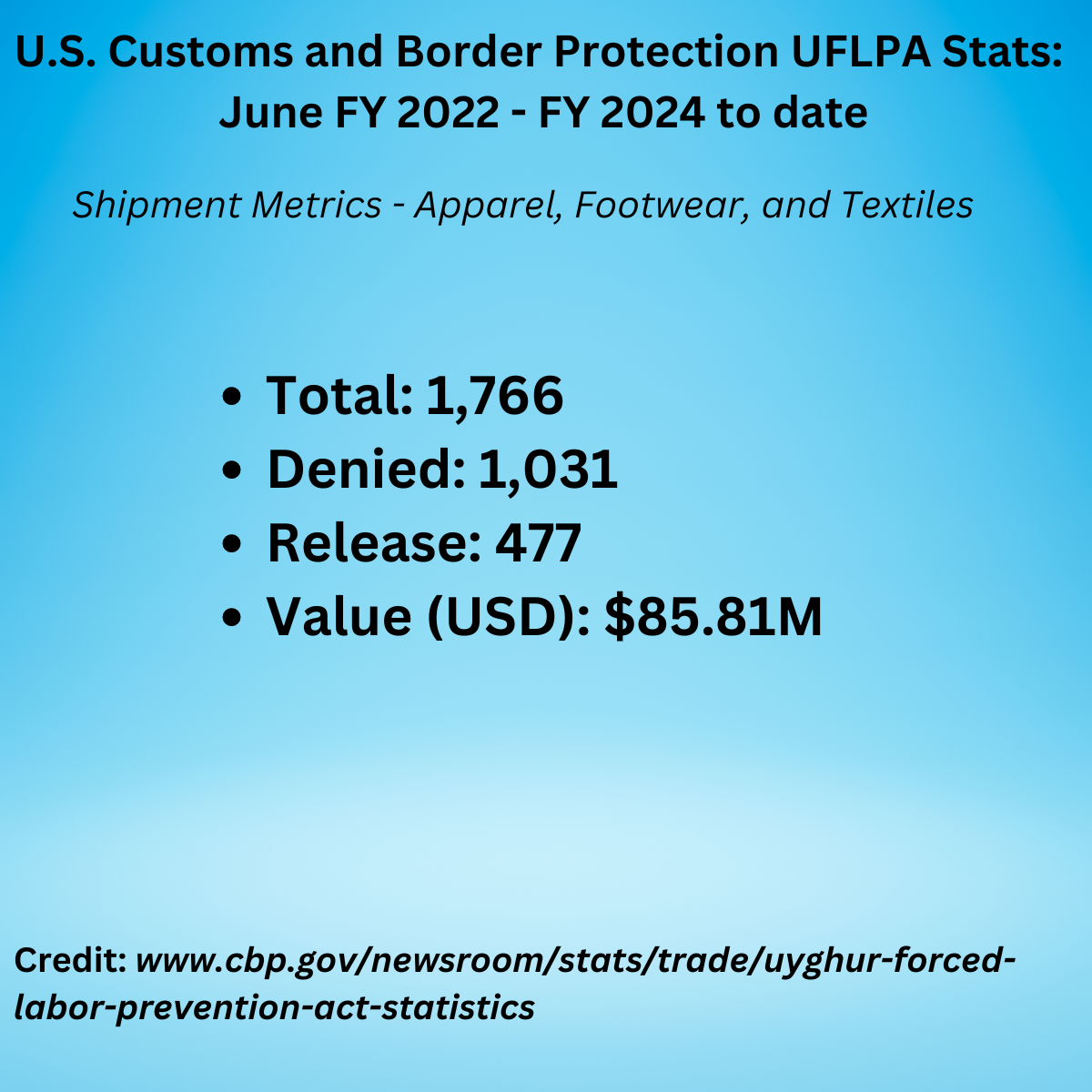
Let’s look at a few additional data points to set the scene. As of Aug. 19, 2024, 1,766 apparel, footwear, and textiles shipments have been subject to UFLPA reviews or enforcement actions, according to the CBP. Of that number, a whopping 1,031 were denied. If you think this doesn’t impact your apparel decorating business at the supply chain level, think again.
“Product liability is something all participants [including manufacturers, suppliers, and decorators] should be aware of and consider,” explains Garry Bell, Chasing Better Consultants. “Given the complex and disassociated nature of textile and apparel supply chains, inserting these new requirements is very challenging and forcing the industry to rethink and re-rationalize their supply chains.”
Not only is it a supply chain issue, but it’s also a human rights issue.
In an article shared by the Bureau of International Labor Affairs, it’s recently come to light that forced labor extends beyond just the Xinjiang region. The article states, “While previous research has focused on goods and products produced in Xinjiang, recent external reports indicate that Uyghurs also have been transported to work in other provinces in China, increasing the number of goods potentially made with forced labor and broadening the risk of forced labor in supply chains.”
“Many distributors, brands, and corporations have bans on the use of forced labor as a condition of acting as a supplier,” Kriya Stevens, director of econscious, points out. Because of this, your shop has probably already seen a change in inventory in terms of how fast it gets to you, where it’s coming from, and whether you receive it at all.
While Europe leads the charge, U.S. states are starting to take individual action on top of the federal legislation. For example, Florida recently signed a bill into effect prohibiting the state from contracting with companies for commodities produced, in whole or in part, by forced labor.
One more data point to hammer the importance of this topic home: At the time of writing (Aug. 19, 2024), the total number of banned entities is 73. As the list grows, so does the apparel industry’s need to dive deep into where its products come from.
Why Should Apparel Decorators Care About UFLPA?

The question apparel decorators might be asking is: What can I do about it? It’s easy enough to say, “That’s my supplier’s problem,” but the reality is, it’s everyone’s problem. There’s a high likelihood that your shop has several customers that care about forced labor and human rights. You might even have employees who are passionate about it.
And now, with the implementation of new state laws growing, you might be forced to care.
Shameek Ghosh, CEO of TrusTrace — a traceability and compliance data platform for fashion and footwear brands — notes that because enforcement is improving on UFLPA, alongside the evolving supply chain, these directives are expanding. Regulations are not limited to just one region of the world anymore. “It’s a problem in China, Vietnam, Cambodia, and [with] other products coming from different areas,” he points out. “Fundamentally, it points to brands and leaders needing to be ultra-vigilant and needing granular data.”
“As we currently understand the laws (already in place or in development), it seems increasingly that all participants in the supply chain are going to be expected to comply with these regulations,” says Bell. “As decorators, the responsibility may not extend to the production of the base garments, but they most certainly will apply to the processes and materials added in the decoration steps.”
Bell also draws specific focus to the customer-facing side of your business. “The other issue increasingly coming to light is that the world is moving toward a place where individual consumers will expect to receive full visibility of all participants in the supply chain, including decorators and other intermediaries,” he says.
But there’s some good news here in terms of progress according to Stevens. “Apparel decorators have become more aware about the country of origin for the finished goods they use and where the raw materials came from,” she believes. “We are also seeing more requests for manufacturing agreements that clearly state dis-allowed regions within the agreement.”
This might seem like a huge lift both financially and in your time management, but like any big change, it’s worth it in the long run. For example, your shop may start utilizing platforms like TrusTrace or Oritain to collect supply chain data and testing options, and that can be an added cost to your bottom line. But as Ghosh points out, it will be nothing compared to any legal fees you may face when and if you violate a law. Not to mention the cost of not being able to get goods into your business and losing customers can ultimately lead to an untimely “Out of Business” sign.
“UFLPA is broadly the overall legislation, so individual states are already dealing with bigger UFLPA,” Ghosh adds. “It’s reaffirmation that individual states are committing to following it — they’re pushing their own people to follow it and adhere to it. It’s a basic necessity for you to be in business [at this stage] … If you can’t get the goods into the store, you can’t do business.”
Resources to Get You Started
Hopefully the point has landed. If you’re ready to make changes now, there are plenty of resources to help you.
First and foremost is the simple act of asking questions. “Decorators can contact their suppliers and request information of their sourcing policies to confirm they align with federal import regulations,” suggests Stevens. “We recommend contacting organizations like SGS and Qima, who conduct regulatory webinars on topics related to legislation and product safety.”
She adds that there are so many tools currently available, decorators should easily be able to take advantage of the technology. “Everything from unique physical IDs on each garment as used by Aware, who adds tracer technology into recycled polyester filament yarn to track a product’s journey, to digital product passport (DPP) platforms like TradeBeyond [are available],” she says.
Ghosh suggests setting up tracking and data collection using platforms like TrusTrace. He recommends keeping a checklist of the things you’re tracking to keep you on task.
Don’t forget to utilize resources like the CBP, just do so with care. Ghosh notes that it’s a living document and that the entities listed there are constantly changing and being updated as new information becomes available.
This particular point is crucial to understand as, unfortunately, “it’s a game of cops and robbers. [Those entities using forced labor] are getting smarter — they’ll route products through other means to skirt regulation. They’ll re-route through other countries to avoid tracking. Proactively monitor your supply chains,” Ghosh says.
This offensive approach is one Bell strongly encourages. “Adopt an offensive as opposed to a defensive strategy by adjusting your perspective to look at all these changes as ways to make your company and the product/services you offer more valuable to your customers,” he says.
Ultimately, it starts at the top with leadership. “The biggest regulations will become a CEO agenda,” Ghosh believes. “Anything to do with forced labor and environmental acts are the minimum expectation at this point. It’s prudent for brands to really pull their efforts up on this and focus on it. If you’re not prepared for it and [don’t] put the time and effort in, you’ll be behind. This is a new reality.”
What is the Uyghur Forced Labor Prevention Act?
“The Uyghur Forced Labor Prevention Act (Public Law No. 117-78), also known as the UFLPA, directs the Forced Labor Enforcement Task Force to develop a strategy for supporting enforcement of the prohibition on the importation of goods into the United States manufactured wholly or in part with forced labor in the People's Republic of China, especially from the Xinjiang Uyghur Autonomous Region, or Xinjiang.
The Uyghur Forced Labor Prevention Act (UFLPA) establishes a rebuttable presumption that the importation of any goods, wares, articles, and merchandise mined, produced, or manufactured wholly or in part in the Xinjiang Uyghur Autonomous Region of the People’s Republic of China, or produced by certain entities, is prohibited by Section 307 of the Tariff Act of 1930 and that such goods, wares, articles, and merchandise are not entitled to entry to the United States. The presumption applies unless the Commissioner of U.S. Customs and Border Protection (CBP) determines, through clear and convincing evidence, that the goods, wares, articles, or merchandise were not produced using forced labor or that UFLPA does not apply to the goods, wares, or merchandise seeking to be entered into the United States. The statistics provided below are shipments subjected to UFLPA reviews or enforcement actions.”
—U.S. Customs and Border Protection

Technology Example: The argument for how digital on-demand textile production addresses near- and on-shoring challenges
By Sharon Donovich, Director at Kornit Digital
For decades, major brands have offshored their manufacturing operations to low-cost, less-regulated developing nations to keep operational expenses low and support healthy profit margins. Air and sea freight could transport goods to all corners of the globe, a “reasonable” amount of waste was tolerated, and demand was predictable.
But this mode of thinking is woefully outdated.
Human ingenuity has wrought a digital marketplace that completely reconceptualizes the supply-and-demand paradigm, standards of living in traditionally third-world manufacturing epicenters have risen, and the call for using innovation to meet global imperatives for ecological sustainability, human rights, and safe, responsible practices is growing.
While the upside of technological development presents its own challenges for manufacturers, the more troubling aspects of financial, logistical, and sociopolitical dynamics between economies are still as problematic for producers as ever.
Consumers may understand these challenges in the abstract, but it is a web-driven economy that has conditioned them to expect instant gratification, unlimited variety, customization, quality, responsible and transparent business practices. The internet offers infinite possibilities, and traditional fulfillment models don’t offer a corresponding flexibility to bring those possibilities to one’s doorstep.
While risk mitigation and shrinking time to market may be obvious benefits of bringing operations closer to home, it still leaves other critical concerns, such as labor costs, which alongside energy and other core OPEX remain high “at home.” Furthermore, the mechanics of a reshoring project — hiring and developing new labor forces, resetting supply chains in service of domestic production, building or leasing production facilities, etc. – are considerable.
While a digitized marketplace applies pressure on manufacturers to merge supply chains and fulfillment models, it is digitization itself that promises to make reshoring a simpler, even more profitable proposition for those businesses. It also has the potential to meet the industry’s increasingly stringent mandates and benchmarks for sustainability.
Let’s consider textiles and apparel decoration — and our proposition for scratching the “why offshoring made sense” itch in a way that meets the promise of a web-driven, instant-gratification marketplace while helping both consumer and producer (and designer).
With on-demand digital (i.e., inkjet printing) textile decoration, producers can print imagery on a host of fabrics much the same way we’ve put ink to paper for decades.
These direct-to-garment or direct-to-fabric print systems require a single operator, generating a ready-to-ship imprinted piece within minutes. The quality meets requirements of some of the world’s most recognized apparel brands. There’s also no need for specialized skills or deep knowledge of textiles.
This technology empowers on-demand production. Because it is pushbutton-quick, producers can sell the product first, then produce and ship within days or even hours. This cuts inventory risk and generates considerable profit per employee.
Because the mechanism is digital, management gains transparency to the complete fulfillment process, from order to shipment. They gain visibility and control across multiple production floors, even different regions. Production systems integrate directly with e-commerce sites, online design applications, and even social media channels. On-demand digital printing also streamlines supply chain management.
With sustainable, on-demand digital production, traditional offshore production epicenters cease to be factories vulnerable to floods, tariffs, skirmishes, fires, or stranded inventory; they become new markets for selling products.
For those building fulfillment strategies around onshore and localized on-demand production, a digitized world means tapping new markets and growing in years to come.