
Comfort Colors Announces New Sustainability Initiative
Comfort Colors shares that its proprietary dyeing process, the recipe behind the weathered hues for which Comfort Colors has come to be known, has a new name and look – Pigment Pure.
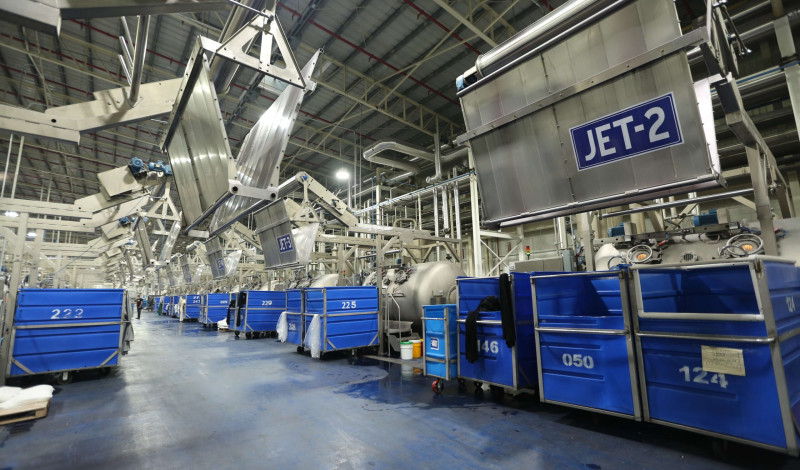
Built on years of research and development, Pigment Pure dyeing technology uses, on average, three times less water, consumes less energy, and has a quicker processing time versus other traditional dyeing processes.1 In addition to a lower-impact dyeing process, Comfort Colors uses 100% ring-spun U.S. cotton to make durable, long-lasting and comfortable T-shirts that are Made with Respect.
“From soft fabrics to colorful dyes, Comfort Colors is a brand that’s all about spreading good vibes and making you feel good, and we are doing that with Pigment Pure, a unique process that helps us create colors inspired by nature using fewer resources2,” says Emma Budzisz, vice president of marketing at Gildan Activewear SRL. “Thanks to this technology, our customers can take comfort in knowing that our clothes are always soft, and even softer towards the planet.”
A Look into Comfort Colors’ Pigment Pure Dyeing Process with Product and Textile Leaders
Hear from Kevin Freeman, vice president of product merchandising and development, and Maria Frohmader, vice president of textiles and dyeing at Gildan Activewear (owner of Comfort Colors), to better understand the dyeing process and learn about some of its sustainability attributes.
Question: Can you walk us through the Pigment Pure method?
Frohmader: A common dyeing method used for cotton in our industry is known as reactive dyeing, which is where the dye forms a bond with the fiber. Pigment Pure, however, dyes fabric on a surface level, allowing us to produce subtle, vintage-looking colors, and ultimately maintain the nature-inspired shades for which the brand is known. This method uses a set palette of base colors, which are mixed and matched to produce the vast array of shades we have in our product line. In addition, it allows us to maintain shade consistency, has incredible attributes for printability, and even reduces chemical discharge.
Freeman: What’s exciting about Pigment Pure is that beyond its ability to produce beautiful fabric, it has interesting environmental and manufacturing advantages. For instance, when compared to reactive dyeing, the dyeing time is reduced by approximately 40% with Pigment Pure, allowing us to save on both water and energy, and making Comfort Colors T-shirts a great lower-impact choice.1
Question: How did you go about developing this dyeing method?
Frohmader: We are consistently searching for new ways to optimize our manufacturing process, looking at every stage of production to find new or more efficient techniques in making our apparel. Pigment Pure was brought to life after years of research and development and continuously optimizing the process. What’s great about this method is that it improves the dyeing process from three angles: conserving resources, saving time, and enhancing the performance of our end products. So, it’s a win-win from an environmental, manufacturing, and product standpoint!
What are some environmental benefits of Pigment Pure?
Maria: Dyeing is traditionally one of the most water-intensive processes in the clothing production cycle. At Gildan, we are always looking for ways to reduce our impact on the environment, and Pigment Pure is a perfect example of that as it uses on average three times less water and consumes less energy, which in turn reduces our emissions footprint.1 It also supports our Climate, Energy, and Water targets established as part of our Next Generation ESG strategy, where we committed to reducing water withdrawal from nature by 20% by 2030 (compared to a 2018 baseline), as well reducing our absolute Scope 1 (3) and 2 (4) GHG emissions by 30% by 2030 (compared to a 2018 baseline).
1. The data on the Pigment Pure process are based on approximate comparisons with conventional reactive dyeing.
2. Compared to a conventional reactive dyeing process.
3. Scope 1 refers to direct emissions resulting from fuels used for stationary and mobile combustion across Gildan-operated facilities.
4. Scope 2 refers to emissions resulting from Gildan’s purchase of electricity.
The preceding press release was provided by a company unaffiliated with Apparelist. The views expressed within do not directly reflect the thoughts or opinions of the staff of Apparelist.


