

Apparel Decorating Pricing Guide
How Correct Pricing Methods Help Your Business Stay Afloat in the Midst of Financial Uncertainty
With a recession looming and increasing prices for just about everything, it is important now more than ever to evaluate your pricing and overhead. I hate to break it to you, but apparel decorating is not a recession-proof service. I anticipate that if things continue as they are trending, many decorators will again be forced to pivot or expand their services and product offerings to survive.
For the record, financial downturns can last anywhere from a few weeks to a few years. Hopefully this quick apparel decorating pricing guide gives you some ideas on where to start.
Quick disclaimer: I am only sharing this information to encourage you to proactively plan, not to invoke fear. The goal is always longevity. Therefore, it would be counterproductive to ignore the realities of doing business.
5 Pricing Tips to Prepare for Economic Downturn
Let’s take a page from the books of the big dogs, a.k.a. large corporations. Large organizations have crisis management plans for a variety of natural disasters and other events that can severely impact business operations, and so should you. Ironically, no one had a plan for a worldwide pandemic, but they do now!
Here are some tips for how you can prep your business for an economic downturn:
- Optimize your pricing – Yesterday’s price might not be tomorrow’s price. You need to ask yourself some key questions. Is your business making a sustainable profit on each order? Does the current pricing structure serve the business and the customer by offering them value and you profit?
- Build up your cash reserves – Take a break from reinvesting into your business and instead store away some cash. Whether that’s through a traditional savings account or other savings instruments, make sure that you’ve got a decent amount of cash on hand.
- Manage your cash flow – In my last article “The Importance of Automating Invoicing and Accounts Receivable,” I talked about the significance of strategically setting your payment terms. Getting paid in a timely manner for work performed is key. For example, if issuing credit to customers affects your ability to pay the bills when they are due, then issuing credit might not be a good fit for your business.
- Get a handle on your costs – In order to successfully build cash reserves, you have to make a profit. Profit equals total revenue minus total expenses. If your customers have less discretionary income, then you’ve got less revenue. Take a look at your overhead costs. What can you cut?
- Make data-driven decisions – During the COVID-19 pandemic, so many businesses made changes to their services in an effort to make money. Look at how many of us were printing custom face masks! While it is ok to follow demand, make sure that you make sound decisions based on quality data. Understand the impact of the pivot before diving headfirst. Just because something works for a decorator in Boise, Idaho, does not mean that it will work for a decorator in Miami, Florida. There are simply so many factors including demographics, climate, and competition to name a few that can affect the outcome.
How to Optimize Your Pricing
Let’s take a closer look at how to optimize your pricing because if your pricing is not right, nothing else stands a chance.
Keep in mind that apparel decorating services are elastic, meaning that demand is influenced by pricing changes. Before making adjustments, understand how your customers will react.
To optimize your pricing, first identify what your customers value because you don’t want to get rid of that. Frankly, you want to capitalize on that value. Start thinking of how you can “charge” for that value.
I’m an avid user of grocery delivery services. Recently, a feature was added that guarantees you faster delivery for a small upcharge. They identified that their customer values time and used that to enhance their service and increase the average order total. You can adopt some of these same practices to optimize your pricing. Get creative!
Next, gather some data about your sales, target audience, demand, market projections, elasticity, and any additional data you find beneficial. To start, I recommend choosing three to five focus areas to research to avoid going crazy with data.
The last step is to choose a pricing strategy, which is a method used to establish the best price for your goods or services. One of the easiest ways to get started is to look at what your competitors do. But, and this can’t be emphasized enough, do not base your prices solely on your competitors’ prices. They have a completely different business with different overhead costs, demographics, etc. Simply use it as a temperature gauge to see what others around you do.
Below are a few basic pros and cons for commonly used strategies:
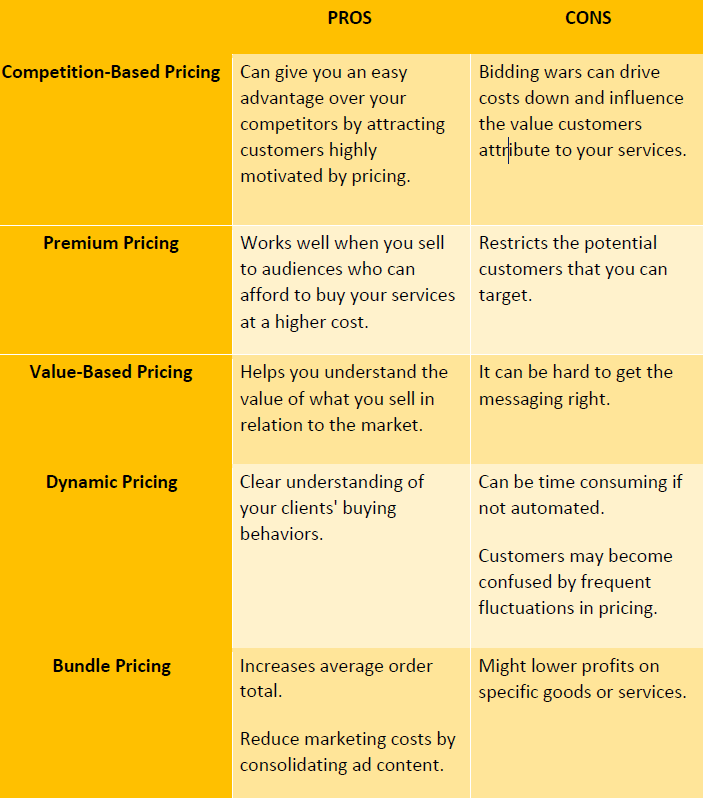
Your pricing should be reviewed at least annually. A reassessment does not necessarily mean that prices will change. It simply means that they will be evaluated to provide insight on how they impact sales.
If you ask me, there is an opportunity to do so in any season. Remain innovative. If you’ve saved a decent amount of cash because you planned ahead, look into expanding your investment portfolio if you can tolerate the risk. Or you might be able to acquire quality equipment at lower prices as market participants seek to sell off assets for cash.
Final Thoughts on Pricing
As a self-proclaimed techy, I would be remiss if I did not mention that there is AI (artificial intelligence) software that will assess your pricing and adjust it or make recommendations based on customers’ buying habits and the market for identical services. This method of simultaneously changing prices in response to demand is commonly used by airline and hospitality companies.
At the end of the day, even if you do all of this and we don’t experience a recession, the impact on your business is astronomically beneficial. You would have lowered costs, improved the timeliness of collections, and saved some money! It’s a win-win situation.
Happy printing!


