
Methods of Convergence
Stories of Success in Convergence from Printers Around the Industry
Before you read this article, I encourage you to stop and evaluate your business’s offerings. Do you only print T-shirts? Are you only serving the local sports apparel market? Are you simply screen-printing an order of 25 hoodies and nothing more?
Or are you one of the growing number of apparel decorators out there that houses screen printing presses, embroidery machines, heat transfer equipment, and possibly even a vinyl cutter and digital printer? Maybe you are even one of those that also has a wide-format printer or laser engraver.
Across the country, apparel decorators are exploring the world of convergence: printing something other than T-shirts. There are, of course, pros and cons to being a one-stop shop. There are business avenues that make sense and there are ones that don’t, and it’s up to you to decide what fits where for your scenario.
For those who are looking to expand, check out these stories from printers around the industry that have already explored convergence. Some are traditional apparel decorators, some are lifestyle apparel companies, and some are even in-plants. But the common thread they all share is each one has successfully managed to grow their business utilizing new equipment, niche opportunities, and a little bit of sweat.
One In-Plant’s Success with Apparel
Meet Judy Peace, the manager at Printing Services, an in-plant for the University of Regina in Saskatchewan, Canada. For those who aren’t familiar with in-plants, these are businesses that operate to fulfill the printing needs of organizations such as hospitals, colleges, and the like.
Printing Services employees seven people. The digital presses onsite include a Kodak Nexpress, Konica C2070, and Konica 6136. They also have an HP316 latex 54” with a cutter for large-format needs. “We are an ancillary department,” adds Peace. “Therefore, we accept external customers, which makes up approximately 40% of our revenue.”
You’ll notice that list doesn’t include apparel decoration equipment, or at least up until 2018, it didn’t. Printing Services made the leap into apparel with the purchase of a Sawgrass SG800 dye-sublimation printer that year.
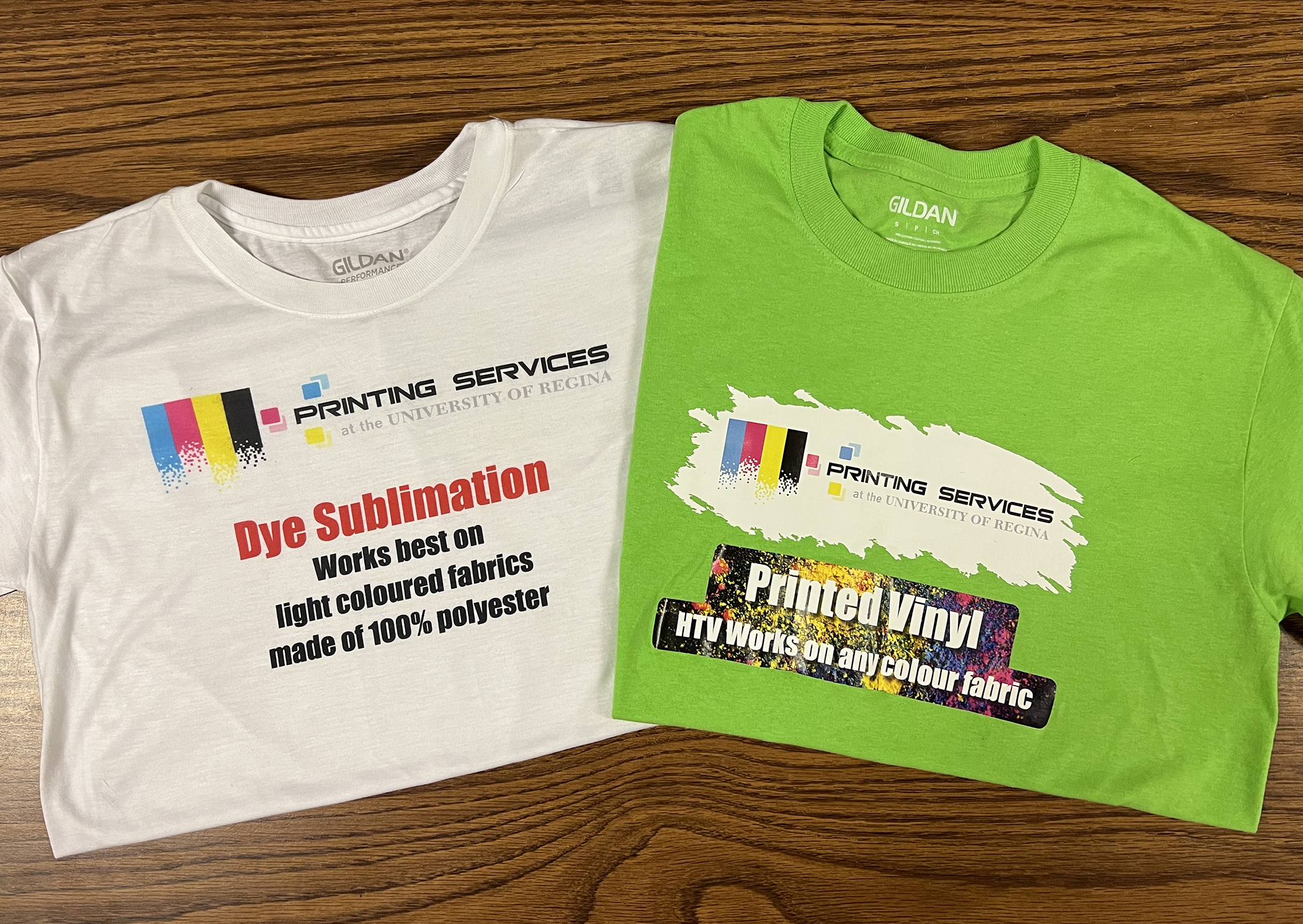
“We purchased the dye-sublimation equipment in order to produce the university name badges that we had been outsourcing,” explains Peace. “We added other merchandise items at that time to better utilize the equipment. We sell mugs, ornaments, tumblers, slates, coasters, T-shirts, hoodies, aprons, and pillowcases.”
While it’s clear the in-plant is using its dye-sub equipment for more than just apparel, Peace notes that thus far, the apparel decorating capabilities it’s opened up are beneficial. “Because dye-sublimation only works well on white or light-colored 100% polyester, we’ve started printing on HTV (heat transfer vinyl), which now allows us to do dark colors and cotton apparel,” she adds. “Since then, we have seen a small growth in garment printing.”
Printing Services is the perfect example of how to make the equipment you already have work with new equipment to explore different opportunities. “Now that we’ve added the printable HTV, I think the garment printing will grow a bit,” Peace states. “We’ve added the printable HTV on our HP316 latex printer because that can be used on dark fabric and any type, so it’s not just limited to 100% polyester. We also do just straight HTV vinyl cutting.”
For Printing Services, there is a very specific niche that adding apparel decorating has helped them fill. “People like the fact that they can come and order one-offs,” says Peace. “It’s convenient for them and more economic for them when they only want a few shirts or one item from the dye-sub merchandise.
“The library orders dark-colored T-shirts for their student staff that just has the wording ‘Library Staff’ on the back. They only order four to six at a time. We just cut these from black HTV. The AV department orders vests for their staff that has their department name on them. This didn’t require any new purchase as it’s utilizing the equipment we already had.”
Peace finishes by pointing out that overall, adding apparel decoration to Printing Services’ offerings has been a good thing. “Adding garment printing and other dye-sub merchandise just helped with the ROI on the equipment because now it’s used for more than just name badges,” she says. “We started doing the HTV because again, we didn’t purchase any equipment for it, but we’ve now expanded our ability to do garment printing on dark and cotton fabrics.”
Pop Culture Retail Success in Convergence
For a completely different perspective, we went to Gotham City Online, a pop-culture manufacturer and retailer based in Austin, Texas. Gotham falls into a variety of categories when it comes to how they define themselves — the website reads, “Our seasoned team powers e-commerce for major pop-culture brands via our proprietary value added technology platform.”
Meet David Topkins, the co-founder and director of licensing. He breaks down that model starting with the history of the brand. “We began as a reseller of pop culture products we purchased from wholesalers. Eventually we began printing images that were public domain or our own designs using Epson F2000 printers and clamshell heat presses,” he explains. “Over the years, we expanded our sales and marketing team to sell more product. When we hit a critical mass of sales, we were able to start obtaining our own pop culture licenses to print in-house.”
But to really look at how the apparel side of the business operates, Topkins points to its clothing brand. “We started [the] Pop Threads brand years ago,” he says. And it all stemmed from the need to expand into new areas. “Prior to that, we mostly printed wall décor and we wanted a new brand to differentiate the product lines.”
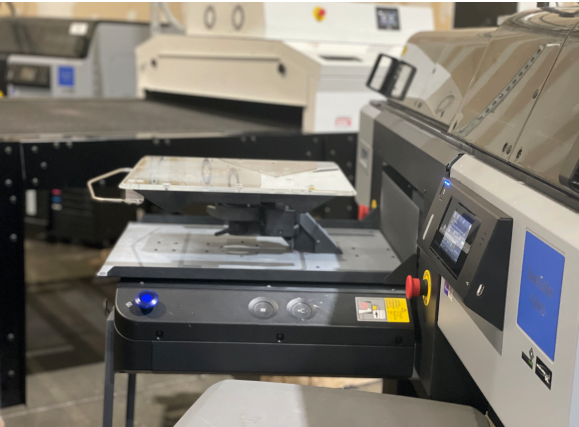
As the business has evolved and changed, so has its needs. Recently, the company made a rather large investment in a fleet of Epson SureColor F2100 and SureColor F3070 direct-to-garment (DTG) printers. “Consumers are always looking for new fashion styles, and we like that Epson continues to evolve their products to help address that demand,” Topkins notes.
He’s specifically keen on the opportunity that DTG technology has to offer. “We pride ourselves in domestic printing,” Topkins says. “Our goal is to have more made-in-the-USA products in the future. We believe DTG technology will be an integral part of our evolution, especially when the need to pre-treat fabrics becomes easier to do and/or hopefully a legacy process eventually!”
The One-Stop Shop Success Story
Thom Loreman is the current owner of Loremans’ Embroidery, Engraving & Screen Printing LLC. If ever there was a business that represented convergence, it’s Loremans’. What began as an operation that ran out of a car trunk now operates a variety of equipment. A short list of what they offer includes screen printing, embroidery, heat transfer, pad printing, wide-format digital printing, and engraving. And of course, that’s just some of it, with things ever evolving.
Loreman states that apparel makes up about 55% of the entire business, but he wants to make sure they can service all customers with varying needs. “We always try to add on to existing customers with extra items — not an upsell, but an education,” he says. “I [once] received a call from a nervous assistant [who had] looked all over the internet for someone to help. He needed a T-shirt printed, a hat embroidered, a lava lamp pad printed, and all items placed in a bag with a cover letter and mailed. [They needed] 1,500 pieces total, [and] he had two to three weeks to do this. I said we could do it all. We kept that customer almost 10 years until they went out of business.”
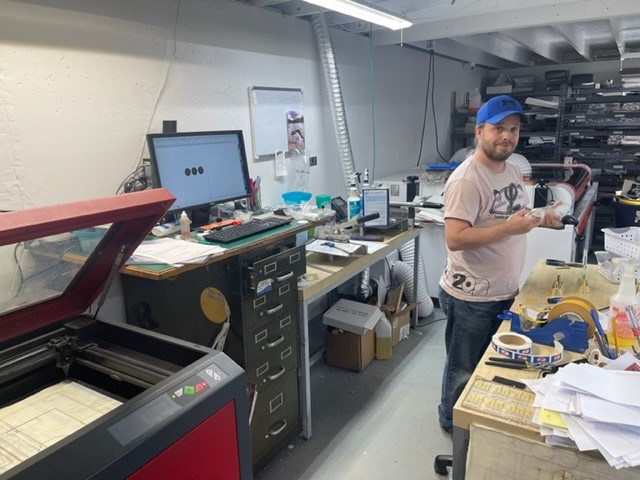
When asked why it’s so important to buy into this convergence method, Thom has one answer: “Being the one to come to, the one-stop shop, is important. Being flexible with [our offering] and almost never saying no makes us different.”
But beyond standing out from the competition, Thom also believes that having such a varied showroom and variety of equipment has not only allowed his business to stay viable through changing times, but also grow. He notes that every step keeps the business moving forward, to stay relevant and stay in the know.
That’s not to say he wants to put competitors out of business — quite the contrary, actually. Thom is of the mindset that convergence helps everyone, and if he can instill that in others, then that’s considered a win in the printing industry. “We are well versed and pretty stable at all aspects of decoration,” he says. “We share a lot of information, but as we grow, we want the industry to be stronger and vibrant.”
When it comes down to it, Loremans’ is just one example of why convergence is a strong business strategy for those in the printing world. It’s not about competition, it’s about growing, succeeding, and helping others. “I would most certainly share good and bad experiences as a mentor, trade partner, and future friend,” he finishes.