
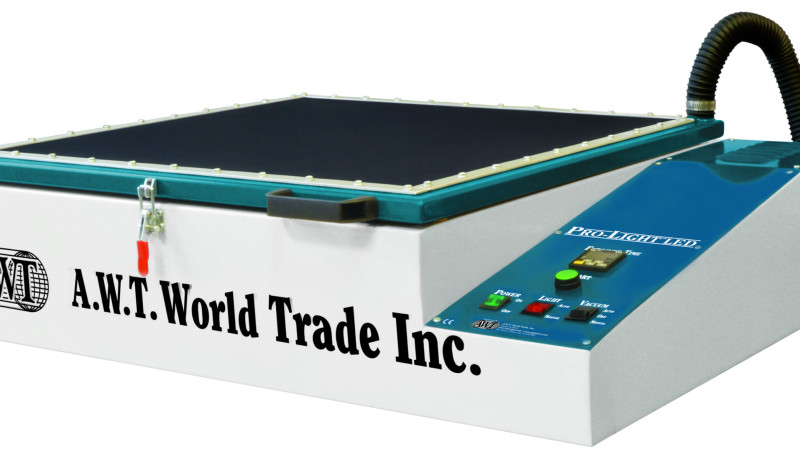
Choosing the Optimal LED Screen Exposing Unit for Your Workshop or Studio
A great way for screen printing startups and smaller shops to reduce costs and gain greater control over production is to bring screen making operations in house. Exposing their own screens frees screen printers from the constraints of dealing with outside vendors, reducing costs and lead times. It also allows them to increase production while maintaining strict control over image quality.
Exposing units have evolved over the past decade as high-efficiency LED lamps have come to dominate the market. While large-scale industrial facilities still tend to favor heavy-duty units with high-output mercury halide lamps, smaller shops have a choice of more economical LED technologies to meet their screen exposing requirements.
LED technology reduces operating costs with lower energy consumption and longer lamp life. LED light degrades minimally with use over time in comparison to other light sources. Instead, LED lamps provide consistent high-quality UV output for longer service times, up to 10 years or more depending on conditions.
Manufacturers have developed a range of LED screen exposing units, using different LED technologies and light sources, allowing printers to achieve accurate exposures while taking advantage of the savings of LED technology.
In choosing an exposing unit for your shop, three important questions arise:
- What kind of emulsion will you be using?
- What kind of artwork will you be exposing?
- What is the volume of your operation?
The answers to these questions can help you determine the optimal exposing unit and light source for your particular application or applications.
Emulsion
Screen printing emulsions cure when exposed to UV light. Photosensitizers in the emulsion respond to the ultraviolet light and bond with the resins in the emulsion, hardening the emulsion on the screen.
The three main types of emulsion used in screen printing are diazo, SBQ, and dual-cure emulsions. Diazo emulsions typically must be manually mixed before use, and may take longer to fully expose. SBQ emulsions require no mixing and cure very quickly when exposed to UV light. Dual-cure emulsions combine characteristics of both diazo and SBQ emulsions and must be mixed, although they generally cure faster than diazo emulsions.
Most of today’s emulsions respond well to LED light sources, and screen printers should be able to obtain satisfactory results with either low-cost LED tubes or higher-output UV LED light sources, depending on the characteristics of the images being exposed, with the most significant variable being exposure time.
Artwork
If the images you print tend to be simple, with large blocks of color and no fine lines, halftones, or very small print, then a light source that has less available UV light will be sufficient for exposure in most cases. For such projects AWT’s (Booth C8715) Pro-Light F/LED units are effective and reliable.
More complex artwork involving fine lines, halftones, small-point fonts, and other artistic subtleties can certainly be satisfactorily exposed with the Pro-Light F/LED, but these projects may require longer exposure times. If you regularly work with such designs, you might want to consider upgrading to a higher-output source of UV light for greater efficiency.
Under such conditions, AWT’s Pro-Light UV LED units deliver professional results, with crisply defined images and even faster exposure times, while still providing significant savings over mercury halide systems.
Volume
A final consideration is the quantity of jobs you are producing. For smaller shops, the slightly longer exposure interval of tube-based LED exposing units may not be a factor, and the cost benefits of LED tube technology remain decisive.
On the other hand, higher-output LED light sources can expose a wider range of artwork — including complex designs — more quickly and accurately. More screens can be exposed per hour for greater volume and efficiency. This in turn boosts overall productivity and offers a different set of economic advantages.
Do You See the Light Yet?
Using LED technology to expose screens presents several advantages, and LED will continue to displace other light sources as the technology is further refined. LED lamps are safe, generate little heat, and are easy to use. They are also economical in comparison with other light sources, with longer lifetimes.
Depending on specific operational parameters and requirements, most screen printers should be able to leverage LED solutions for their operations. Deciding on the optimal exposing unit for your workshop will require consideration of the specific characteristics of your artwork as well as your operational parameters.


