
How to Build a Scalable Business
Quick tips and inside pointers from the Apparelist Live Theatre
What does it take to truly grow and scale your apparel decorating business? Mayn owners in the industry rely on a “hub-and-spoke” business model, where the owner is the central cog of the wheel, and all employees branch out from them. They are the sole decision makers; they are the overseers of every department; they run every faucet of the business.
And that model can work … for a little while. But in order to really push into true growth, growth that will lead to $8, $10, or even $15 million+ in revenue a year, owners cannot adhere to that model for long.
The hub-and -spoke method isn’t scalable, but what is? For so many owners trying to cross that threshold, it can be hard to remodel and adopt a business plan that does accomplish scalable growth.
In order to identify what works, and what doesn’t, we interviewed owners and leaders of three huge decorators while onsite at PRINTING United Expo 2025:
- Brian de Zavala, Screenworks USA
- Rodney MacDonald, USColorworks
- Jaymes Clements, Monster Digital

Each of these businesses earns well past the $10-million mark in revenue. In this real-world case study conversation that happened at the Apparelist Live Theatre, tips and advice can be taken away to apply to any-size apparel decorator looking to scale their business.
A Basic Understanding of Growth Strategies
Your business can’t truly grow if you as the owner don’t understand its current model and identify areas that need to change. It is up to the owner to define such areas as the business mission, values, concrete goals, and structure in order to achieve real growth.
And that means a good hard look at whether it’s currently set up for long-term success. “You're not going into [your business] just trying to be successful for the next quarter or the next year,” de Zavala says. “You want to build a business that's sustainable. You want to build it from the ground up with a strong foundation financially, with a really solid team.”
He adds that the strongest thing Screenworks has ever done is defining its mission, vision, and values. “I can't stress how important that is to establish where your North Star is, so you'd know in what direction you're going,” de Zavala says.
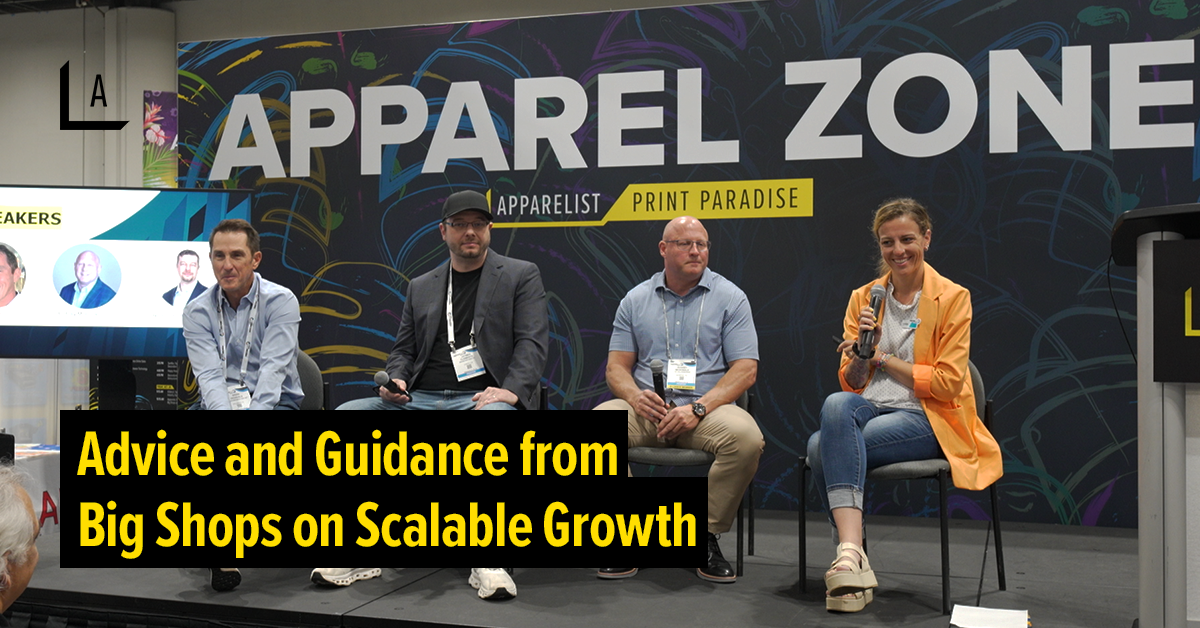
Click the above image to watch the full video presentation.
Clements adds that a huge focus that has helped Monster grow is its emphasis on being a partner. “Our focus is actually to grow with our customers, to add value to them,” he explains. “How do I help you grow, what value can I add to your business? And how do we do it in a mutually beneficial way?”
MacDonald emphasizes that an important value to adhere to in order to achieve growth is to not be the cheapest. “We literally tell our customers we're not the cheapest,” he says. Instead, they focus on the why and what benefit charging a higher price brings.
“It's not about price warring,” Clements agrees. “It's about building long-term, sustainable relationships, being meaningful to your partners.” Aim to be your customers’ best printing partner, not their cheapest.
All three sources emphasize that a lot of this growth success also comes from building strong internal culture. If you don’t have a clearly defined mission, with actionable goals and real targets, your employees won’t buy in. “A wise person once told me that culture eats strategy for lunch,” de Zavala notes. “It's all about establishing that … that everyone's kind of on the same page and working for the same common goal.”
Having standard operating procedures (SOPs), a solid training program, and readily-available data sets helps. “Focus on consistency and systems ... one of the things that we always worked on to maybe set ourselves apart was having systems in place that required consistency, that give you no other option but to be consistent,” MacDonald says of USColorworks. “If you have something in your business that only one person knows, that's preventing you from growth.”
What You Can Learn at Expo
If you want to hear the full conversation, Apparelist provided a recording of the session (see above). But for those that want to listen to every valuable session in the Apparelist Live Theatre, make sure you attend PRINTING United Expo 2026, taking place this year Sept. 23-25 in Las Vegas.
As an attendee, you will get exclusive access to Apparelist Live Theatre presentations, general session educations, and the full Expo experience.
10 Rules for Scalable Growth
- Define your North Star - Write down your mission, vision, and values. Make sure every decision and hire supports those.
- Compete on value, not price - Don’t try to be the cheapest. Win on quality, reliability, and service instead.
- Think in stair steps - Picture growth as steps, not a rocket. Know your next step (not three steps ahead) and what it requires in:
- People
- Equipment
- Technology
- Systematize before you scale - Turn “tribal knowledge” into SOPs and checklists. Make quality and customer requirements automatic, not dependent on one person.
- Build a culture that actually uses the systems - Hire and reward people who follow process and own outcomes. Talk about your values regularly so they become habits, not wall art.
- Watch cash and profit more than revenue – Track:
- Bookings (orders coming in)
- Cash position (daily/weekly)
Prioritize healthy margins over big top‑line numbers.
- Guard against risky growth - Limit any single customer to ~20% of revenue where possible. Be careful with long terms (e.g., aim for 10-30 days, not 60-90).
- Say “yes” strategically - Say yes when: It fits your capabilities and values; you can deliver consistently. Say no (or price accordingly) when: It will overload your team; it forces you into low‑margin, high‑stress work.
- Use AI and tools to “punch above your weight” - Start with quoting, customer service, artwork handling, and shipping analysis. Use tools to free people up for higher‑value work, not just to “cut cost.”
- Check your ego, clarify your why - Decide what you’re really optimizing for: Lifestyle? Legacy? Sale? Size? Grow in a way that doesn’t collapse your culture, your family life, or your cash.