
Essential OSHA Compliance Insights for Apparel Decorators

Expert advice to help shops stay safe, compliant, and penalty-free
Typically, “Top 10” lists are something to be excited about — maybe your print business is being recognized as one of the best places to work, or you're ranking high in revenue. But there’s one list apparel decorators don’t want to mess with: The Top 10 OSHA Violations in the Printing Industry.
Getting familiar with this list can not only serve as a resource to improve your print shop’s safety and procedures, but it can also save you thousands in penalties.
Apparelist sat down with Gary Jones, vice president of environmental, health, and safety affairs for PRINTING United Alliance, to talk about how apparel decorating shops can stay OSHA-compliant, from understanding OSHA to safety strategies, training, and more.
Understanding OSHA for Apparel Decoration
While it’s smart to understand OSHA violations for the printing industry at large, there are some violations Jones tends to see more often in apparel printing businesses, and the ramifications for a violation can be detrimental to a shop.
“The consequences can be expensive from a penalty perspective, and we've worked with some apparel decorators who have received citations in a couple of different areas,” Jones shares. “Machine guarding is one of them. Methylene chloride is another one.”
Machine Safety
As it relates to machine safety, employees are protected under two regulations: machine guarding and lockout/tagout.
“When the equipment is doing its intended function, it's printing and it's indexing, for example, the standard that applies is machine guarding,” Jones advises. “Basically, employees have to be protected from injury associated with moving parts, especially if they're in a hazardous area. Once you stop that piece of equipment, and you have to lift a guard, bypass a guard, or put yourself into a hazardous situation, like stepping between the platens, then the lockout/tagout standard applies.”
Lockout/tagout requires the equipment’s power to be turned off entirely, so it cannot be started back up again while someone is performing servicing or maintenance, for example.
However, there’s an exception in the lockout/tagout standard, and apparel decorators “make a living” in the exception, Jones says. “The exception says, for activities that are routine, repetitive, and integral to the production process, you can perform them without having to turn all the power off. But — and this is a huge but with a capital B — you have to have a form of alternative protection to prevent unexpected energization.”
The question then becomes: What's the safety system or procedure that prevents the motion from occurring during “makeready” (AKA setup) while still allowing the machine to have power? Suppose a press operator needs to get between platens on a screen-printing press to change a screen or get to a flood bar, for example. In that case, they need to enact some type of safety, whether it’s a safety cable, bar, or stop button, to prevent the machine from indexing and starting up while the operator is in a position where they can be injured if the press moves.
OSHA Compliance Checklist
Not sure where to start? These are five OSHA essentials apparel decorators can review. A quick check can help you avoid the most frequently cited violations in the industry.
✔ Chemical Inventory Updated
Everything used in production appears in a documented list.
✔ SDS's Are Handy
Safety data sheets are organized and easily accessible to all employees.
✔ Hazard Training Completed
Your team has documented training on shop hazards.
✔ Written Programs Ready
Includes HazCom standards, lockout/tagout, emergency plans, and equipment safety procedures.
✔ Containers Clearly Labeled
Every bottle or container (including secondary ones) must have proper identification and hazard info. No unlabeled squirt bottles.
Shops also need to stop using the word “setup” and replace it with "makeready," as calling it “setup” immediately requires the equipment to be completely deenergized and locked out. The industry has a letter of interpretation from OSHA that allows power to the equipment during makeready as long as the employee is protected from unexpected energization.
Methylene Chloride
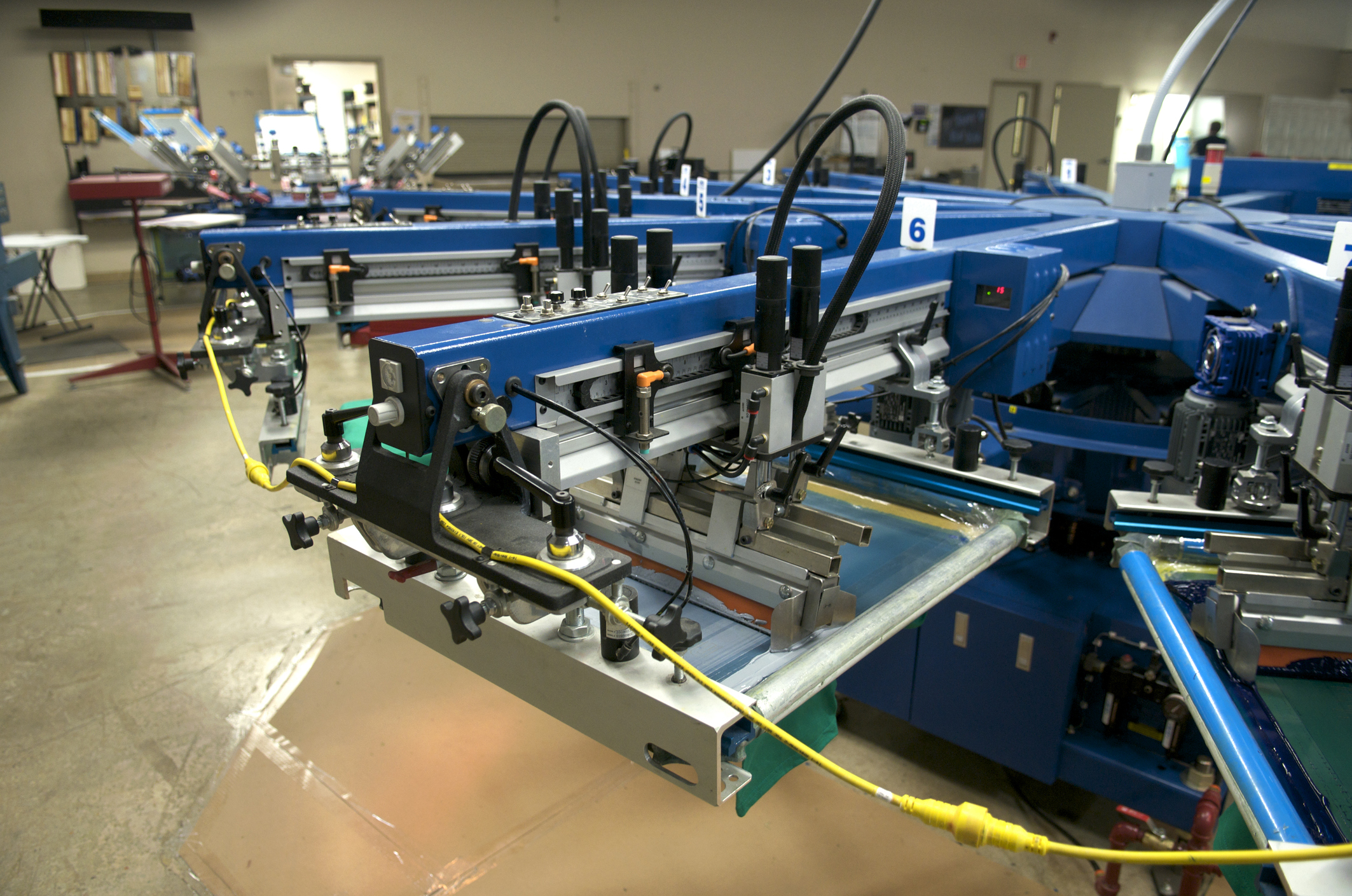
On the topic of methylene chloride, it’s found in two instances in printing: a product called “blanket fix” in commercial printing and as a “spot remover” in apparel decoration. In apparel decoration, the spotting fluid removes unwanted ink from fabric.
“The problem is methylene chloride is considered to be a potential human carcinogen by OSHA,” Jones says. “So, as a result of that designation, they set up regulations many years ago, but if you're using methylene chloride, you actually have to do exposure testing, exposure monitoring of your employees who are using methylene chloride. There's no ifs, ands, or buts.”
While exposure testing is required, Jones says most apparel decorators aren’t even aware they have to perform it.
“It actually rose to No. 11 on the most commonly cited [OSHA violation list] in the 2024 fiscal year. I just looked at fiscal year 2025 stats — it dropped down, but it's still being cited,” he adds. “So methylene chloride is a chemical that they need to be aware of, and about 95% of all spot removers contain methylene chloride.”
Right now, if apparel decorators don’t have any documentation that shows exposure monitoring in their shops, Jones says they’ll pay a penalty. Currently, the maximum penalty for a first-time offender can be as high as $16,500. The Alliance has worked with shops that have received penalties for this violation in the $10,000-$11,000 range.
“The penalty structure is such that every year, OSHA's penalties go up based on the consumer price index,” Jones says. “I'm hoping, but it's not a priority, this new Congress would roll that back, but there was a law passed in 2015 that requires OSHA, Department of Labor, and other agencies to keep pace with inflation, so they increase their penalties.”
One thing to note: Penalties are proposed, meaning they're not set in stone unless the business doesn’t respond within the necessary window. Shops can work with OSHA to reduce penalties based on employee size and good faith commitments. If a shop isn’t cooperative, Jones says OSHA “can throw the book at them,” with the maximum $16,500 penalty. If OSHA finds the shop to be willful or repeat, OSHA will impose a much higher penalty.
“When you get a citation, basically you have 15 working days,” he adds. “You have to do something. If you don't do anything within those 15 working days, OSHA assumes that citation is acceptable, and you're going to pay the fine and do whatever they say that’s in there.”
While there are some alternatives to methylene chloride, Jones says effectiveness is still up for debate. Layered on top of that, the EPA banned the use of methylene chloride for most applications altogether, which is set to be enforced in April 2026. There’s potential it will be reconsidered, as the EPA plans to reopen the assessment.
HazCom
And landing at the No. 1 most cited violation is OSHA’s Hazard Communication Standard. With it come five key requirements. Each shop needs:
- Documented inventory of all the chemicals used
- Safety data sheets (SDS) for all those same chemicals, readily accessible
- Employee training on all hazards present in the shop
- A written program detailing how the shop will meet HazCom requirements, including evaluation, information, and implementation
- Proper labeling on all containers, including secondary containers
“A lot of times [apparel decorators] like to use squirt bottles, and they'll put chemicals in a squirt bottle and not put a label on it,” Jones shares. “'But everybody knows it's Chemical A, right? Because that's what we put in the squirt bottle.' Well, that's not good enough for OSHA. You need to have the product identifier, and then words, pictures, or symbols, or something indicating the hazard associated with it.”
Jones adds that the most common violation he sees under HazCom is secondary containers not having a label.
Fire Exits and Extinguishers
And one potentially overlooked area shops should consider is fire-related violations. It’s not as simple as having a fire extinguisher in case of emergencies and calling it good.
In addition to blocking emergency exits and access to fire extinguishers, Jones says many print shops also overlook fire extinguisher training required for employees expected to use one.
If OSHA performs an inspection and asks an employee if they would use a fire extinguisher during a fire, and the employee responds “yes,” and there are no training records for that employee, that’s a violation. A shop can opt to designate certain employees to use a fire extinguisher, but it requires each person to complete annual training.
An alternative: No one uses a fire extinguisher, and everyone must evacuate and meet at a rally point. If a shop has more than 10 employees, it must have a written evacuation plan as part of its overall emergency action plan. If under 10, it must be communicated verbally, Jones explains.
“Fires can happen, and they do happen,” he says. “You need to have immediate egress access to your exits. You need to make sure your exits are properly illuminated. You need to make sure they’re properly marked with exit signs.”

Documentation and Recordkeeping
If OSHA comes knocking, documentation of safety training, programs, audits, and the like can save a print shop.
“If it isn't documented, it didn't happen,” Jones stresses. “And unfortunately, OSHA’s approach is that you're guilty until proven innocent. ... The way you prove your innocence is through documentation. So, documenting all of your assessments, programs, policies, safe work practices, compliance with OSHA requirements, and training is critically important because you can now prove that you did it.”
Some OSHA requirements are annual, like fire extinguisher training and lockout/tagout assessments, while others only require one-time training, like HazCom, unless a new chemical or hazard is introduced or an employee changes jobs.
As a general rule of thumb, you need names, dates, and subject matter for documentation. Within subject matter, include an outline of topics covered.
Stay Updated and Partner with PRINTING United Alliance
Keeping up with OSHA standards can be tough — not only timewise, but it can be hard to parse through the safety jargon. Being a PRINTING United Alliance member gives you access to subject matter experts — Gary Jones and Sara Osorio — the latest reports, and the information you need to keep your shop safe and avoid pricey penalties.
From annual webinars and exclusive member-only articles focused on OSHA, the Alliance offers plenty of free resources for members looking to succeed in this arena.
“We have checklists; we have written program templates; we have posters; we have sample policies that they can use, that they can just take and modify for their operation,” Jones shares.
Currently, the Alliance is working on a “soup to nuts” toolkit on how printing companies can manage an OSHA inspection. It walks them through the anatomy of an inspection, what they should and shouldn’t do, how to document it, questions to ask, their rights under an inspection, and more.
While the Top 10 OSHA Violations in the Printing Industry isn’t a glamorous list, it’s one to pay attention to for avoiding penalties and keeping employees safe on the production floor. Keep a lookout for the updated 2025 list coming later this year.