
Artmeetschaos: Screen-Printed Garments Complement High-End Denim Collections
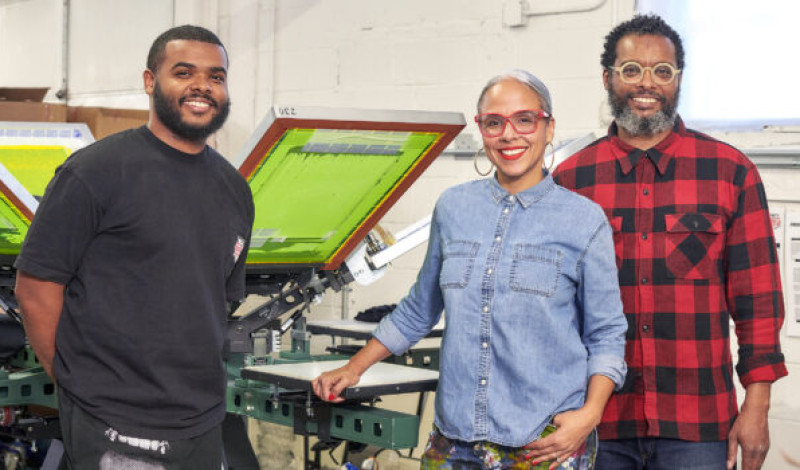
Pictured above (L to R): Joaquin, Jahayra, and Donwan Harrell.
Donwan Harrell knows denim. His unconventional styling has achieved celebrity status among garment manufacturers as well as celebrities, including Brad Pitt and Questlove, who wear his designs.
In 2018, Harrell founded Artmeetschaos, a high-end denim line for men featuring complementary T-shirts and hoodies. His collections are sold in upscale boutiques nationwide and on the company’s e-commerce storefront.
Harrell and his wife Jahayra previously outsourced all of the company’s garment manufacturing and printing overseas. But when minimum order quantities saddled the business with excess inventory, they decided to bring screen-printing operations in-house.
“Manually-made clothing is very appealing to our customers in the denim market, and they’re willing to pay a premium for it,” says Jahayra. “Our T-shirts retail from $85 to $120 and our jeans are $300, so it wasn’t profitable for us to hold leftover stock, especially because we’re a small business.”
The couple also wanted more control over the look and character of the garments’ graphics. Printing in-house gave them the flexibility to carry graphic designs over from one season to another with images that could be applied to the company’s cotton jeans, T-shirts, and hooded sweatshirts.
Supply chain issues cemented the duo’s decision to start their own screen-printing shop.
Harrell Print Company Supports Brand Exclusivity of Artmeetschaos
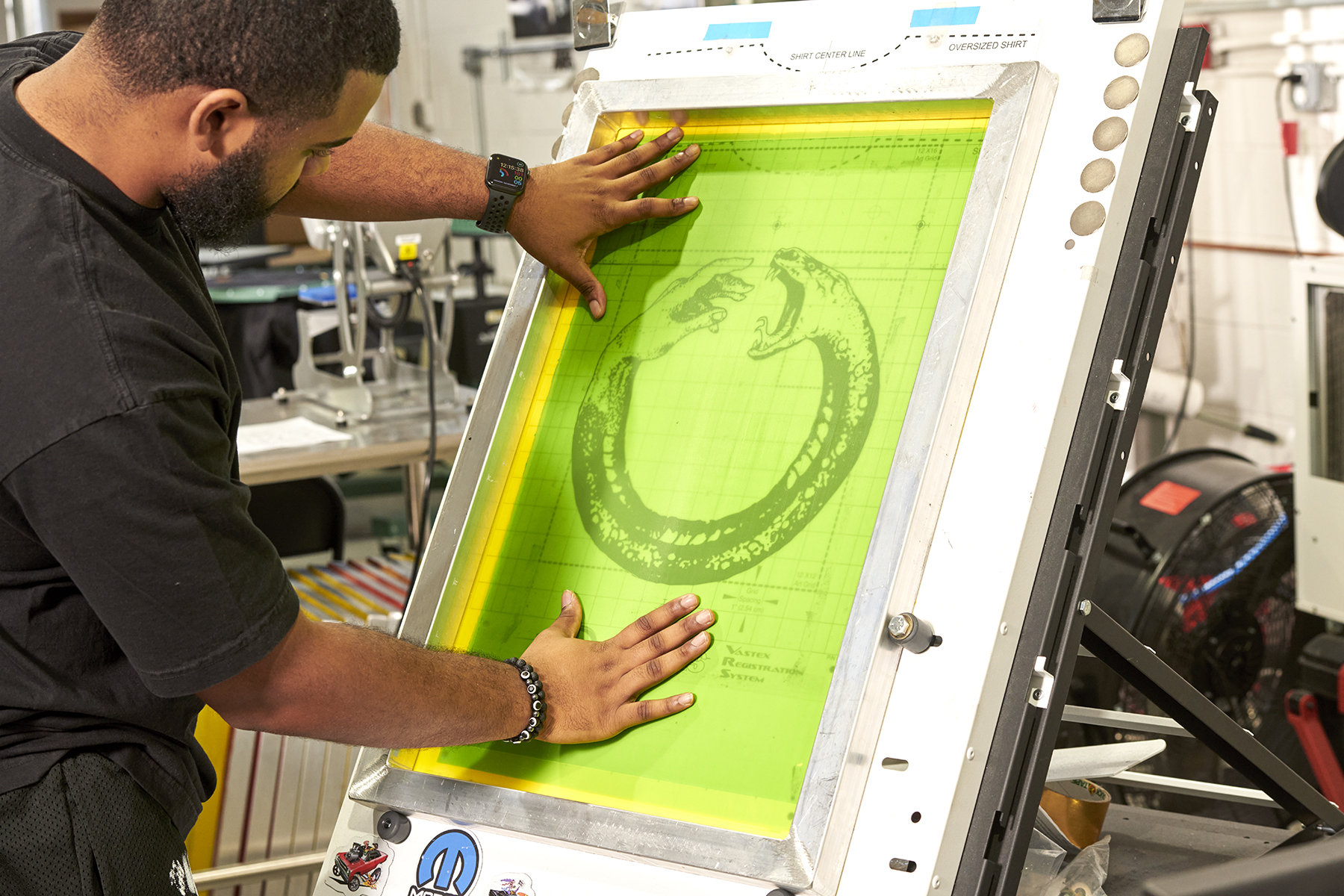
Joaquin Harrell examines a screen. Credit: Vastex/Artmeetschaos | Credit: Vastex/Artmeetschaos
Harrell Print Company was established to screen print the Artmeetschaos garments previously outsourced.
It led off when Donwan and his son, Joaquin, attended a workshop at Vastex International to learn the fundamentals of screen printing, after which he outfitted the shop with a press, screen coater, pin registration system, drying cabinet, exposing unit, flash cure unit, and infrared conveyor dryer from the company.
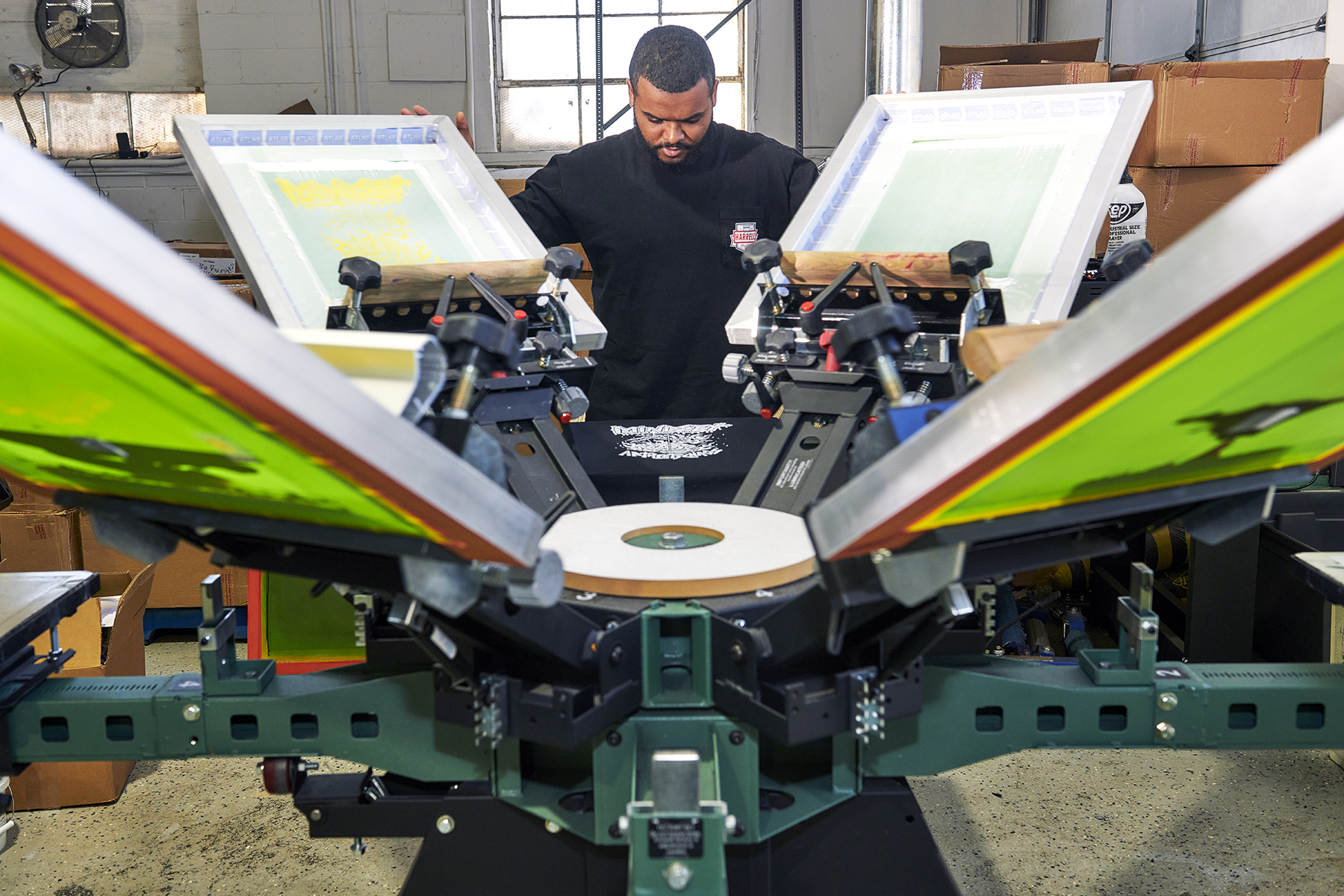
He purchased a V-2000HD four-station/six-color press along with T-shirt platens, sleeve and leg platens, and subsequently increased the number of colors (print heads) to eight. “When generating art that has eight to 12 colors, I previously had to supplement or consolidate colors on the six-color press and sometimes lost the integrity of the original graphic art,” he explains.
Jahayra adds, “We’re more concerned with precision and quality than how many shirts we can print per hour.” The intricate artwork the team works with requires stable equipment for repeatable results.
“We’re using very high mesh counts — 230 to 315 — to accommodate the fine details of some of the art, so stability is everything,” Donwan explains. “When we line up the screens on press and print T-shirt after T-shirt, we can’t have any movement of the frames. And when we swing the heads of the machine around and bring them down on the T-shirt, they can’t move.”
The shop’s manual screen coater allows uniform coating of emulsions onto 23×31” and 20×29” screens. Coated screens are dried in a drying cabinet, with adjustable forced heat that dries emulsions in as little as 20 minutes.
To ensure artwork is aligned precisely, Donwan employs Vastex’s pin registration system that registers screens to one another before they are exposed using the shop’s LED E200 screen exposing unit. Pre-registered screens can then be clamped on press in register in seconds.
During printing, a flash cure unit cures the underbase and flashes garments after every two colors. Donwan automatically rotates the head of the unit into position using a foot pedal and rotates it away from the garment after a preset eight-second dwell time.
“Some flashes take up the space of a pallet, so you have fewer positions to work with,” he says. “The AutoFlash feature swings away from the pallet, which allows all four pallets to be functional.”
Finished garments are placed on a conveyor dryer with a 30”-wide belt and two 24”-wide infrared heaters. Donwan uses high-curing plastisol ink, which requires him to set the temperature to 680 F and slow the belt speed for an output of about 100 garments per hour, adjusting the heater’s height to accommodate T-shirts, hoodies, or denim.
After garments exit the dryer, labels are sewn on the inside and hangtags are attached to the outside with safety pins. Items are then cleaned with a lint roller, folded, and individually bagged and sealed.
Credit: Vastex/Artmeetschaos
Commercial Order Fulfillment on the Horizon
Since bringing screen printing in-house, the Artmeetschaos brand has experienced dramatic growth. “Currently our business is about 90% denim, including screen-printed jeans, and about 10% tops,” notes Jahayra. “We’re aiming to increase our revenue from screen-printed shirts to 50%, so our business will be 50% denim and 50% tops.”
The Harrells also plan to grow the business by fulfilling customized orders for other clothing brands. Recently, the couple entered into a nondisclosure agreement with a large company in need of screen-printing services.
To accommodate larger orders, they will need to invest in screen printing capacity. “Everything we’ve purchased from Vastex has been a great fit for where we are today, but we’re beginning to realize that we need to double the size of all our equipment to accommodate the direction we’re going in,” Donwan says.


