
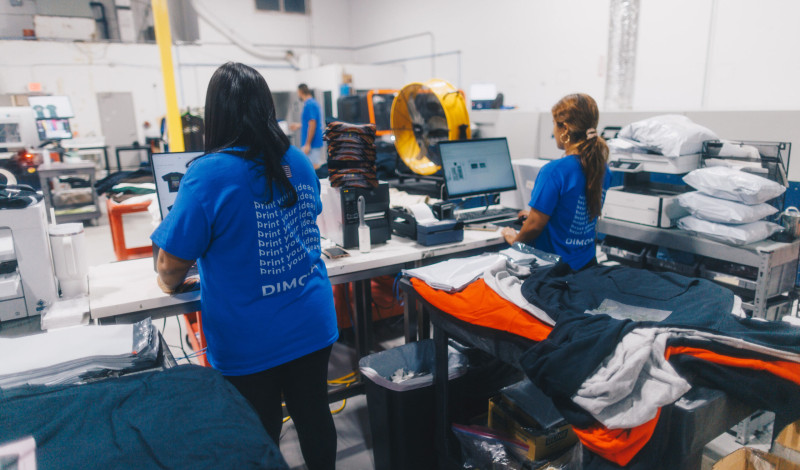
Print-on-Demand, Redefined
The modern POD model is more than a printing method. Experts debunk the myths and misconceptions and reveal how decorators can thrive with it.
When you really look at it, print-on-demand (POD) has been around in the industry for quite a while. It’s gone by several different names (think web-to-print) and has had a lot of different definitions attached to it. The apparel decorating community in particular has associated POD with everything from one-off prints to custom orders.
But the reality is, today’s POD landscape is so much more than just printing a custom T-shirt. The niche went through a massive explosion during the COVID-19 pandemic, and since then, it’s experienced almost astronomical growth. With that growth, however, has come some misconceptions.
What truly is print-on-demand? How are decorators defining this type of print job? And what are some common myths that are preventing others from making the leap into this lucrative market? A few POD experts weigh in.
But What is Print-on-Demand?
When you hear the term “print-on-demand,” the knee-jerk reaction might be to define it as printing a custom, one-off piece of apparel. But by today’s standards, that couldn’t be farther from the truth. While there are a lot of ways to define POD printing, confining it to one-off isn’t accurate.
“I describe POD as a workflow rather than a print method,” says Igor Blumberg, CEO of Dimona Tee USA LLC. “[Look at it as] manufacturing only after an order is confirmed, then using a fully digital system that links the online storefront, production floor, and fulfillment in real time.”
John Hamilton, director at Sub Dimension, agrees. “POD is no longer just another print process; it’s a modern business model,” he feels. “It empowers brands to be faster, more sustainable, and more connected to their customers.”
Hamilton goes on to explain why associating POD with quantities of one misses the mark entirely. “While POD does excel at low-volume orders, its true strength lies in its flexibility and responsiveness,” he says. It enables three major opportunities for printers beyond the one-off order opportunity:
- Rapid product testing
- Short runs with low overhead
- Reactive production aligned with real-time demand
“It’s not about quantity; it’s about production that reacts to demand, not the other way round,” Hamilton adds.
Blumberg uses a real scenario that could happen at an apparel decoration business to demonstrate this concept. He notes that Dimona can produce 5,000 polos, each one embroidered with an individual employee name, which can then be delivered to their home addresses. This is the perfect example of a fully on-demand order that is not even close to a quantity of one.
Another common misconception is that POD is only applicable to items like apparel or promotional products. Hamilton debunks that myth. “If the production process can be [made digital] and automated, POD can be applied, regardless of product category,” he states. For example, Hamilton notes that it’s widely used in:
- Print-on-paper (books, stationery, planners, greeting cards)
- Large/wide-format printing (wall art, posters, banners)
- Homeware (cushions, throws, curtains)
- Packaging (custom boxes, sleeves, labels)
Even within the apparel industry specifically, there are “myths” that decorators are only limited to certain technologies like heat transfers and direct-to-garment (DTG) printing to be successful with POD. Blumberg notes that Dimona is seeing an increase in embroidery on demand. “Every automation improvement — from file processing to fulfillment — directly impacts the bottom line,” he expands. “The key is eliminating manual touchpoints while maintaining quality standards.”
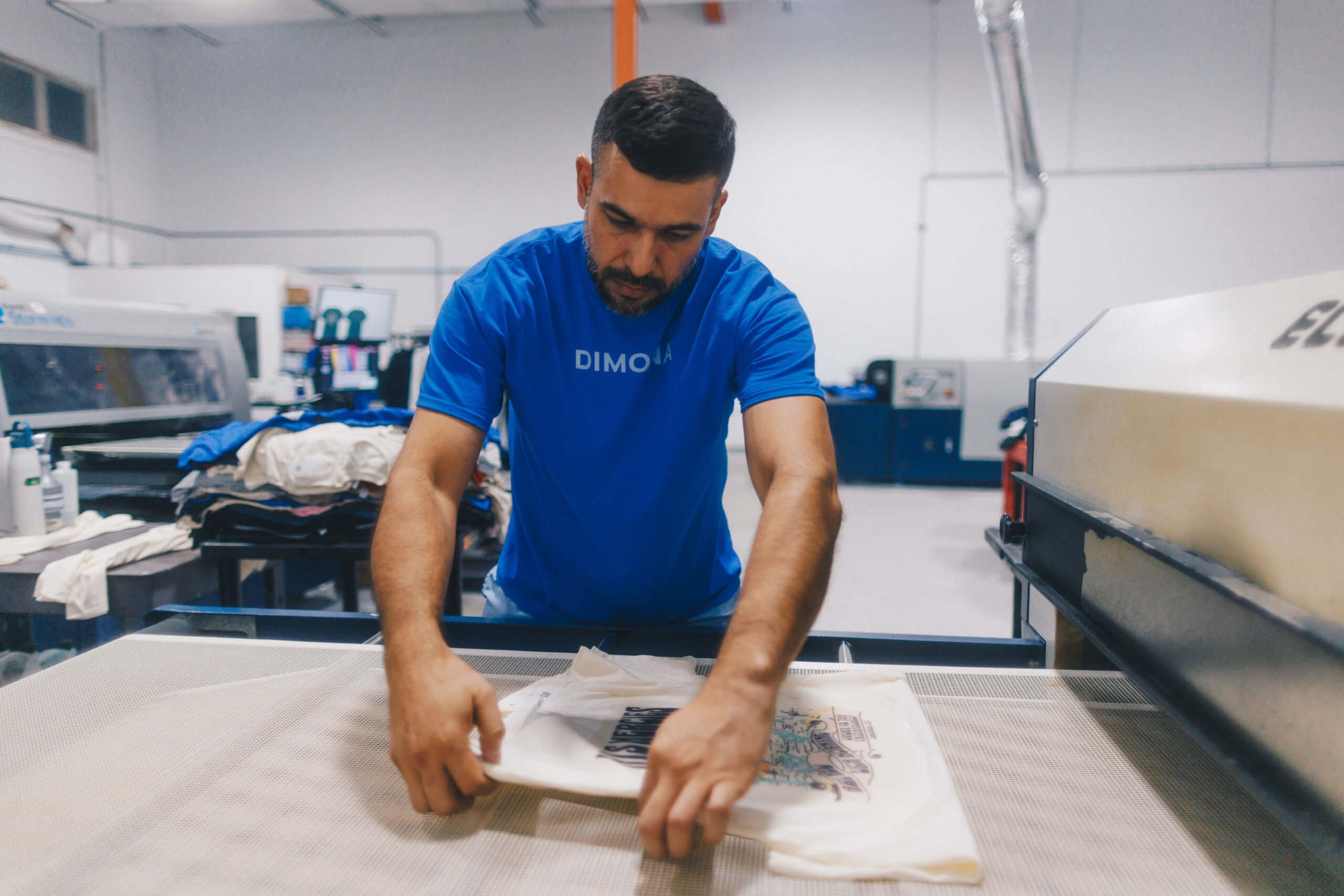
Credit: Dimona Tee USA LLC
POD Challenges
All that being said, there are still some challenges and common misconceptions that plague printers working within the POD space. Whether real or perceived, these challenges can be a stumbling point.
“In POD, profit lives in seconds per order, so every extra touchpoint hurts,” Blumberg explains. So if a shop isn’t automated, if they aren’t tracking every touchpoint and lowering that number, this becomes a real challenge that will prevent POD profit.
Of course, evaluating automation and bringing in new tools to implement it is an investment, another area that Hamilton notes can serve as a pain point. And that’s not the only investment that can make POD printers nervous. “POD requires new investment in software, automation, and training,” he says. “It’s not just about installing a new printer — it’s a business model shift.”
For any decorator that is afraid of change, this is a problem. Hamilton points out that not only is this a business model shift, but it’s also a mindset shift. “Traditional printers are used to batching and bulk runs,” he points out. “POD requires automated workflows, flexible SKUs, and rapid order processing. Those who embrace the shift gain long-term resilience and market responsiveness.”
Blumberg adds that another stumbling block can be the misconception that POD “can’t scale.” However, he points to platforms like Printify/Printful and Amazon as examples that prove that theory wrong.
Blumberg also notes the topic of margins as an area where printers may be afraid to move forward in POD. “[One persistent myth is that] margins are ‘tiny’ — in truth, margin shifts from manufacturing to inventory carry, eliminating dead stock that frees up cash flow,” he says.
As POD continues to grow and offer larger profit share, apparel decorators would be wise to explore it and see for themselves that many of the myths quite simply aren’t true. “Success will only come when treating POD as a fully integrated system, not a bolt-on service,” Hamilton believes. “When approached strategically, it becomes a powerful tool for growth and innovation — not just fulfilment.”


