
Making a Strategic Shift: Transitioning from In-House to Outsourcing
A practical roadmap to build successful contract decorating partnerships

As a leader in the company, you understand that anticipating the next phase of growth is crucial, not just for the business’s overall trajectory, but for individual service offerings as well. To do this successfully, it requires evaluating operations on a consistent basis and identifying opportunities to maximize efficiency and profitability at every turn.
As your company grows, understanding how to better leverage your time will allow you to be the most effective for your team and your clients. You can either be overrun by daily tasks or you can be intentional with how your company operates.
One increasingly common strategy involves transitioning specific decoration services from in-house production to partnerships with other shops. While this shift might seem daunting, it represents a calculated opportunity to streamline operations and focus on core strengths while maintaining high standards. As someone who has successfully navigated this transition, from running full production in-house to sourcing all orders to specialized partners, I can attest to the positive impact this decision can have on your business's growth and sustainability. However, success hinges on careful evaluation of both advantages and challenges, coupled with a clear vision of your company's future at specific milestones.
This evolution in business strategy particularly resonates with established decorators who have traditionally offered multiple services — screen printing, digital printing, and embroidery, for example — but now seek to optimize their operations by contracting out specific services to vetted partners. The insights shared in this article combine industry best practices with real-world experience, offering a practical roadmap for shops considering a similar transition.
Evaluating Current Operations
Before initiating the transition to contract decorating, conduct a thorough assessment of your current operations. This evaluation should encompass more than just financial metrics: It should include an honest analysis of equipment maintenance costs, staffing challenges, and production bottlenecks. Consider tracking metrics such as machine downtime, order completion rates, and customer satisfaction specific to your services over several months.
Understanding your true costs helps identify whether transitioning to contract work makes financial sense. Beyond direct costs such as inks, thread, or screens, factor in indirect expenses such as electricity, employee benefits, training time, and the opportunity cost of floor space dedicated to equipment. This comprehensive analysis often reveals hidden costs that make contract decoration more attractive than initially assumed.

When I made the decision to transition production, one of the biggest pros for me was no longer worrying about high volume and the Catch-22 of “I need more staff to handle more orders, I need more orders to support more staff” cycle. Instead, I put my focus and energy on better serving my clients on how to build and grow their merch brand from ideation to deliverables.
Building Strategic Partnerships
Finding the right contract decorator, or what I like to call source partner, requires a methodical approach focused on compatibility and shared business values. Begin by researching potential partners through industry networks, trade shows, and referrals from non-competing decorators in different markets.
Look for contractors who not only possess technical expertise but also demonstrate reliability in meeting deadlines and maintaining communication standards.
I qualify potential source partners based on what I call the 3 C’s:
⇒ Communication
⇒ Consistent quality
⇒ Competence
Although we like to call it “contract printing,” there is rarely ever a contract in place. This is ok, as long as you establish clear expectations and requirements early in the partnership development process. This includes discussing production capabilities, turnaround times, quality standards, and pricing structures.
Consider starting with a trial period or small batch of orders to evaluate the working relationship before committing to larger volumes. Geographic proximity, while beneficial, shouldn't overshadow other
crucial factors like consistent quality and reliability.
The most successful partnerships often develop when both parties maintain transparent communication about their capabilities and limitations. Create a system and document all agreements, including pricing structures, rush order policies, and quality control procedures, while remaining flexible enough to adjust as the relationship evolves.
Your industry expertise becomes a valuable asset in these partnerships. Understanding both sides of the sourcing relationship means you can provide source partners with exactly what they need, such as POs, print-ready artwork, and detailed specs.
Managing the Transition Period

Implementing a phased approach to the transition helps minimize disruption to your business operations and customer relationships. Start by identifying your most reliable clients for initial contract orders while maintaining in-house capacity. This allows you to fine-tune processes and address any issues before scaling up the new arrangement.
Communication plays a vital role during this phase. Develop a clear internal communication strategy to help your team understand and support the transition. This includes training customer service staff on new procedures and ensuring sales teams can effectively explain any changes in turnaround times or pricing structures. Consider creating detailed standard operating procedures (SOPs) for handling contract orders, including artwork requirements, order submission processes, and quality control checkpoints.
There are two routes you can take when making this transition for your customers:
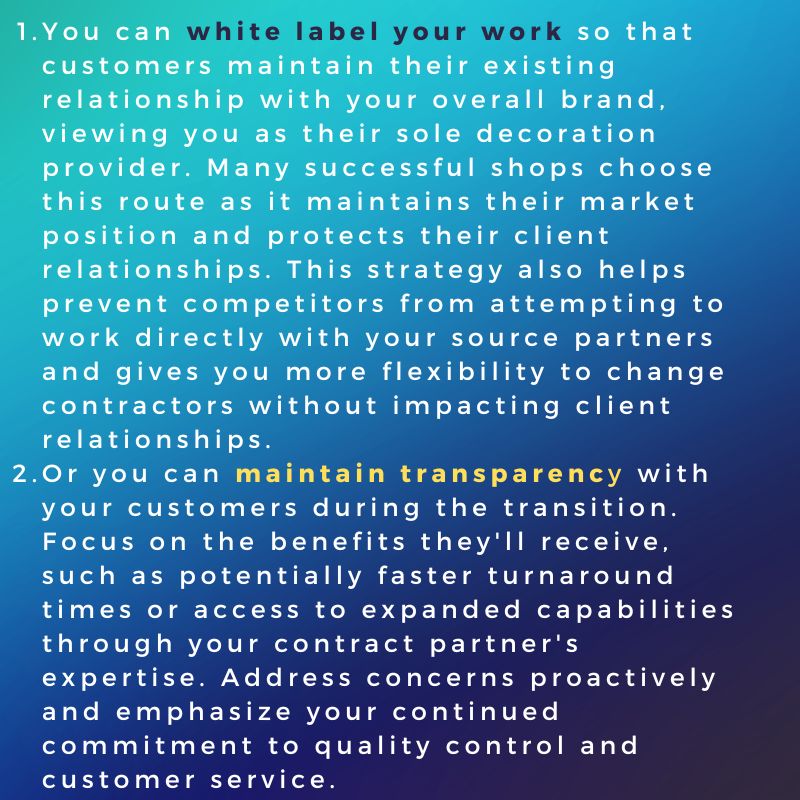
Building strong client relationships means earning their trust in your ability to deliver exceptional results, not just in your production capabilities. When customers deeply value their relationship with you, the physical location of production becomes secondary to the quality, service, and expertise you provide. This foundation of trust allows you to focus on what matters most: being their trusted advisor and ensuring their decoration needs are met consistently, regardless of how those solutions are delivered.
Optimizing Your New Business Model
Once the initial transition is underway, refine your new operational framework. Develop systems for efficient order processing and tracking between your facility and the source partner. This might include implementing a new tech stack that streamlines communication and reduces the potential for errors in order specifications.
Consider reinvesting resources freed up by the transition into strengthening other aspects of your business. This could mean expanding your sales team, enhancing your digital presence, or upgrading equipment in your remaining core services. The goal is to leverage the efficiency gained through outsourcing to grow your business strategically.

It's crucial to recognize that transitioning to a sourcing model isn't simply a modification of your existing business — it's essentially launching a new company with its own unique operational requirements, workflows, and success metrics. While you maintain your client relationships and industry expertise, everything from your internal processes to your profit structures needs to be rebuilt. This mindset shifts from "we're just outsourcing some work" to "we're creating another revenue model" is often the difference between shops that struggle with the transition and those that thrive.
Ultimately, your goal should always be to strategically position your business for long-term success in an industry that never sleeps.