
How Does AI Influence and Aid in the Workflow and Production Space?
Implementing enterprise AI within an apparel decorating business can increase efficiency and productivity through data collection
I often get asked how I collect data inside my screen print shop. Employees find it difficult; it takes a lot of training, and there is a high potential for errors. It is a tedious task: One option is to collect manually using spreadsheets. But there are other options available today, namely enterprise AI.
AI to Create SOPs
One is called ScribeAI, a tool used to create standard operating procedures (SOPs). The SOPs themselves don't just have to be digital SOPs, like artwork management or filing procedures; they can also be manufacturing procedures. While technically not data collection, inside ScribeAI, the AI helps you write the SOP.
This can be a tedious task. I recently made a training artwork for a one-color and two-color document with an underbase or fade separation. The ScribeAI SOP demonstrates step-by-step and teaches Photoshop separation (Image 1).

You can copy and paste a specific final step to someone or link in videos. ScribeAI watches as you use your computer, then documents each step. ScribeAI also has a community of procedures created by other users available.
I created a production SOP about proper storing and handling pigments in a water-based system. I asked the AI to develop the SOP for pigment storage and handling. I defined the areas I wanted the SOP to cover, like prerequisites, scope, and definitions. Then, the AI created an SOP.
It wasn't able to hit the exact specifics I needed for my shop, but it covered things like safety, handling, how to do cleanup, and responsible personnel. It fleshed out the framework of the correct SOP. All I had to do was add in the specifics of my particular handling scenario, which required turning the pigments periodically so that sediment wouldn't change color or durability.
It took minutes to create the SOP versus the time to write an original from scratch or rebuild it from a different SOP. Because it's in this enterprise AI platform, you can build them, and the AI will start learning YOU. Your shop SOPs will all read the same and can be easily updated as the AI assists you through the process.
AI to Produce Online Forms
A method for data collection inside the production factory is using online forms, which is more accessible than using spreadsheets. Employees can access online forms through tablets, handheld devices, and desktop or laptop devices, and the forms can be updated in real-time.
You can use tools like Jotform, which is quite popular. Jotform has its own AI form generator that operates independently, ensuring data privacy and security, according to the company.
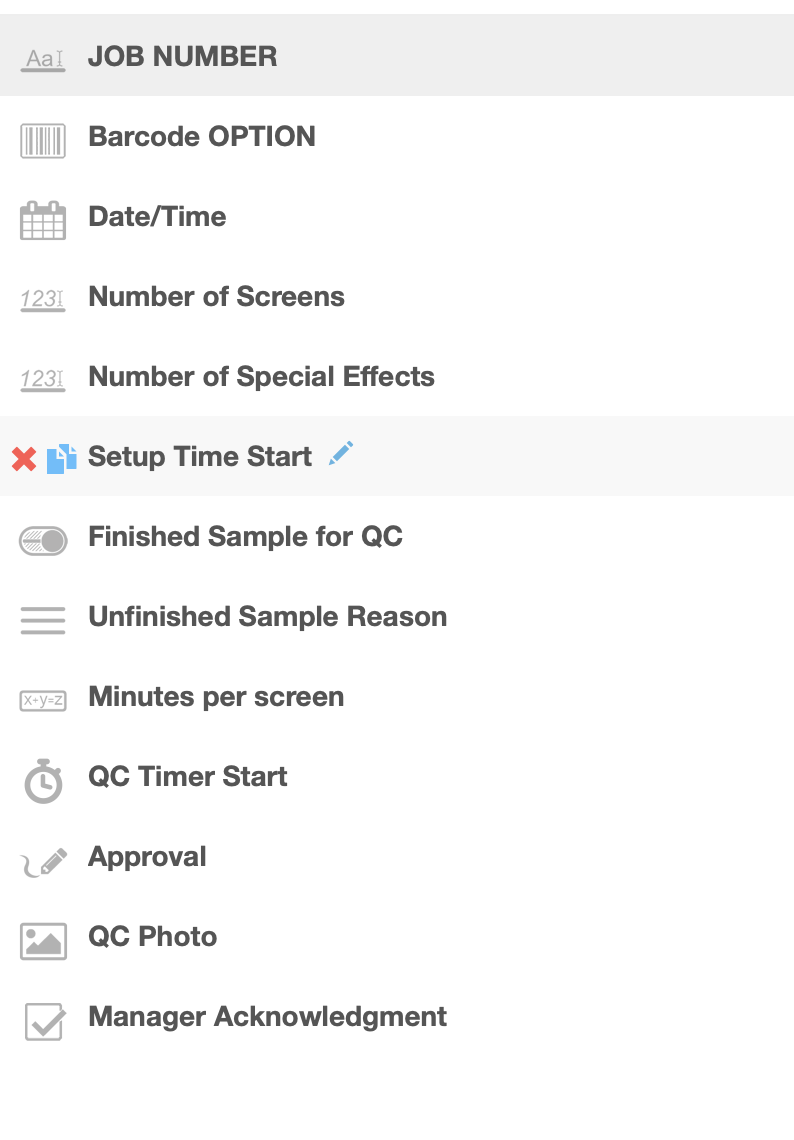
I also tested one called FastField. FastField offers an AI form converter that quickly transforms paper forms into digital formats. I developed a form for setup times based on spreadsheet data collection from the past. Both Jotform and FastField offer additional integration with AI services through Zapier.
I included the form's job number, barcode options, and date and time, as well as the number of screens and the number of special-effects screens, setup time, and a start and finished sample for quality control (QC). I added an unfinished sample reason, minutes per screen, and final approval with QC photo.
Inside the form, employees fill out each section; some data — like date and time — automatically fills based simply on interacting with the form. By hitting start on the timer, the form is timing the operator. The form is accessible if used on a tablet attached to the press. When the press operator finishes and they're ready to show it to QC, they stop the timer and press “prepared for QC.” The approval T-shirt goes to the QC, and the form begins timing again. If QC rejects it, they give a reason, leading to an unfinished sample. All forms get submitted giving shop analytics against setup times and QC times (Image 2).
Generally speaking, all you're asking an operator to do is be accountable for their work and interact with the form. The math is calculated in the form. Shops gain access to performance data, preventative maintenance data, and QC performance with finished QC sample pictures at the time of approval. The interaction takes seconds.
Adding a ScribeAI SOP trains employees on how to use this. The buildout of these two spaces took me less than an hour on the first SOP (separations) and Form (setup times). Again, the enterprise AI will learn the user and adjust in the future, making this initial time investment faster with each interaction.
Data Collection Benefits
Looking to the future, the industrial internet of things (IoT) allows our factories to become smarter. Industry 4.0 is taking data collection to the next level because the data collection can become autonomous. AI-integrated platforms are the future. It's also the present if you're willing to invest. ScribeAI, Jotform, and FastField are enterprise AI, meaning they are subscription-based.
Shops can progress from spreadsheets to data forms and online connectivity, and interactive tablets to sensors. Sensors will do things like forklift management through indoor location tracking, or enhance safety through real-time monitoring of people and machines (Image 3).
Real-time, efficient allocation of resources can be done through accurate tracking, knowing how much you have in inventory and your warehouse, pulling and picking on autonomous vehicles, and using sensors to understand when things need to be reordered. Machine learning and AI tools in IoT applications allow for trend awareness and pattern detection for business key performance indicators (KPIs). It allows for recommendations and prescriptive actions based on root cause analysis. It looks for anomalies, auto-detects deviation from normal behavior, and can predict (Image 4).
Predicting the future state of the industry can be done by learning from machine data and business context. This is where IoT and AI can become powerful for your business. Without those tools, your information gets stuck in silos. Customary reactive processes lead to inefficient manufacturing with a lack of real-time visibility into production times and machines. It takes a lot of work to calculate factory KPIs, let alone anticipate unpredictable equipment failures and maintenance costs. This translates into factory managers struggling to maintain quality and yield.
Active data collection with real-time feedback and predictive and analytical feedback is the most effective use of data to increase profitability and maintain production capacity.