
Special Effects Screen Printing Taught by Industry Expert Showcases True Artistry
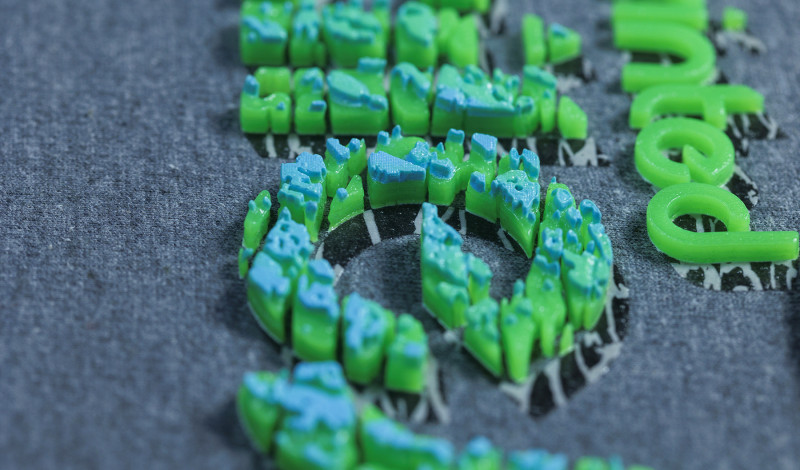
Screen printing is largely considered a technical trade, an artistic craft. And when you mix in special effects printing, it elevates the final product into a high-quality garment. It’s a technique that cannot be fully replicated by the other apparel decorating methods, according to Charlie Taublieb, industry expert. During his presentation “Screen Printing Special Effects” at PRINTING United Expo 2025, Taublieb presented on special effect inks for screen printing focused on high-density inks. But he also talked about discharge printing and water-based inks, as well as other eye-catching effects.
High-Density Printing Pointers
Taublieb opened by stating something so many in the industry currently speculate about: Will direct-to-film (DTF) printing replace screen printing? And like most experts, he disputed that assumption, using special-effects screen printing as an example.
“The big thing in the industry right now is everybody’s talking about DTF, and certainly it’s here to stay,” Taublieb acknowledged during the presentation. “High density is one of the things that you cannot do with DTF. [It’s] one of those things that you can do some really cool stuff.”
It was a discussion of pure technical prowess, something that Taublieb is known for in the industry. He discussed everything from the importance of mesh count, to thread thickness and stencil film.
Getting to the heart of the presentation, Taublieb dove into the technical application process to achieve a high-density screen print. He detailed:
- The use of different mesh counts and their corresponding thread thicknesses.
- The types of film used for high-density inks (he recommends 200, 300, or 400 micron film).
- The importance of not applying too much pressure to high-density inks to avoid embedding them into the garment.
- The use of a squeeze bottle for precise emulsion application and the importance of a compatible emulsion.
Taublieb also covered the color aspect of high-density printing, noting the need to stack colors when using high-density inks due to its thickness and opacity. “The ink is so heavy, so thick and so opaque, that in order to do an outline print, you would actually have a base, which would be the black part of the image,” he explained to the audience. “Your red (for example) would go on top of it, and you would end up with what’s on the bottom, which is an outline of the black. So, stacking your colors is something that you have to do.”
He finished out the discussion on high-density printing by outlining exposure and washing techniques as well as squeegee selection.
Bonus Reading: How One Ex-Mechanic Uses High-Density Printing to Accomplish 3D T-Shirts
Discharge and Water-Based Details
High-density isn’t the only special effect you can achieve with the screen-printing technique. The next part of Taublieb’s presentation centered on discharge and water-based printing. “It’s one of those things that I think is really popular again as an underlay,” he said. “But there are some great effects that you can do with it without going to underlay.”
Taublieb spoke on some of the challenges with this process, particularly with the stencils and exposure. But he also noted that decorators can also face challenges with color matching.
That being said, he also pointed out the great effects that can be achieved using discharge. “The thing about discharge is you can do so many things with it, especially combinations of discharge and foiling,” he explained. “In essence, whatever color you print on the garment, it pulls the color of the dye out and replaces it with the color that you printed.”
But that’s both a blessing a curse, as Taublieb explained that he once worked with a decorator that discharge two separate shirts from the same company. “One discharged beautifully, the other one didn’t,” he said. “One was from Honduras. The other one was from El Salvador, same brand, same color, two totally different finishes.”
Final Thoughts
The final part of the presentation looked at burnout, which is not a common method these days. Taublieb explained that the basic premise is that burnout was used on polyester/cotton shirts, then the cotton would “go away,” leaving the poly to hold the shirt together.
Taublieb presented previous samples of burnout projects that showcased the details that can be achieved. However, the method has been discontinued largely for safety reasons.
He concluded the entire presentation by passing around samples and answering questions.


