
State of the Decorated Apparel Industry 2025: Key Trends, Risks, and Opportunities Revealed
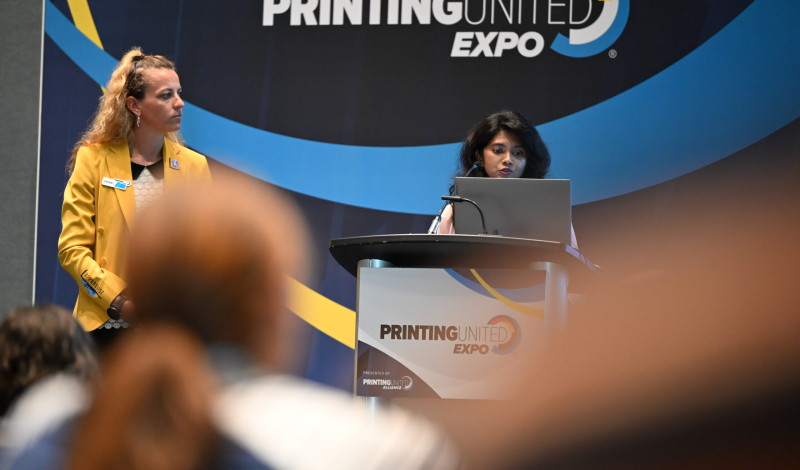
At PRINTING United Expo 2025, Alliance Economist Onamica Dhar and Apparelist Content Director Cassie Green shared the results from the Summer 2025 State of the Decorated Apparel (SODA) Industry Survey. Sponsored by Hirsch Solutions, the report was conducted by Apparelist and the Alliance with the aim of offering insight into the market and what’s ahead.
The report covers everything from tariffs and sales expectations to business risks, sustainability, and print-on-demand (POD). It also features a dedicated section of actionable tips and business practices that apparel decorators can implement.
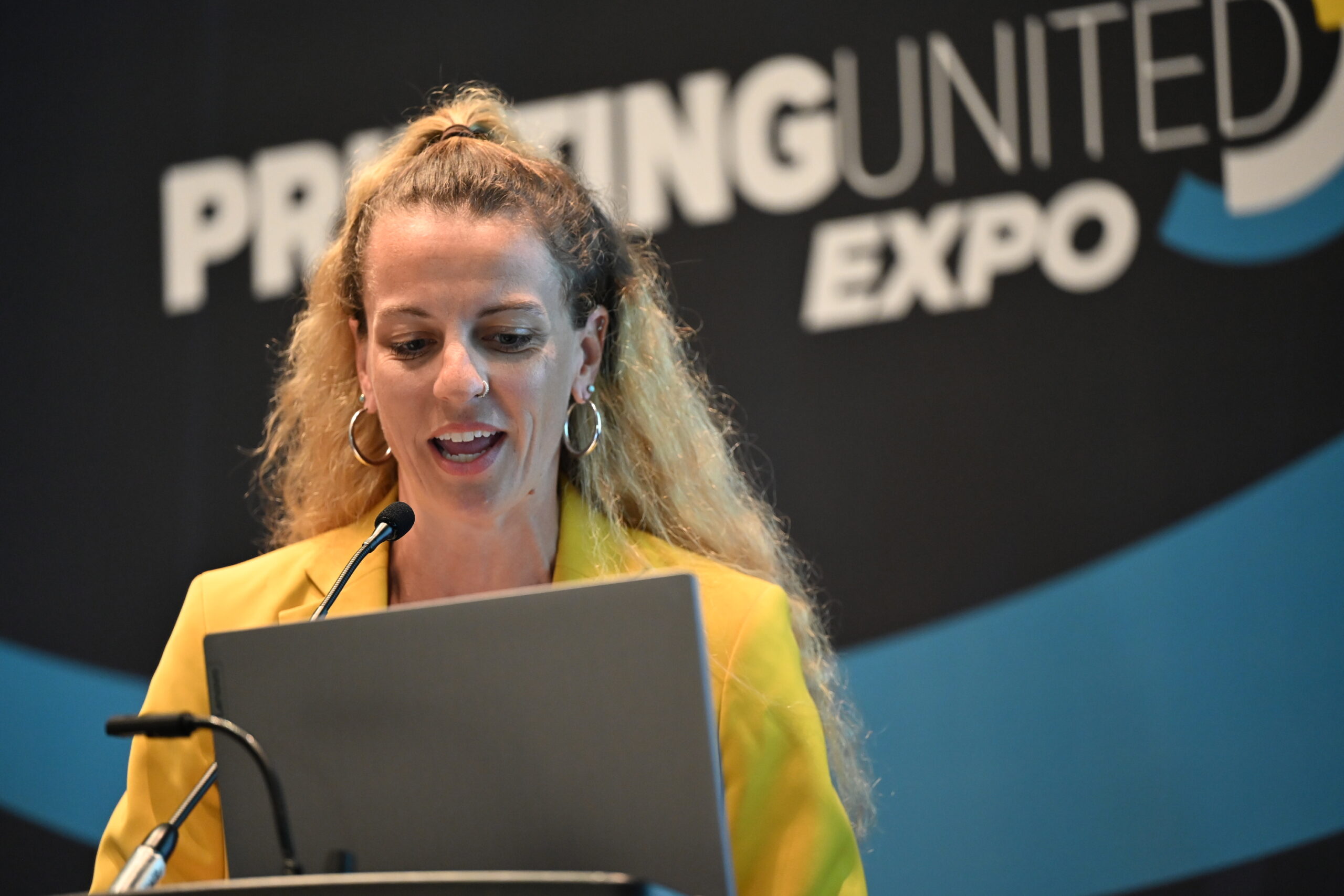
Apparelist Content Director Cassie Green presenting SODA survey results at PRINTING United Expo 2025.
Who Participated?
Among the 73 apparel decoration businesses that participated in the survey, annual sales ranged from less than $250,000 to $20 million. Most are small to mid-size companies — about 30% report sales of $1 million or less, and 54.1% report sales of $3 million or less.
Looking at decoration methods used, heat-transfer technologies, embroidery, and screen printing are the most common. On average, participants offer three decoration methods in-house and outsource two in whole or in part. Within heat-transfer technologies, direct-to-film (DTF) and heat transfer vinyl (HTV) are the most used, both key drivers in the growing print-on-demand model.
It’s no secret that convergence continues to be the talk of the printing industry, and the apparel space is no stranger to it. Nearly 66% of respondents said they have diversified beyond their core apparel decoration business. Of those diversifying, 84% have moved into promotional products decoration, and 52% have added signage or graphics. The diversification doesn’t stop there: About one in five decorators have entered commercial and functional printing, while 9.1% have added package printing/converting.
What’s Happening?
Amid ongoing tariff uncertainty and the concerns that come with that, some apparel decoration companies plan to “hold steady,” seeing expansion as too risky amid unpredictability. Others are investing in productivity, automation, e-commerce, print-on-demand, marketing, and customer engagement.
“Instead of sitting tight, we encourage people to invest in their business and to take their business forward,” Dhar says.
For most key indicators — sales, production, work on hand, quotes, payroll production hours, employment, and profitability — the trend is flat to down. Prices are the only exception – 53.5% report an upward trend, reflecting efforts to partially offset cost inflation.
When asked how they expect the rest of 2025 to round out, it’s a mixed bag. While 39.4% expect improvements, nearly as many (36.6%) expect no change. About 12.7% anticipate deterioration, and 11.3% say business is too inconsistent to predict.
This year, the biggest risk decorators noted is a downturn in the economy, cited by 73.9%. Trailing close behind are:
- Uncertainty created by Washington – 60.9%
- Persistent cost inflation – 55.1%
- Tariffs inflating costs and disrupting supply chains – 55.1%
- Clients pulling back spending – 46.4%
- Limited ability to pass cost increases through as higher prices – 31.9%
What’s Next?
Despite these risks, there’s an opportunity here to step up communication with customers and move ahead with business priorities, plans, and capital investments. These efforts and investments can position apparel decorators as solution providers amid disruption while boosting productivity, automation, innovation, and product expansion.
One opportunity is print-on-demand, which Green says should be seen as a business model rather than a printing method.
“The explosive shift we saw toward POD happened during and post-COVID. But as of right now, we don’t see this trend subsiding,” Green noted. “In fact, I think it’s only going to grow, and it’s only going to become more dominant in the apparel decorating industry. Bulk runs still have their very important place in the industry. Bulk screen printing, still very important. Bulk heat pressing even still very important. However, most shops are adopting POD either as a main focus of their business or as a complementary facet of their business.”
According to survey results, over 50% of respondents currently offer POD services in their shops, with 74.3% saying they expect their POD sales to increase year-over-year from 2024-2025. With that, 62.9% say POD sales make up 10% or more of their profit, while 34.3% say it makes up 20% or more of their profit.
“If you are not currently offering this, or you are, but you’re not finding a lot of success, I really encourage you to look at this as a business model,” Green stressed. “Look at it as how you can grow it more as an opportunity in your business, rather than just a decoration method.”
Even amid economic headwinds, opportunity remains strong for apparel decorators who stay adaptable, forward-thinking, strategic in their investing.


