
Famous Retail Brand Life is Good Launches Custom Apparel Business
Well-known Boston, Massachusetts-based retail apparel brand Life is Good steps into the custom apparel world with the launch of Keep It Simple, operating out of its new Hudson, New Hampshire fulfillment facility.
The retail brand celebrated its 30th anniversary in May, announcing the 504,000-square-foot building that would bring printing, shipping, and special projects under one roof. According to The New Hampshire Union Leader, the facility boasts 16 picking stations and 102 Geek+ robots that help employees pick orders. One of those special projects is Keep It Simple, bringing the retail brand into the custom printing business.
New Hampshire Business Review’s Mike Cote took a tour of the new facility to learn more about Keep It Simple.
What Keep It Simple Offers
According to Cote, Keep It Simple quietly launched in May when the building was announced. Now, Keep It Simple is coming to the surface with a website — keepitsimple.co — that outlines its offerings. The new business arm offers custom apparel to restaurants, rock bands, and the like, looking for logoed T-shirts and apparel.
The website boasts:
- 48-hour turnaround on orders under 288 units
- No minimums
- Full customization including neck labels
Its catalog features women’s, men’s, and youth styles, including short-sleeve and long-sleeve T-shirts and hoodies in Life is Good’s signature neutral and earthy colors.
Tom Hassell, president of Life is Good, took to LinkedIn to share the news, stating:
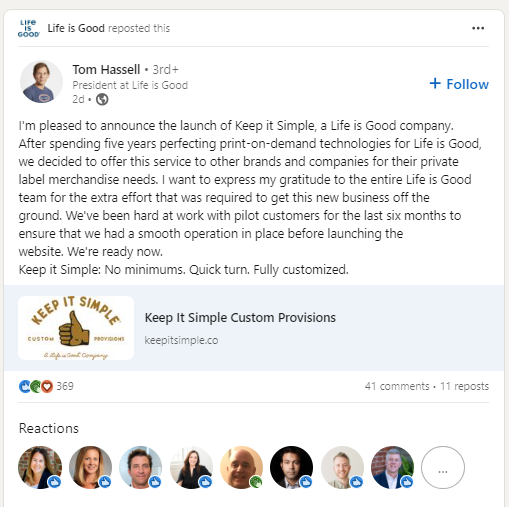
Credit: LinkedIn
“I’m pleased to announce the launch of Keep It Simple, a Life is Good company. After spending five years perfecting print-on-demand technologies for Life is Good, we decided to offer this service to other brands and companies for their private label merchandise needs.”
Inside the Facility
The Hudson operation employs roughly 150 full-time staff, Cote notes, and 50-150 temporary workers come in daily based on needs. Bert Jacobs, one of Life is Good’s founders, says the custom printing arm will help even things out when the slower months come.
“Our business is steady for 12 months, but it does peak in the summer and peak at Christmas. Already we’ve got musicians and bands and lots of things jumping on board. I just came from a conference, and several friends with businesses are going to start printing with us,” Jacobs explains.
Life is Good first brought printing in-house in 2019, integrating screen printing to have more control over lead times. While its shirts are still made in Peru, in-house printing allows the business to create graphics on the fly and test out new designs. That move was the first step toward offering full customization.
“We bought our first printer in 2019. It took us about a year to get good at it, because there’s actually a lot of research and development associated with printing on any new color or fabric, and we need to ensure that you can wash a product 15 times and have it still look great,” Hassell tells Cote.
Custom Apparel with Print-on-Demand
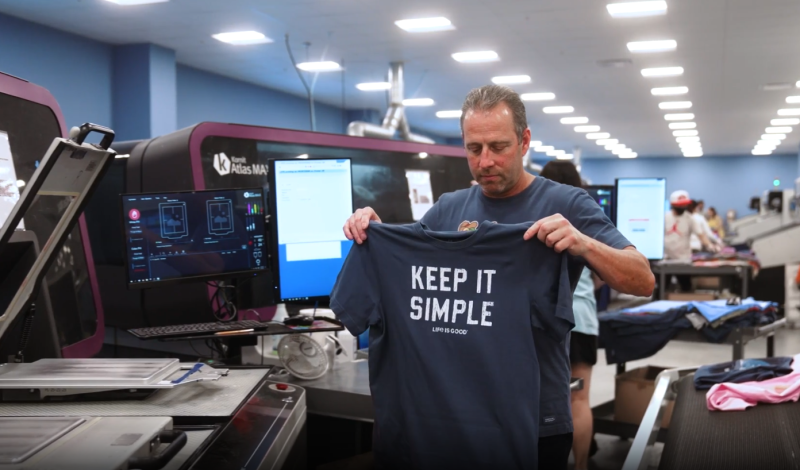
With printers at the ready, Life is Good/Keep It Simple can print 14,000 shirts per day per printer, and it has 12 of them. That’s a lot of printing, and the company has leaned on automation to make the process more efficient. Video screens help workers feed shirts onto direct-to-garment printers, and barcodes on each blank specify its corresponding design.
“Every single one of these shirts is going to have a different logo on it. And every one could be going to a different customer,” Hassell tells Cote during the facility tour.
After printing, the Geek+ robots roll through aisles, pick products, and bring them to employees for packing and shipping.
“This is called a goods-to-person system,” Hassell shares. “In the past, we used to have people walking up and down aisles like you would do in the grocery store to pick goods. And now the picker is the same person as the packer. The robots go pick up the racks and bring the products to the people.”


