
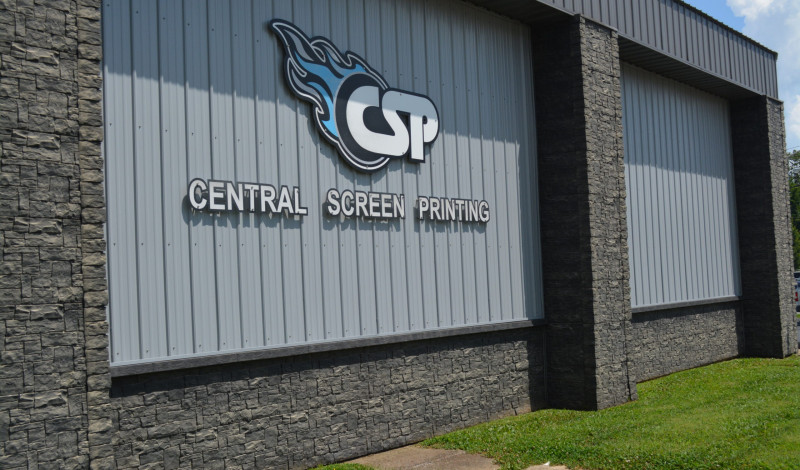
Family-Run Kentucky Screen-Printing Shop Puts Over $1 Million into Expansion
President Josh Randall credits quality supervisors, management software, and equipment for CSP's success.
Central Screen Printing (CSP) has served its community in Central City, Kentucky, since 1984. The shop’s CEO and president Josh Randall says it all started with his father, Kenny, who worked for Ebonite Bowling. When Kenny left, he became his former employer’s source for printed towels, bowling gloves, and other bowling accessories. One year later, Kenny started printing for the public, Josh says. Now, 40 years later, the business is investing roughly $1.2-$1.5 million into a major expansion.
“I started working since day one when I was 10 years old,” Josh shares with Apparelist. “I became half-owner right out of high school in ’93. My father and I ran the company together, but I have been the president since 1997. We now employ 130 people and will be expanding to 180.”
More Than Screen Printing

Josh and his brothers Nathan and Jason own the print shop together. Nathan runs sales, Jason leads the embroidery department, and Josh’s day-to-day as president and CEO involves expansion projects; meeting with production supervisors and head maintenance to ensure smooth operations; and daily updates with the human resources department. In short, he’s on the business side, but Central Screen Printing offers a slew of decoration services, both directly to consumers and via contract printing.
In addition to screen printing and embroidery, the company offers direct-to-film (DTF), direct-to-garment (DTG), order fulfillment, and e-commerce stores to customers. Currently, contract work makes up 40% of the business, while retail work takes up the other 60%.
“We do 10,000-20,000-piece orders consistently in printing, but the average order size is 100-200 pieces,” Josh shares. “Embroidery, we specialize in one-piece orders all the way up to 10,000-piece orders.”
-

- CSP’s showroom | Credit: Central Screen Printing
-

- CSP’s facility and customer entrance | Credit: Central Screen Printing
Taking Central Screen Printing to New Heights
With such a vast array of offerings and technologies, CSP has seen growth and success over the years, and Josh says that rapid growth came once the family business figured out how to expand and scale.
“For example, we knew that if we hired two salespeople, we knew what type of volume they could sell. Then, we could figure out our need for a certain amount of equipment, graphic designers, and production staff it would take to handle their sales growth,” he explains. “Then, it was a matter of hiring salespeople and buying equipment. Also, building in-house proprietary software that fit all of our needs to enter orders, track orders in production, and manage those orders in every department gave us the foundation to grow at a more rapid pace.”
That foundation has brought the print business to where it is today — investing over a million dollars into its expansion. While CSP is footing the bill for the expansion, the Kentucky Economic Development Finance Authority gave the business an incentive to build business locally.


Josh says once CSP spends a certain amount of dollars, the program will give back to the business via payroll taxes over the years. The incentives are only available to those in manufacturing and those who spend a specific amount of money and hire a certain number of people. This works well for CSP because with the expansion comes the need for more hands. Josh plans to bring in 50 additional employees, which comes with an incentive of roughly $15,000-$18,000 per employee.
While CSP would love to hire skilled workers with backgrounds in printing, “it normally just isn’t an option,” he says. “We normally train all new production staff. There are certain people in each department that we bonus to help train all new employees for each particular job.”
Building a Solid Foundation
With the expansion well underway, CSP has purchased all the available property surrounding its current footprint, and an adjacent building. It also plans to build a 60×150′ building to handle additional production. Talking equipment, Josh plans to buy three additional automatic screen-printing presses, three more dryers, and additional bagging and folding equipment to expand its fulfillment department. After adding the three automatic screen-printing presses, CSP will have 13 total autos and three manuals — all running two shifts.
As of right now, CSP has already hired 20 new people, and Josh says the completed expansion will likely take one to two years.
Sharing advice with other print shops expanding, he says: “Check with your local industrial board to see if there are any incentives offered by your state. Let them help you with the process. They have done this before, and it’s a lot easier and that’s their job to help you. I’ve found it’s easier to help existing businesses expand than it is to bring in new companies!”
To find success and see growth, he says it’s all about building a solid foundation. “Get quality supervisors, management software, and good equipment,” he says. “Then pile on the sales staff!”


