
Curing Upgrades Boost Output, Quality for Growing Screen Printer
Robert Merrill’s screen printing business, Cornerstone Printing, was born of his interest in skateboarding and skateboarding apparel. He began with an inexpensive six-color/four-station press to print T-shirts for local businesses, focusing on one- and two-color jobs with intricate designs and strong graphics. His attention to detail soon garnered the attention of family-owned businesses in the community.
Merrill first relied on a heat gun to flash shirts between colors and a heat press for the final cure, but both processes were time-consuming and unreliable. “Initially, I was spending 60 to 90 seconds flashing each shirt with the heat gun,” he says. “I would hover over the shirt a distance of three inches for a few seconds in each area. If I held it too close or in one place for too long, it would burn the shirts.”
 Neither did the heat gun work well on all fabrics. “Switching to polyester required a change in temperature, but the heat gun wasn’t adjustable,” says Merrill. “This caused the T-shirts to shrink a little and fall out of registration when applying a secondary coat of ink.”
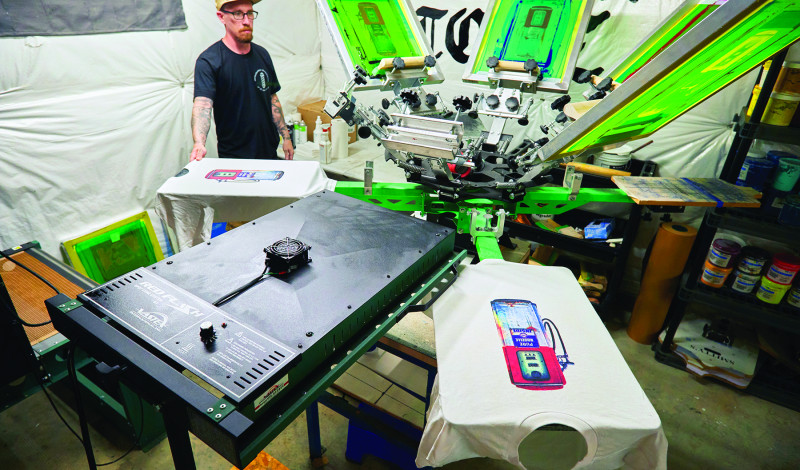
To improve quality and production speed, Merrill purchased an 18×24″ (46x61cm) RedFlash flash cure unit manufactured by Vastex (Booth C10118), providing the adjustability and consistency needed to prevent scorching, uneven drying, and associated rejects.
By pressing a foot pedal, the unit’s AutoFlash option swings the infrared heater above the printed image, and swings it away once the pre-set dwell time has elapsed, preventing over- or under-flashing of garments.
 Conveyor drying boosts output, consistency
Merrill found that using a heat press for the final curing of ink affected the quality and appearance of prints. “The ink dried thick and heavy on the shirts and looked wrinkled after one or two washes — similar to a heat transfer vinyl,” he recounts.
The turning point came when he had a problem with an order for 250 shirts from a local plumbing company. “The front-left chest area washed out because the ink hadn’t cured properly,” says Merrill. “That was the first time I lost a customer, and made me realize I needed a conveyor dryer.”
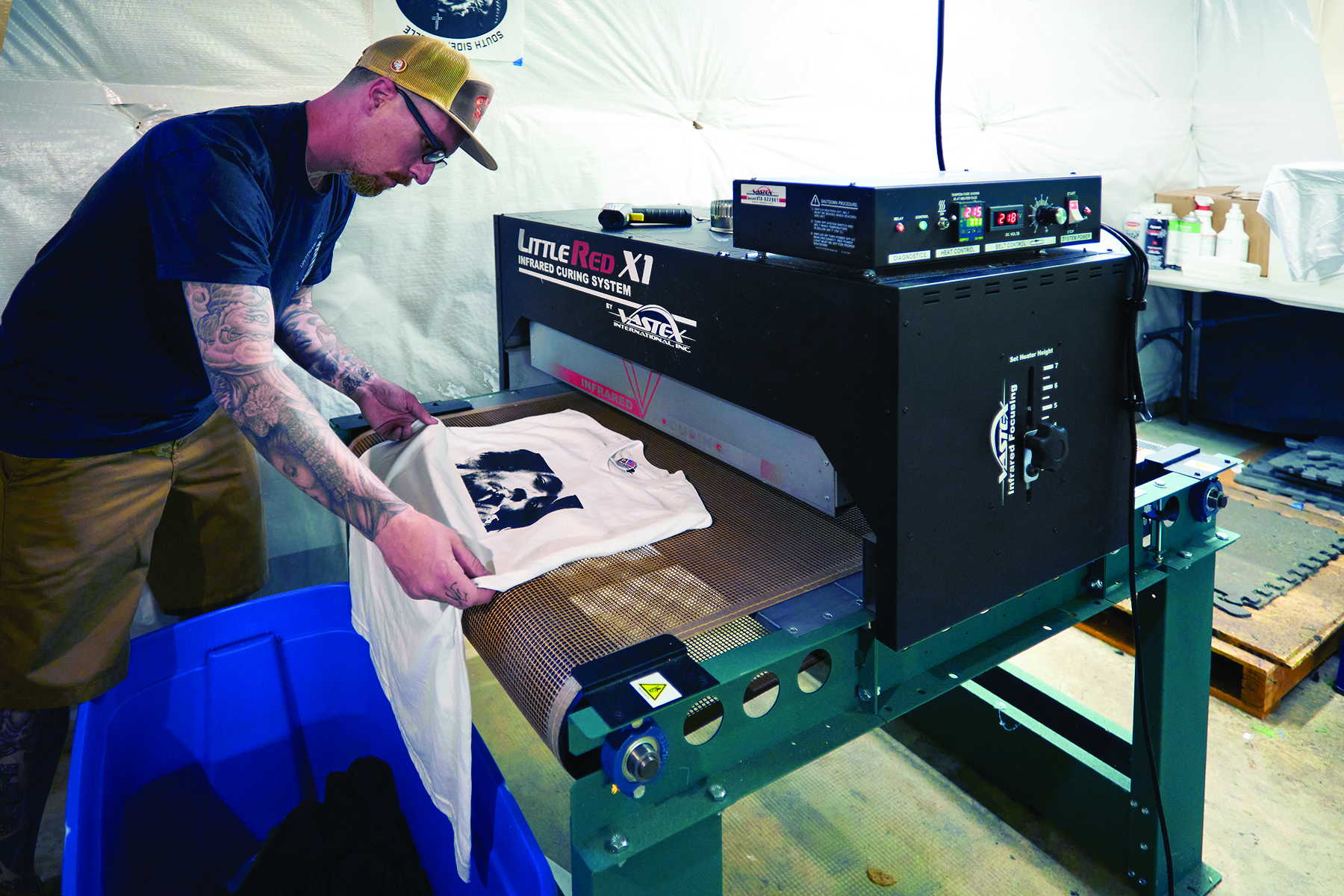
He then purchased a LittleRed X1 infrared conveyor dryer, also from Vastex, with a 30″ (76cm) wide belt, which doubled his output. “I’m able to feed garments at a rapid pace, allowing me to dry 150 single-color shirts in about four hours versus all night previously.”
Over- or under-curing is prevented by virtue of temperature accuracy to +/-1°F, consistency of the adjustable belt speed, and adjustability of belt-to-heater height to compensate for sweatshirts and other bulky items.
“The ability to reposition the heating chamber on the conveyor belt makes it easy to create more space at the end of it, which extends the cool-down period after curing,” Merrill says, adding, “this helps to prevent shirts from sticking together when they exit the conveyor belt and collect in a bin.”
Dryer leaves indelible impression
Merrill says since he started using the conveyor dryer, his customers have noticed an improvement in the look and feel of the finished product, and his business has grown through repeat business and word-of-mouth referrals.
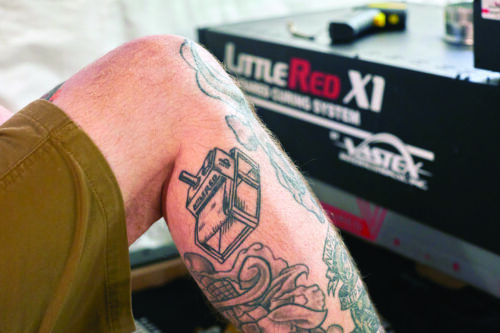
“The LittleRed has saved me so much time and energy that I had to dedicate a leg to it,” he laughs, pointing to his LittleRed tattoo.
Coming full circle, he recently printed shirts for a startup skateboarding magazine to promote the publication. “I want to be there for everyone in my life who’s trying to achieve something and help them get the recognition they deserve,” he says.


